Showing posts with label crime and punishment. Show all posts

Tuesday, September 7, 2021

Taliban death squads ‘trawl porn sites to compile kill list of Afghan prostitutes after US withdrawal'

From the US Sun:
Taliban death squads are trawling porn sites to compile a kill list of Afghan prostitutes and are putting names to faces of brothel workers who have been filmed having sex during the 20-year allied occupation of Afghanistan.

Security sources told The Sun Online that videos featuring Afghan prostitutes have made their way onto niche porn sites and have been discovered by the jihadis.

Our source said the Taliban are now “hell-bent” on “hunting down” the prostitutes to publicly execute or “humiliate for their own pleasure”.

They added the women face being gang-raped by the terror nuts before being “beheaded, stoned or hung”.

Some of the videos allegedly feature the women having sex with Westerners - further raising the fury of the Taliban.

Women are expected to face the most vicious and brutal repression under the new Taliban regime, with strict new rules and morality codes expected to erase them from public life.

“The Taliban are displaying the height of hypocrisy with this horrific witch-hunt," a source said.

read more here @ US Sun

Wednesday, October 14, 2020

Horrifying Attacks On Indian Women

An Indian husband walked to a police station in India carrying the decapitated head of his wife who he beheaded after accusing her of having an affair. 

Chinnar Yadav attacked his wife Vimla with a sharp weapon after a heated argument in which he accused her of being unfaithful with their neighbour, according to police.

After killing and beheading his wife, Yadav was then filmed carrying her severed head to their local police station in the northern Indian state of Uttar Pradesh.

Similar scenes were captured in Uttar Pradesh in February when another man decapitated his wife and walked through the streets singing the Indian national anthem. 


This is not the only attacks on women in this region. You have the following horrific examples:

- husband kills wife he thinks is about to give birth to a daughter
- gang rape reported but not believed by police
- reporting sexual assault is termed a conspiracy
- rape culture criticised
- vulnerability of women
- acid attack on woman by neighbours
- cremation of rape victim under scrutiny
- high incidents of crime against women
- congress woman assaulted for speaking out
- another gang rape death
- sexual assault not believed, justice delayed
- woman beaten for resisting public molestation
- high level of crimes against women


The northern region of Uttar Pradesh is one of the four largest states in India, with a population to 200 million (and growing). With the fifth largest economy, the state is now dominated by the services industry. The service sector comprises travel and tourism, hotel industry, real estate, insurance and financial consultancies.

Uttar Pradesh also has the highest number of crimes among any state in India, but due to its high population. Uttar Pradesh also continues to top the list of states with maximum communal violence incidents. An analysis of Ministers of State of Home Affairs states (2014), 23% of all incidents of communal violence in India took place in Uttar Pradesh - this includes violence against religious minorities, social castes, and women. According to a post from NDTV, "... 4,322 cases of rape were reported in 2018, with almost 12 taking place daily ..." - and further statistics are provided in this article from The Hindu, with this alarming statistic that "... the conviction rate in rape-related cases stood at 27.2% even though the rate of filing chargesheets was 85.3% in such cases ..."

This is just over the last year or so; it boggles the mind to think of the brutality women and girls have been silently subjected to in years past. Something needs to be done!

Sunday, November 26, 2017

Marie Lafarge - Celebrated French Poison Trial

In France, in 1840, a notorious murder trial put the young science of toxicology to a dramatic test. Rumored to be unhappy in her marriage, Marie Lafarge, age 24, was charged with poisoning her husband Charles. Witnesses had seen her buying arsenic—to exterminate rats, she claimed—and testified that she had stirred a white powder into her husband's food. The prosecution sought to build on this by introducing the findings of local doctors who performed chemical tests on Charles Lafarge's stomach and on the white powders that had been gathered as evidence.


At the resulting trial, the raven-haired Marie at first excited great sympathy. Her lawyer, Hempel says, made sure that the jury knew of “the excellence of her piano-playing, her delightful voice, her competence in more than one science, her reading and translation of Goethe, her fluency in several languages and composing of Italian verse.” She also had a flair for drama. When it was reported in court that a group of doctors had found no evidence of arsenic in the corpse, Marie responded, Hempel writes, by “clasping her hands, raising her eyes to heaven, and then fainting and having to be carried out of the court, while her lawyer sat weeping.” Other experts, however, believed that arsenic was present. About a year into the trial, the renowned toxicologist Mathieu Orfila was called upon to examine Lafarge’s remains.

read more here


Sunday, November 5, 2017

The witch trial that made legal history

Article in BBC News about the Pendle witch trials:

In recent years children as young as three have given evidence in court cases, but in the past children under 14 were seen as unreliable witnesses. A notorious 17th Century witch trial changed that.
Nine-year-old Jennet Device was an illegitimate beggar and would have been lost to history but for her role in one of the most disturbing trials on record. Jennet's evidence in the 1612 Pendle witch trial in Lancashire led to the execution of 10 people, including all of her own family.
Her convincing evidence was believed by the jury and after a two-day trial all her family and most of her neighbours were found guilty of causing death or harm by witchcraft.
Ultimately though, Jennet fell victim to the very precedent she set herself in 1633. Twenty years after the trial she too was accused of witchcraft along with 16 others by 10-year-old Edmund Robinson.
read more here @ BBC News

read also: Mary Sharratt's "Daughters of the Witching Hill"

Monday, June 13, 2016

Silenced Women–Modern Lessons from an Ancient Murder

Silenced Women–Modern Lessons from an Ancient Murder
In the second century A.D., the pregnant wife of a prosperous Greek politician died from a vicious assault.
Appia Annia Regilla Atilia Caudicia Tertulla, or Regilla, was born into an affluent Roman family in 125 A.D.; she married the Greek politician Herodes Atticus, also from an affluent family, around 140 (when she was 15); and 20 years later, when she was 8-months pregnant with their 6th child, she died from a brutal beating which included a fatal kick to her stomach.
This is a case of domestic abuse that resulted in murder. A wife was beaten to death by the order of her husband. An unborn child, just weeks from birth, was killed by a father’s command.

Sunday, June 12, 2016

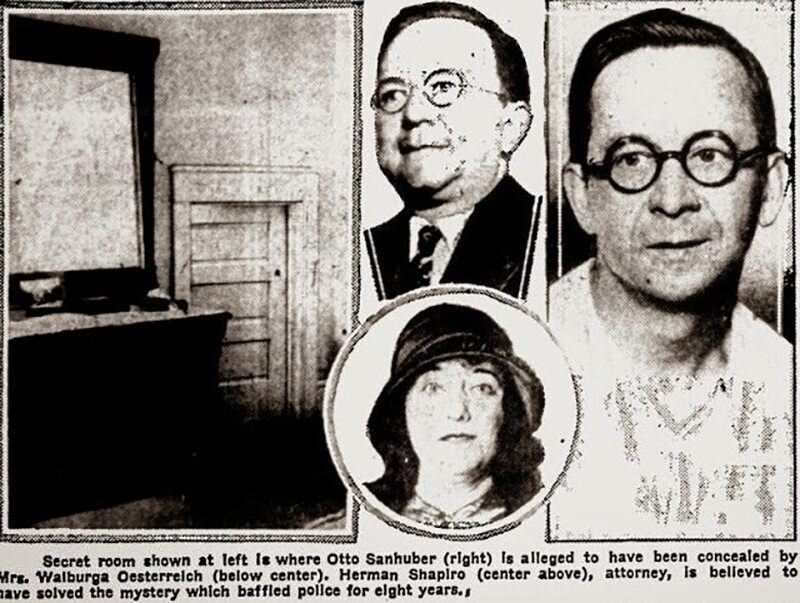
The Married Woman Who Kept Her Lover in the Attic

In April 1930, the Los Angeles Times began publishing what would end up being months’ worth of eye-popping details from an exceedingly strange court case. It involved a “comely” woman named Dolly, her murdered husband, and her lover, a man known as the “garret ghost” who, at Dolly’s behest, lived a “bat-like life in hidden rooms.”
On August 22, 1922 a particularly brutal fight broke out and Sanhuber, fearing for Dolly's life, ran downstairs brandishing Fred's two .25 caliber rifles. He fired three rounds straight into his rival's chest, killing him instantly.
By the time the ex-lovers were arrested the papers had gotten wind of the sordid tale and shutterbugs followed Dolly and Sanhuber everywhere. But the trial outcome was not as eventful as the public would have hoped: though the jury found Sanhuber guilty of manslaughter on July 1, the statute of limitations for such an offense was seven years. Eight years had passed since Frank’s death. Sanhuber’s charges was dropped.

Further Reading: Women Who Kill Men: California Courts, Gender, and the Press by Gordon Morris Bakken & Brenda Farrington

Monday, April 22, 2013

Sorry State of Women In India

Tragic tales of violence against women and children has emerged from India.  Here are just a few of the headlines that have appeared this week:

Indian PM Manmohan Singh: women's status and safety a growing concern...  India must make vast improvements to protect women, says prime minister amid protests over rape of five-year-old girl.

From the Times of India:
CPM politburo member Brinda Karat on Sunday called for the need to amend the criminal law to protect tribal women against the atrocities by officials and guards of forest department.Expressing concern over the increase in crimes against women, Brinda Karat said the issue of atrocities against tribal women should also be addressed. 

From The Hindu:
Even as protests against the brutal rape of a five-year-old girl in the Gandhi Nagar area of East Delhi snowballed into widespread public outrage, the 22-year-old casual worker accused of the crime was brought here on Saturday.

From The Siasat Daily:
The brutal rapist of the five-year-old girl had met his equally vile partner-in-crime during a chance meeting aboard a train earlier this year, sources claimed on Sunday. Identified by sources as one Pradeep, the man in question is now ‘officially’ the second accused in the case which took place precisely a week ago. “Manoj Kumar Sah, the main accused, kept twisting facts, changing his statements and putting the entire blame on Pradeep as soon as he was arrested,” said an officer.

Also from The Siasat Daily:
Second Delhi child rape accused arrested from Bihar .....One more person allegedly involved in the rape of a five-year-old girl in New Delhi a week ago has been arrested, police said on Monday. Pradeep, the second accused, was apprehended from Bihar in a joint operation by Delhi and Bihar Police, Delhi Police Commissioner Neeraj Kumar told PTI.

And this again from The Siasat Daily:
Delhi rape accused Manoj raped wife before marriage .....In another shocking revelation it has been reported that rape accused Manoj Kumar, who was arrested by police yesterday had also raped his wife before marriage.

From Huffington Post:
Women's groups here are hailing a new law, passed March 21, that stiffens punishments of sexual violence in the aftermath of the notorious gang rape last December that left a medical student dead.

And then this tragic story from The Siasat Daily:
A 22-year-old mentally challenged woman was raped allegedly by a ward boy at a nursing home whose doctors have been arrested on charge of trying to bribe the victim's kin to hush up the matter. The incident occurred at Walhekarwadi in Chinchwad town near hear on April 16 in the nursing home run by Dr Vishal Sonawane (34) and his wife Dr Varsha (31) where the victim was undergoing treatment, police said today. Police arrested the accused, identified as Subhash Modad (22), on the charge of rape and the doctor couple for trying to hush up the matter and bribe the victim's kin to not report the incident to police as it would bring bad name to their hospital.

Gruesome footage surfaced today of four men relentlessly beating an Indian woman in Ludhiana, a city in the northwest Indian province of Punjab. The woman says she was beaten because she asked to be repaid a sum of money that she had lent to one of the men. The amount is reported to be 20,000 rupees, the equivalent of about $370 USD.

From CTV News:
But exotic ancient India has run headlong into the rapidly growing economic powerhouse, where women have stepped out of traditional roles, resulting in harsh questions about their treatment which is considered to be among the worst in the world. Rape is common. Sexual assault goes unreported. The victim is often blamed, which the perpetrator walks free.


Thursday, December 20, 2012

New Delhi Gang Rape Outrage

From Time World:
Last Sunday in New Delhi, at around 9.30 p.m., a 23-year-old woman was gang raped for almost an hour on a moving bus and then thrown semi-naked on the road to die. Hideous violence against women is nothing new in India, but this particular outrage has caused widespread anger. Perhaps it was the casual ferocity of it. Or the fact that it took place on some of the teeming capital’s busiest streets. Or perhaps a nation at great pains to modernize is finding it hard to stomach what feels like an increasingly predatory sexual culture.


Experts say blaming survivors of sexual assault is common in India. Rather than prosecute perpetrators, many say the fault belongs to rape survivors, who are shamed for, say, daring to walk alone, taking public transportation or wearing certain clothes. “Blaming the victim has been in some way also part of the larger design of the system, where you want to push the women to say they are responsible for what happens to them,” says Ranjana Kumari, a member of the National Mission for Empowerment of Women. “It is like saying men are not responsible but it is the women who lured them into this.”


Monday, July 30, 2012

Abandoned Women

From the Daily Record:

THEY are the women history has chosen to forget – the 2500 Scots banished to Tasmania for the pettiest of crimes.
Today, for the first time, we can reveal the stories Scotland was too ashamed to tell – and celebrate the women cruelly sentenced to exile on the other side of the world.
Not only did these formidable females survive the treacherous journey and years of servitude, many went on to become model citizens once free and the mothers of a new nation.
In her new book, Abandoned Women, historian Lucy Frost remembers these long-forgotten women. More than 12,500 British convicts were banished to Van Diemen’s Land – Tasmania – between 1803 and 1853. A fifth were Scots women.


Thursday, April 12, 2012

End Invasion Searches Of Female Prisoners

The American Civil Liberties Union said it plans today to urge the Michigan Department of Corrections to ban an invasive vaginal strip search that humiliates female prisoners.

It said women are forced to expose themselves, often with unclean hands while sitting on an unsanitized chair and in full view of other prisoners, while a female guard checks to see whether they're concealing contraband.

The ACLU said it believes Michigan's is the only prison system in the nation to routinely use such searches as a matter of policy.

The searches can be especially traumatic because many female prisoners are victims of sexual assault, the ACLU said.

Over the years, female prisoners in Michigan have been awarded more than $100 million in suits resulting from sexual assaults by corrections staff.

Friday, March 30, 2012

Oksana Loses Her Brave Battle

An 18-year-old Ukrainian woman who prosecutors say was gang-raped, half-strangled and then set on fire in an attack that sparked street protests in a provincial Ukrainian town, has died, a hospital official said.

Hundreds of people took to the streets earlier this month after police released two of Oksana Makar's three suspected attackers whose parents had political connections, re-igniting a public debate on corruption in the ex-Soviet republic.

Oksana's story went worldwide after her mother made a video of her lying distraught in her hospital bed and prodded her to describe her attack on camera.

Monday, December 12, 2011

Acid Attack On Mother & Daughters

Acid attacks are one of such violent forms of assault that is most common in countries like Cambodia, Afghanistan, India, Bangladesh, and Pakistan. A recent story from Afghanistan left four women – 3 daughters and their mother – disfigured from an acid attack.

The perpetrators were after the family’s oldest daughter because her father had denied one of the men’s requests for her hand in marriage. The girl’s father said he rejected the man’s offer of marriage at the time because his daughter was too young. Forced marriage of young Afghan girls is not uncommon today which makes the father’s protection notable.

Rejected, the man and his brothers, who are suspected of being members of a local militia, broke into the house to attack the girls and their mother in revenge. The men involved in the attack have since been brought to the capital by the Interior Ministry for investigation and potential prosecution.

“The attackers defamed Afghanistan in the eyes of the world,” said the ministry’s spokesman, Sediq Sediqui. “It was the harshest violence they could ever carry out.”

He said that the Afghan police were warning “those who commit such brutal acts that they will be brought to justice at any cost.”

The Elimination of Violence Against Women law, which was passed last year, specifically prohibits chemical attacks against women. Such offenses carry a punishment of at least 10 years of imprisonment and at most life in prison.

Given the law and the ministry’s quick arrest, one would hope that the men will be adequately punished, but history has proved differently. Since Afghanistan enacted the law banning violence against women there have been 2,299 complaints of gender-motivated abuse registered with the Afghan Independent Human Rights Commission from March 2010 to March 2011 only 7% of those crimes have been prosecuted.


Monday, February 28, 2011

Criminal Records of Victorian Women Online

From the Times of Malta:
Thousands of Victorian criminal records giving details of female convicts, including a teenager jailed for five years for stealing an umbrella, were published online for the first time.

Family history website Ancestry.co.uk said more than 4,400 criminal records and 500 mugshots will be included in the collection.

Women and young girls featured in the records include Mary Richards, who was jailed for five years in 1880 at the age 59 for stealing 130 oysters valued at eight shillings; Elizabeth Murphy, 19, sentenced to five years of hard labour in 1884 and seven years of police supervision for stealing an umbrella; and Dorcas Mary Snell, 45, who was sentenced to five years of imprisonment with hard labour in 1883 for the theft of a single piece of bacon, although she was paroled two years later.

The website said the records, the originals of which are held by the National Archives, provide a picture of the “harsh” British judicial system at the time.

The site’s international content director Dan Jones said: “Crime is more often associated with men; however, these intriguing records shed light on some rather colourful female lawbreakers of their day and, given the petty nature of many of their crimes, also serves as a reminder of how harsh our judicial system was not so very long ago.”

Thursday, December 2, 2010

Iran: "Temporary Wife" Hanged

Iran on Wednesday hanged a former soccer player's mistress who was convicted of murdering her love rival, the player's wife, the official IRNA news agency reported.

Shahla Jahed was hanged after spending more than eight years in jail, IRNA said, in a case that has captivated the Iranian public for several years.

Jahed had become what is known as a "temporary wife" of former soccer star Nasser Mohammad Khani. She was charged in 2002 with stabbing to death Laleh Saharkhizan, the player's wife, and convicted of murder in 2004 and again in 2009, after her appeal was denied.

Contracts with "temporary wives" are a legal way for Iranian men to have mistresses outside marriage, with the agreements lasting from between several hours to a few years.

Wednesday's death sentence was based on the Islamic law of "qisas" - or eye for an eye retribution.

International human rights groups, including Amnesty International, had campaigned for Jahed's punishment to be halted.

Saturday, November 27, 2010

The Bastille - 5-Star Prison

From the Washington Post:
A roaring fireplace, a warm bed, some wine and little pastries welcomed people to La Bastille. This was no charming inn, but the notorious French prison, stormed by an angry Parisian mob on July 14, 1789, in an outburst that helped set off the French Revolution.

For the first time, an exhibit in Paris has pulled together archives on the prison to offer a glimpse into the hidden world of the Bastille. It shows the inmates' relative comfort - and why it became such a target of revolutionary ire.

"I maintain it was a 5-star prison," said historian and Bastille expert Claude Quetel. He said the prison's privileged position came from being directly under the king's eye, both geographically and because it was where monarch after monarch sent his personal enemies.

Monday, November 8, 2010

Review: The Last Duel

My rating: 5 of 5 stars

The story of the Last Duel focuses on the last "legalised" duel to be held in medieval France in which one man seeks justice through trial by combat.

The two protagonists are a knight and a squire. First, these are misleading titles. Both are military men of comparable age; both men were - in the few years prior to the duel - of the rank of squire. One man was knighted on the field of battle - the other on the field of justice - therefore at the time of the duel both men were of equal rank. The title of squire or "escuier" was ascribed to a "battle hardened veteran" rather than the romanticised vision of a youth attending to his master. Though squire did serve their superiors, the context, in this case, as with the title of knight, is purely a military one.

Now to the protagonists themselves. There was a long period of friendship between the two, which slowly dissolved as one received preference over the other; and one felt that he was more deserving of preferment than the other. Tensions finally boil over when one man accuses the other of rape and violence against his wife, culminating in the long drawn-out process of having the case examined and pondered before (to the delight of all), the duel to the death is granted.

Jager goes to great lengths to fill in the background information on those involved and to enlighten the reader on the intracies of medieval French politics and law. In bringing the suit forward, the women herself, if her testimony proves false, faces a most grusesome end - to be burnt alive - and her champion, certain death. There is no half measures - at the end of the day, someone will die.

I have been wanting to read this book for some time since it was recommended to me about four years ago. And I highly recommend it myself.

Sunday, October 24, 2010

A Convict's Life

So what happened to a convict once he or she arrived in Australia. Firstly, upon departing the ship, the convicts were sent to a barracks where they would find out exactly how their sentence was to be served.

The worst of the convicts were transported to prison settlements, where hard labour was their reward - and supervision was of the most severe kind. Those who committed crimes or behaved "badly" were then sent to prisons of even more stringent rules and regulations - Port Arthur or Norfolk Island. The conditions of these two penal settlements was so harsh and terrible, that a number of convicts took their own lives rather than endure these conditions.

Most convicts, however, were employed by the Government or were assigned to "free settlers". Work was undertaken in towns or farms. However, the fate or conditions of a convict rested in the mood or character of his or her master.

If the master was of a considerate nature, the convict might have enough food and comfortable conditions. Good behaviour led to the opportunity of obtaining a "ticket of leave" or even a pardon. With a "ticket of leave" a convict might work freely in a district, reporting to the local magistrate at regular periods. This system can be likened to the modern-day "parole" system. However, a convict could not own land until his or her sentence was fully served. A conditional pardon granted the convict freedom and restoration of all legal rights - on the condition that he or she did not return to England until the full sentence had expired. A pardon could only be granted at the discretion of the Governor.

However, if a master were harsh or cruel, the convict lived in daily fear of being whipped, even for the most trivial or imagined offences. This threat kept the convicts in a constant state of submission. Worse still, a convict may find themselves sentenced to hard labour.

For convicts assigned to farmers - and later "squatters" - life could be one of hazard and loneliness. Others were assigned to the labour intensive quarrying, road and bridge construction.

Those convicts who were lucky enough to find employment with the Government were usually those who had some skill. Having a skill greatly improved the prospects of a convict. Skilled tradesmen were in constant demand to undertake the construction of government buildings; other may be employed in government stores; other found employment in the homes of prosperous settlers.

Essentially, convicts provided cheap - and expendable - labour for a colony that was undergoing growth and the arrival of new settlers.

More Strange But True

Again from Nigel Cawthorn's "The Strange Laws of Old England" - 

Burning: Women were not hanged, drawn & quartered for treason as men were - the law required that some " decency due to their sex" forbade women from being exposed and their bodies publicly mutilated.  Instead, they would be dragged to the gallows to be burnt - alive.

Typically, burning was reserved for heretics; however, women who were found guilty of murdering their husbands or masters - an offence known as petty treason -- were also burned at the stake.  In the early days, a prisoner would be burned alive while still concious.  But by the time of Queen Mary I of England, women would be burned naked but were permitted to have a bag of gunpowder around their necks to hasten death.  Later still, as an act of mercy, the prisoner was stangled first.

The last burning took place in 1789 - the practice was abolished in 1790.

For The Murder of Her Child: Margaret Alexander was convicted of murdering her two illegitimate children by Patrick Learmouth.  She was forced to dig up the body of the second child from the Churchyard, and then carry it in a public procession around the town to the Brewhouse where she gave birth to the babe.  Margaret was then required to take the tiny corpse to the place by the riverbank where she had originally buried the body to hide her crime.

After publicly confessing to her crimes, Margaret was hanged, and her arms were cut off.  One arm was displayed in Haddington, the other at Aberlady, where she had given birth to the first child.

Trial By Swallowing: In Anglo Saxon times, suspected purjurers were subjected to "corsned" - being forced to swallow consecrated barley-cake in the belief that a lying mouth would choke on it.  Later, powdered eagle-stone (a form or iron ore) was sprinkled on dry bread to see whether or not the accused could swallow it.

This tale concerns Godwin, Earl of Wessex and father of King Harold II.  Godwin was accused of murder during the reign of King Edward the Confessor and was tried by the ordeal of "corsned".  An ounce of bread was consecrated by exorcism, and Godwin was ordered to swallow it.  However, the bread stuck in Godwin's throat and he died.

The ordeal of "corsned" was abolished by the Fourth Lateran Council in 1261.

Saturday, October 23, 2010

Chicago: The Girls of Murder City

Look at those eyes. In their time, in their prime, they must have held all the power of incantatory spells. They were the eyes of a killer.

They belonged to Beulah Annan, who was the inspiration for Roxie Hart of Chicago — the 1924 play, the 1927 silent, the 1975 musical and the 2002 Oscar-winning film (and that 1942 Ginger Rogers flick). A married woman accused of shooting her lover in the back, Annan’s murder trial was inescapably tabloid-ready.

And as Douglas Perry explains in his new book, The Girls of Murder City: Fame Lust, and the Beautiful Killers Who Inspired Chicago, all Chicago was ready for a ripping-good yarn. Except, arguably, for Belva “Belle” Brown, more formally known as Mrs. William Gaertner as well as “Stylish Belva,” whose own sordid accused-murder tale scored headlines a few weeks before Annan’s. A multiple divorcee and cabaret performer, she was the inspiration for the one and only Velma Kelly.