Showing posts with label 20th century. Show all posts

Wednesday, January 18, 2023

Tom Felton film unearths ‘epic story’ of female archaeologist


He is one of the most recognisable actors in the world, known for his role as Draco Malfoy in the Harry Potter franchise. But now Tom Felton wants to use his platform to spotlight someone whose historical achievements have been obscured for decades.

Felton has produced his first feature film, Canyon Del Muerto, recounting the story of Ann Axtell Morris, one of the US’s first female archaeologists, who worked with the Navajo in the 1920s to uncover North America’s earliest civilisation, the Anasazi.

“It’s an epic story that hasn’t been told before,” Felton said. “Ann Morris was only recently acknowledged as a credible archaeologist, even though she set the tone for the next 100 years of young women having the opportunity to enter the field.”

The film, expected to be released this spring, also stars Felton as Morris’s husband, Earl, who is often cited as the model for George Lucas’s Indiana Jones character. It explores how Morris’s accomplishments were overshadowed by her husband’s fame and prejudices against women.

The film was the first to be granted access to shoot in the sacred and culturally significant landscape of Canyon de Chelly on Navajo tribal lands in Arizona. It has been praised by Jonathan Nez, the president of the Navajo Nation, who called it “an extraordinary showcase of our land, our people and our culture”.

Read more here at The Guardian


Monday, January 2, 2023

Dorothy Pitman Hughes, pioneering feminist who co-founded Ms. Magazine, dies at 84

From NBC News:
Dorothy Pitman Hughes, a pioneering Black feminist, child welfare advocate and activist who co-founded Ms. Magazine with Gloria Steinem, formed a powerful speaking partnership with her and appeared with her in one of the most iconic photos of the feminist movement, has died. She was 84.

Hughes died Dec. 1 in Tampa, Florida, at the home of her daughter and son-in-law, said Maurice Sconiers of the Sconiers Funeral Home in Columbus, Georgia. The home said it did not know the cause of death.

Hughes was not as well known as Steinem, but the two forged an important partnership at a time when feminism was viewed as a very white, middle-class movement. Steinem credited Hughes with helping her become comfortable speaking in public.

In one of the most famous photos of the movement, taken in October 1971, the two raised their right arms in the Black Power salute.


Hughes, a pioneering voice in child care, organized the first shelter for battered women in New York City and co-founded the New York City Agency for Child Development.

She met Steinem in 1968, according to a biography on the Ms. Magazine website, when Steinem, then a journalist, was writing a story for New York Magazine about Pitman Hughes’ child care center. From 1969 to 1973, they spoke across the country at college campuses, community centers and other venues on gender and race issues.

Hughes was born Dorothy Jean Ridley on Oct. 2, 1938, in Lumpkin, Georgia, her family wrote in an obituary posted by the funeral home.

Sunday, November 15, 2020

The True Story of Rose Dugdale - The Woman Who Stole Vermeer

From CrimeReads:
When Rose Dugdale became international news in the mid-1970s, she emerged as an emblem of the times. Fiery, bold, and brash, she defied the conventions of her birth and of her gender in everything from action to attire. At the same time, she was generous, articulate, and unquestionably bright. Her criminality, combined with her lineage, her degree from Oxford, and her doctorate in economics, made her a curiosity to journalists not only in Ireland and Britain but in North America as well. She was media gold, having abandoned a life of wealth and leisure to take up arms in operations that would almost certainly, if not intentionally, lead her to prison.


Dugdale was also a radical, not just politically but criminally. No woman before her or since has ever committed anything resembling the art thefts for which she served as mastermind, leader, and perpetrator. For these and other crimes, she carries no regrets or remorse and offers no alibis. The ethical decisions she made during her life were her own, formed after years of intense study in universities and on the ground, from Cuba to Belfast.

Hers was an age of conflict. The antiwar movement, assassinations and riots in the United States, massive student protests in major cities in Europe, civil wars from Guatemala to Ethiopia, a recent revolution in Cuba, a coup in Portugal, and the Troubles in Northern Ireland— these were the fires burning around the world, and she studied all of them.

Her unbridled zeal for her causes was the topic of countless contemporaneous journalistic opinions, and they typically lay somewhere on a continuum, with “Reluctant Debutante Rebelling against Her Parents” at one end and “Poor Little Rich Girl Radicalized by Her Boyfriend” at the other. In fact, neither of these is completely accurate. Yes, there are elements of rebellion against her parents’ wealth, and it is indeed correct that her militancy intensified while she was with boyfriend Walter Heaton, but the truth is that her convictions were the result of her own studies, her own mind, and her own soul. Rose Dugdale was her own person—not her parents’, not Heaton’s, and not the IRA’s.


read more here from Anthony Amore @ CrimeReads

Sunday, November 3, 2019

POLL - 81% back idea of Japan having female emperor

From Kyodo News

A whopping 81.9 percent of respondents to a Kyodo News survey over the weekend said they are in favor of the idea of Japan having a female emperor, while 13.5 percent indicated they are opposed.

Concerns persist over the stability of Japan's imperial succession, as the 1947 Imperial House Law stipulates that only males of the patrilineage can ascend the throne.

Following the enthronement of Emperor Naruhito, 59, the family now has only three heirs -- the emperor's younger brother Crown Prince Fumihito, 53; the crown prince's son Prince Hisahito, 13; and Prince Hitachi (Masahito), 83, the uncle of the emperor.


Emperor Naruhito and Empress Masako have a daughter -- Princess Aiko, 17 -- and there are other females in the imperial family, but the Imperial House Law requires women to abandon their imperial status after marrying commoners. 

Regarding whether to allow heirs of female lineage to ascend the throne, 70.0 percent in the poll supported the idea, while 21.9 percent were against it.


read more here @ Kyodo News

Saturday, October 5, 2019

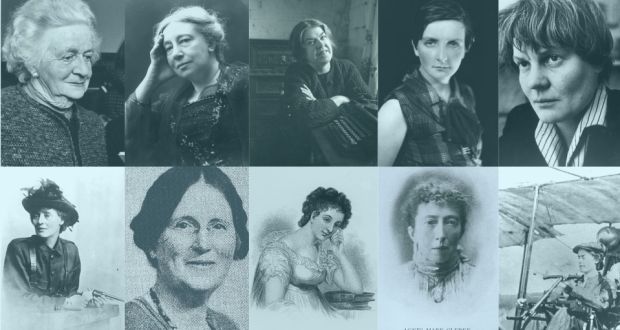
Trinity College’s new sculpture: 30 women to put on a pedestal

It has been more than 200 years coming, but better late than never: the provost of Trinity College Dublin wants the first woman to join the 40 men memorialised in marble busts in the Long Room of the Old Library. 


Worthy of honour:  all of these women, from Thekla Beere (top left) to Lillian Bland (bottom right), are ideal candidates for Trinity College Dublin's Long Room bust

Patrick Prendergast has asked for nominations for who should sit alongside Aristotle, Isaac Newton, Edmund Burke and Jonathan Swift, among others. The woman needn’t have a Trinity connection nor be Irish, just be a scholar who is no longer alive. 

To get the ball rolling, here are 30 Irish scholars, writers and thinkers worth considering for the honour. 

read more here @ Irish Times

Monday, March 11, 2019

Kitty Marion: Radical Suffragette

Kitty Marion (Katherina Maria Schafer), by Criminal Record Office, after  Unknown photographer - NPG x45561
Criminal Records Office c.1913
Kitty Marion (1871-1944) was born Katherina Maria Schafer in Westphalia in 1871. Her mother died when she was two years old and when she was fifteen went to live with her aunt in England. She learnt English and it became clear that her ambition was to become a music hall actress, which she achieved three years later in 1889 when she was cast in a pantomime in Glasgow. 

She joined the Women's Social & Political Union (WSPU) in around 1908, taking part in their marches on parliament and selling copies of their journal 'Votes for Women' in the street. When the Actress' Franchise League began in 1909, she was one of the first members. That same year she was arrested for the first time. The second arrest came in Newcastle a few months later when she threw a stone through the window of a post office, an offence for which she received a month's prison sentence. In Holloway jail she was force fed and reacted by setting her cell on fire. Further attacks on property ranging from breaking windows (Mar 1912) and a fire alarm (late 1912) to burning properties (Levetleigh House in Sussex in April 1913, the Grand Stand at Hurst Park racecourse in June 1913, various houses in Liverpool in August 1913 and Manchester in November 1913). These incidents resulted in a series of further terms of imprisonment during which force-feeding occurred followed by release under the Cat and Mouse Act

Fellow WSPU workers finally took her to Paris in May 1914. At the outbreak of war in Aug 1914, Marion's position became doubly uncertain: firstly, there was some question, soon dropped, of returning the suffragette prisoners to jail to serve the rest of their term; secondly Marion was a German by birth and therefore suspect. Despite briefly resuming her career on the stage, she was finally deported, going to America in 1915 where she would spend most of her remaining years. There she quickly became active in the family planning movement and after 1917, she began working with the Birth Control Review published by New York Women's Publishing Company under Margaret Sanger. Marion, with her experience selling 'Votes for Women', became a street hawker, selling the Review in New York for 13 years. She was arrested several times for violating obscenity laws, and was imprisoned for 30 days in 1918. She was granted US citizenship in 1924. 

She returned to London in 1930 to attend the unveiling of the statue to Mrs Pankhurst and began work in the Birth Control International Centre under Edith How Martyn. However, she finally returned to New York where she worked in Sanger's office once more before retiring to the Margaret Sanger Home in New York State where she died in 1944.

read more here:
@ Time


read also:
  • Death in Ten Minutes: Kitty Marion: Activist. Arsonist. Suffragette by Fern Riddell
  • The Company She Kept: The Radical Activism of Actress Kitty Marion from Piccadilly Circus to Times Square by Christine Woodworth
  • Rise Up Women!: The Remarkable Lives of the Suffragettes by Diane Atkinson
  • The Suffragette Bombers: Britain's Forgotten Terrorists by Simon Webb

see also:


Sunday, September 10, 2017

Mother, dancer, wife, spy: the real Mata Hari

As the centenary of Mata Hari’s execution approaches (15th October), there are signs of renewed interest in her story.

Here is an article by Julie Wheelwright in the Guardian:
Since her execution on the outskirts of Paris almost a century ago, the Dutch exotic dancer Margaretha “Gretha” MacLeod – universally known as Mata Hari – has been synonymous with female sexual betrayal. Convicted by the French of passing secrets to the enemy during the first world war, MacLeod’s prosecutors damned her as the “greatest woman spy of the century”, responsible for sending 20,000 Allied soldiers to their deaths. MacLeod’s status as both a foreigner and a divorcee, who was unrepentant about sleeping with officers of different nationalities, made her a perfect scapegoat in 1917.

Read more here:


How the British treated 'hardcore' Mau Mau women

From the University of Cambridge:

New research on the treatment of 'hardcore' female Mau Mau prisoners by the British in the late 1950s sheds new light on how ideas about gender, deviancy and mental health shaped colonial practices of punishment.
The research, published in the Journal of Eastern African Studies, was conducted by Gates Cambridge Scholar Katherine Bruce-Lockhart and is the first study to make use of new material on a camp in Gitamayu used to hold "hardcore" female detainees.
Bruce-Lockhart is interested in the treatment of "hardcore" Mau Mau women in the final years of the Emergency Period, one that was marked by uncertainty, violence and an increasing reliance on ethno-psychiatry.
From 1954 to 1960, the British detained approximately 8,000 women under the Emergency Powers imposed to combat the Mau Mau Rebellion in Kenya. The majority of female detainees were held in Kamiti Detention Camp and its importance has been widely acknowledged by historians.

Monday, June 26, 2017

Last Days of Freedom For Anne Frank

"Not being able to go outside upsets me more than I can say, 
and I'm terrified our hiding place will be discovered 
and that we'll be shot," she wrote in her diary in September 1942.

The Jews in hiding had withstood bombs, near-starvation, two break-in attempts, and the many privations of their helpers during over two years in hiding, and the suspense had begun to take its toll. They were pale and malnourished from life without sun, but they were alive.

And then, on August 4, 1944, everything changed.

read more here @ Mental Floss


Sunday, May 14, 2017

How Women Fought For The Right To Be Educated Throughout History

Great little article from Bustle:

Women's pursuit of an equal, in-depth, high-level education as adults has met many stumbling blocks over the centuries: inferior standards (or the complete absence) of education for young girls, beliefs in women's intellectual inferiority, and worries that education in non-domestic subjects wouldn't adequately prepare women for their "natural" role as wives and mothers. To the women of a century ago, the fact that 11.7 million women started college in America in 2016 — a majority of the total number of new students — would seem like a miracle. The ability to get your degrees as a woman isn't something to be taken for granted, so let's have a look at the history of women who just wanted to have the same education as everybody else — and the incredible fight it took to get them there.

read entire article here @ Bustle


Dr Helen Pankhurst: 'The suffragettes were violent freedom fighters."


As a new exhibition about women's suffrage opens, Dr Helen Pankhurst, the great granddaughter of suffragette leader Emmeline, explains why it made her chuckle and recalls the truly damaging tactics of her ancestors.

One hundred years ago, the National Portrait Gallery was issued surveillance photographs of suffragettes, including my great-grandmother Emmeline Pankhurst, by the Criminal Records Bureau. It was hoped that, as a result, staff would be able to recognise women planning to attack the gallery’s artworks in their campaign of political protest. Such concerns were justified: on March 10 1914 Mary Richardson slashed the Rokeby Venus, hanging just a few steps away in the National Gallery, with a small axe. She was also arrested for arson, vandalising the Home Office and bombing a railway station.
Now the internal warning memos and surveillance images of my great-grandmother and her fellow campaigners are themselves part of a fascinating exhibition at the NPG, entitled “Suffragettes: Deeds not Words”. I must confess that I chuckled on first seeing the display. What a wonderful irony it is that the Gallery is now positively promoting those whom it once looked out for in fear. Trouble makers have, over time, become worthy of tribute.
Read entire article here @ the Telegraph

Sunday, May 7, 2017

The Innocence of Joan Little

Will Packer ~ ~ ~ Joan Little
Will Packer is getting ready to develop a miniseries adaptation about the landmark case of Joan Little, called The Innocence of Joan Little, reports Shadow and Act.


Little’s case in 1974 drew national attention to a jail in Beaufort County in Washington, North Carolina, after Little was found innocent for killing a jailer who attempted to rape her. It was a landmark case, not only the first in United States history to recognize a woman’s right to kill a potential rapist in self-defense but also a case that acknowledged the rights of prisoners in the United States. She was found not guilty by a jury of six whites and six African-Americans.

Little was the first woman in US history to be acquitted under the defense that she killed 62-year-old Clarence Alligood, her would-be rapist, in self-defense. Her case set off a wave of support from civil rights, feminist, and anti-death penalty movements at the time as well.

Will Packer’s Will Packer Productions as well as Paulist Productions are on board to develop and produce the miniseries, though no network is yet attached, and there has been no word on casting. The series will be based on the book by author James Reston Jr., “The Innocence of Joan Little: A Southern Mystery.”

Saturday, May 6, 2017

Chasing Amelia Earhart

When a team of experts travels to a remote Pacific island next year in search of clues that Amelia Earhart landed there nearly 80 years ago, Eugene archaeologist Rick Pettigrew hopes to document the expedition.


These are some of the Amelia Earhart-related artifacts
recovered from Nikumaroro Island by
The International Group for Aircraft Recovery.
Pettigrew and filmmaker Teal Greyhavens want to film an international research team as it voyages to the island of Nikumaroro to uncover a rock cairn where Earhart’s navigator is believed to be buried, scuba dive along the nearby reef to look for traces of Earhart’s airplane and search the island for bone fragments and other traces of human life.


The international research group said in a statement late last month it believes new evidence shows partial skeletal remains found in 1940 on the island could belong to Earhart. The bones were first analyzed in 1940, but a doctor concluded they belonged to a male and the bones were later lost. In 1998, the international team discovered files about the remains, including skeletal measurements, and researchers determined the bones were actually consistent with a female of Earhart’s height.

Read entire article here @ The Register-Guard

I have posted many news items on this mystery - read more here:

Monday, April 17, 2017

Sumaria's "Mona Lisa"

Lady or Uruk c3700BC
Back in February 2008, I posted this:

An article published in Gulf News reports on the re-discovery of this ancient artifact:
"The 'Sayedat Al Warkaa', a Sumarian 20cm facial curving, known among archaeologists as the Sumarian Mona Lisa, and which is more than 5000 years old, was found in a garden after the police and occupation forces received a report." (note: link no longer working)

During the war in Iraq, the Baghdad Museum was looted of many of its priceless treasures (April 2003), including what was known as "The Lady of Warka" or "The Mask of Warka" or "The Lady of Uruk".

From IOL - 23rd September 2003:
The 5 000-year-old alabaster sculpture, which topped a list of 30 priceless antiques looted from the museum at the end of the invasion of Iraq, is believed to be one of the earliest representations of the human face, dating from around 3 500 BC. The Lady of Warka had been entombed for weeks in a Baghdad backyard before her rescue. Her saviours were a New York police officer and prosecutor who tracked the mask-like sculpture down to a shallow grave. 

From Irish Times - 19th September 2003
The alabaster sculpture is believed to be one of the earliest artistic representations of the human face, and dates from around 3500 BC. The work is originally from the ancient city of Warka. "During the past two days, we were able to recover the second most-valuable item of the Iraqi National Museum - the face of the Lady of Warka, which is known as the Sumerian Mona Lisa," Mr Mofeed al-Jazairi told a news conference. 

From Middle East Online - 24th September 2003:
Also known as the "Mona Lisa of Mesopotamia," the 20-centimetre (eight-inch) high limestone sculpture, dating from 3,100 BC, depicts the head of a woman and was returned to Iraq's National Museum in a formal handover.  It was fashioned in the southern city of Warka during the Sumerian period, and was among the five most precious pieces still missing since the museum was ransacked after the April 9 fall of Saddam.

From Ancient Pages -15th September 2016
The artifact – the first accurate depiction of the human face – is one of the earliest representations of the human face. Researchers believe that carved out of marble female face is a depiction of Inanna, the Sumerian goddess of love, fertility, and warfare, and the most prominent female deity in Mesopotamia.

From SFGate - 24th September 2003
The Lady of Warka lay buried half a foot underground in a farmer's backyard, wrapped casually in a cotton cloth and stuffed into a plastic bag, before a joint force of American soldiers and Iraqi police discovered the priceless 5,200-year-old sculpture last week.

Since it was stolen in April, the artifact -- known familiarly as the Mona Lisa of Mesopotamia -- had changed hands half a dozen times in the maze of Baghdad's back alleys and clandestine antique shops, going from dealer to dealer, said Col. Walid Misil, a Baghdad police spokesman.

Read More:
Open Access - The Mask of Warka
The Bible & Interpretation - Mesopotamian Ruins and American Scholars
Archaeology Magazine (online) - National Museum, Baghdad: 10 Years Later
University of Chicago Chronicle - Archaeologists review loss of valuable artifacts one year after looting
The Iraq War & Archaeology - Article 12 - 2nd 1/2 of September 2003

Friday, April 14, 2017

Violet Jessop: Miss Unsinkable

From the Vintage News comes this remarkable story of a woman - Violet Jessop "Miss Unsinkable" - who survived three historic shipping accidents:
White Star Line was a prominent British shipping company, famous for their luxurious liners. Founded in 1845, the company had their first liner, the Oceanic, built in 1870. The ship had a successful run; it was taking passengers across the Pacific until 1895 when it was decommissioned and sold for scrap. Encouraged by this success, White Star Line ordered three more vessels from Harland & Wolff, the same company that built the Oceanic. The new trio of luxurious ships were named Olympic-class ocean liners, which were constructed in the period from 1908 to 1914, and one of those ships later became the most famous vessel of all time.
These three ships where known as the Olympic, the Titanic, and the Britannic. Violet was aboard all three and survived to tell the tale. The story continues ....

Ship 1 - The Olympic:
In 1910, she became an employee of White Star Line and started working on the biggest civilian vessel of that time, the Olympic. On 20 September 1911, the Olympic collided with HMS Hawke, a British warship, specially designed to ram into other ships and sink them. The Olympic had its hull breached but still managed to sail into port. Violet Jessop was not harmed in the accident.
Ship 2 - the Titanic
Several months after the Olympic mishap, Violet joined the crew of the RMS Titanic. The luxurious and now biggest ship in the world left Southampton on 10 April 1912 and struck an iceberg in the North Atlantic Ocean four days later. Two hours after the accident, the ship sank, and 1503 passengers lost their lives.
Ship 3 - the Britannic
On 21 November 1916, the Britannic was in the Aegean Sea when she hit a mine planted by a German submarine. 57 minutes after that, the grandiose ship was already at the bottom of the sea. (Violet was working as a nurse).

Read More Here:

Sunday, April 9, 2017

Schoolgirls 'stripped' to check for menstrual blood

Period shaming in India is not new, but the fact that girls can be "punished" for menstruating, that too inside educational institutes, is indeed a matter of great shame.


Girl students of a residential school in Muzaffarnagar were reportedly stripped naked by a warden to “check for menstrual blood”. According to this report, around 70 students of Kasturba Gandhi Girls Residential School complained that the female warden asked them to take off their clothes and allegedly threatened them to punish if they disobeyed.

The inspection resulted after the warden spotted some blood stains in the bathroom. "The warden ordered us to remove our clothes. It was very humiliating for all of us. We want action against her,” one of the students was quoted as saying but the CNN-News18.

Our society is still driven by the mindset that women turn impure during their periods. And what is most disgusting is that the idea is so deep ingrained and the practice so ancient that even women themselves look at menstruation blood with aversion.

And just like all other obnoxious claims attaching scientific significance to Indian traditions, this custom too, the sanskari Indians believe, has "empirical" proof — menstrual blood is unhygienic which makes the women impure and untouchable during her monthly cycle. 

Sunday, April 2, 2017

Womens' Suffrage Marches

WHY YOU MUST MARCH
Because this is the most conspicuous and important demonstration that has ever been attempted by suffragists in this country.
Because this parade will be taken to indicate the importance of the suffrage movement by the press of the country and the thousands of spectators from all over the United States gathered in Washington for the Inauguration.
So said the broadsheets handed out and so they gathered. There were three notable marches recorded for posterity - the first in Washington, the next two in New York.

Suffrage Parade - 6th May 1912 - New York City
It was a bold tactic, adopted by suffragists and the more militant suffragettes shortly after the turn of the century. Although some women chose to quit the movement rather than march in public, others embraced the parade as a way of publicizing their cause and combating the idea that women should be relegated to the home. (Source: World Digital Library)


Suffrage Parade - 3rd March 1913 - Washington.
In 1913, the first major national efforts were undertaken, beginning with a massive parade in Washington, D.C., on March 3 -- one day before the inauguration of President Woodrow Wilson. Organized by Alice Paul for the National American Woman Suffrage Association, the parade, calling for a constitutional amendment, featured 8,000 marchers, including nine bands, four mounted brigades, 20 floats, and an allegorical performance near the Treasury Building. (Source: The Atlantic - March 1st, 2013)

Women from countries that had enfranchised women held the place of honor in the first section of the procession. Then came the “Pioneers” who had been struggling for so many decades to secure women's right to vote. The next sections celebrated working women, who were grouped by occupation and wearing appropriate garb—nurses in uniform, women farmers, homemakers, women doctors and pharmacists, actresses, librarians, college women in academic gowns. Harriet Hifton of the Library of Congress Copyright Division led the librarians' contingent. The state delegations followed, and finally the separate section for male supporters of women's suffrage. All had come from around the country to “march in a spirit of protest against the present political organization of society, from which women are excluded.” (Source: Library of Congress - Official Program: Woman Suffrage Procession).

Read more here:
- The Atlantic
- Library of Congress
- Women of History - Suffrage March of 1913
- Smithsonian - Original Women's March
- Activist New York


Suffrage March - 23rd October 2015 - New York
On October 23, 1915, over 25,000 women marched up Fifth Avenue in New York City to advocate for women’s suffrage. At that point, the fight had been ongoing for more than 65 years, with the Seneca Falls Convention in 1848 first passing a resolution in favor of women’s suffrage. Unfortunately, they wouldn’t find success for another five years. New York’s 1915 suffrage parade was the largest held in the city until that time. (Source: Behind the Scenes: New York History)

Read more here at:
- The Bowery Boys: New York City History
- The Feminist Majority Foundation


Suffrage March - October 1917 - New York
This NY Times article covers the Fifth Avenue Parade in 1917. Many leaders from various groups, including NAWSA, were a part of this event that used the fighting for democracy in World War I to help promote their cause for fighting for democracy at home. This parade, filled with patriotism for our troops, also used President Wilson’s suffrage endorsement to support their cause. While women, like Carrie Chapman Catt, walked in the parade, NWP members were in the crowd passing out their newspapers and encouraging the protest of the war time President. (Source: New York Times)

Read more here at:
- Women's Suffrage in the United States (wikipedia)
- New York Times: 1917 - When Women Won Right ToVote
- Yates County History Centre
- Night of Terror
- Timeline of Women's Suffrage in United States (wikipedia)
- National Archives - Women's Suffrage Party Petition
- New York Rediscovered
- Digital Documents - Women's Suffrage

Sunday, March 19, 2017

Li Zhao - Female Pioneer of Communist China

Li Zhao is best known in China as the wife of the 1980s liberal reformer Hu Yaobang, who held the country's highest office as general secretary of the Communist Party – until being forced out. It was his death in 1989 that famously sparked the Tiananmen Square student protests.

One of the female pioneers of communist China, Li Zhao joined the revolution as a 16-year-old in 1937. After her father was killed at an anti-Japanese occupation rally, she took inspiration from the classical Chinese legend Mulan and disguised herself as a man – even shaving her head – to travel alone the long and dangerous road to Yanan.

She was laid to rest at the Babaoshan Revolutionary Cemetery on Friday, in an ancient hall reserved for Communism's heroes with unblemished careers. Hu hadn't been buried here. But on Friday the white floral wreaths included those from Xi and Premier Li Keqiang.

Read more here @ Stuff dot co dot nz

Sunday, March 12, 2017

Women before, during and after the Russian Revolution

The history of Bolshevism from the very early days right up to the Russian revolution contains a wealth of lessons on how it is the class struggle that provides the final answer to the women’s question. In this article Marie Frederiksen looks at the approach of the Bolshevik Party to the women’s question from its early days, right through to the revolution and after taking power.
She looks at the measures taken by the party to involve women, the progressive measures introduced by the Bolsheviks once in power, but also the negative consequences for women of the later Stalinist degeneration.
Women are  involved in social struggles, and the question of women's oppression is on the agenda to a degree we have not seen in decades. Sexism and the oppression of women is an integral part of capitalism, and they can only be removed by uprooting the system. A socialist revolution is the precondition for women's liberation.
The Russian revolution and the revolutionary energy of Russian women show the powerful reserves of courage and determination which can be mobilised for a socialist revolution. The Bolsheviks in 1917 began the task of the emancipation of women. It is up to us to finish it.
Read entire article by Marie Frederiksen here @ In Defence of Marxism

Thursday, February 16, 2017

Buchi Emecheta, Nigerian Novelist, Dies at 72


Buchi Emecheta, a British-based Nigerian writer who, in “Second-Class Citizen,” “The Joys of Motherhood” and other novels, gave voice to African women struggling to reconcile traditional roles with the demands of modernity, died on Jan. 25 at her home in London. She was 72.  The cause was dementia, her son Sylvester Onwordi wrote in the British magazine New Statesman.

Ms. Emecheta (pronounced BOO-chee em-EH-cheh-tah) came to the attention of British readers in the early 1970s when New Statesman began running her accounts of the travails of a young Nigerian woman in London. Adah, a thinly disguised version of the author, lived in a dreary apartment, worked menial jobs to support her young children and abusive husband, studied at night and weathered the slights meted out by a racist society. Buoyed by ambition and pluck, she remained undaunted.

In the Ditch,” a novel based on those columns, appeared in 1972.  With the publication two years later of a second Adah novel, “Second-Class Citizen,” critics in Britain and the United States hailed the arrival of an important new African writer. Like her immediate predecessor Flora Nwapa, Ms. Emecheta revealed the thoughts and aspirations of her countrywomen, shaped by a patriarchal culture but stirred by the modern promise of freedom and self-definition.