Showing posts with label chinese history. Show all posts

Saturday, June 17, 2017

Chinese Actress Liu Xiaoqing on Playing Empress Wu

Liu Xiaoqing as Empress Wu Zetain
In the pantheon of great Chinese actresses, few names come as revered as Liu. The star of more than 60 films and TV shows, Madame Liu, as she likes to be called, has a résumé that includes four marriages, once being China’s richest woman and a jail term for tax evasion. Now 61 years young, she is keen to discuss her latest role over dinner at Beijing’s Four Seasons Hotel. It's a role she has already played four times over.

“The tale of Empress Wu is like jade,” she tells TIME, dressed in a black tee bearing the slogan ”Little Cutie” over a green military-style shirt. “We’re on a treasure hunt for this most precious of treasures, unraveling the mysteries of that period and person.”

That person is Wu Zetian, the only woman to have ever ruled China, and that period is the Tang Dynasty (AD618 to 906). Liu is due to reprise the role in a 14-part series entitled Empress, due to hit American screens late next year.

Empress Wu is legendary in China for using her wit, intelligence and cunning to eclipse all rivals and rise from her position as Emperor Taizong’s favorite concubine to the very apex of court life. She also had scores of lovers, ruled through 72 prime ministers, and is believed to have killed her own daughter. “Only after I acted as Empress Wu did people start thinking positive things about her,” says Liu.

read more here
@ Time


Sunday, March 19, 2017

The Demonization of Empress Wu

“She killed her sister, butchered her elder brothers, murdered the ruler, poisoned her mother,” the chronicles say. But is the empress unfairly maligned?


Of all these female rulers, though, none has aroused so much controversy, or wielded such great power, as a monarch whose real achievements and character remain obscured behind layers of obloquy. Her name was Wu Zetian, and in the seventh century A.D. she became the only woman in more than 3,000 years of Chinese history to rule in her own right.

In death, as in life, then, Wu remains controversial. Even her gravesite is remarkable. When she died, she was laid to rest in an elaborate tomb in the countryside about 50 miles north of the then capital, Xi’an. It was approached via a mile-long causeway running between two low hills topped with watchtowers, known today as the “nipple hills” because Chinese tradition holds that the spot was selected because the hills reminded Gaozong of the young Wu’s breasts.


Read entire article by Mike Dash @ The Smithsonian Magazine
Women of History: Wu Chao
Ancient History Encyclopedia: Wu Zetain


Six Ancient Chinese Women

From ECNS:
Here are six talented ancient Chinese women who once impressed in their time, and still affect us in our time.

Li Qingzhao: Praised as the "No.1 talented woman", Li Qingzhao, a poet from the Song Dynasty (960-1279), was born in Shandong province.

Cai Wenji: Daughter of literatus Cai Yi of the Eastern Han Dynasty (25-220). Cai was good not only at poetry and calligraphy, but also mathematics, astronomy, debate and music. Her masterpieces were Hu Jia Shi Ba Pai, or Eighteen Songs of a Nomad Flute, and Bei Feng Shi, or Indignant Poems.

Ban Zhao: Ban was the first female historian in China. Her father, Ban Biao, was an historian during the Eastern Han Dynasty. She was also good at writing poems, yet only seven of her works have survived.

Shangguan Wan'er: Shangguan was famous for being given an important position by the only female emperor, Wu Zetian of the Tang Dynasty (618-907).

Su Hui: Su Hui, from the Qian Qin (351-394) was famously known for a handkerchief she made. The textile was embroidered with 841 characters that could form 7,958 poems.

Xue Tao: It is recorded that Xue Tao, a talented female entertainer during the Tang Dynasty created this colored paper to write poems. During her time, writing papers were often yellow, yet Xue changed the simple color into different shades of red or green. Later, people made similar colorful paper and named them "Xue Tao Jian".


Li Zhao - Female Pioneer of Communist China

Li Zhao is best known in China as the wife of the 1980s liberal reformer Hu Yaobang, who held the country's highest office as general secretary of the Communist Party – until being forced out. It was his death in 1989 that famously sparked the Tiananmen Square student protests.

One of the female pioneers of communist China, Li Zhao joined the revolution as a 16-year-old in 1937. After her father was killed at an anti-Japanese occupation rally, she took inspiration from the classical Chinese legend Mulan and disguised herself as a man – even shaving her head – to travel alone the long and dangerous road to Yanan.

She was laid to rest at the Babaoshan Revolutionary Cemetery on Friday, in an ancient hall reserved for Communism's heroes with unblemished careers. Hu hadn't been buried here. But on Friday the white floral wreaths included those from Xi and Premier Li Keqiang.

Read more here @ Stuff dot co dot nz

Thursday, February 16, 2017

Was it Love or Witchcraft?

Usually, the Empress of the Han Dynasty was invincible, untouchable, and protected by the law more than anyone else. However, in the case of Empress Chen of Wu, the accusation of practicing black magic destroyed her life. Nowadays, she is remembered as an ancient Chinese witch.
She was the wife of Emperor Wu of Han, who ruled between 141 and 87 BC. Their marriage was arranged and was not based on love. She was her husband’s servant when she was a little girl. Instead of playing and having fun like most children, she had to follow the strict rules laid out for Han Dynasty women.
Read more here: Ancient Origins

Tuesday, September 13, 2016

Monday, October 7, 2013

Empress Dowager Cixi

Bel Mooney's review of Jung Chang's "Empress Dowager Cixi" from the Mail Online:
She was a version of Margaret Thatcher, in a different age, an alien culture. From humble origins yet a natural leader, she used a powerful mixture of intelligence and natural charm to get her way, fighting a single-minded path to the top.

Autocratic and determined, she would let few things or people stand in the way of her ambition to change history.

The lady knew how to manipulate men who were weaker - which was most, even in a male-dominated culture. Powerful rivals held no terror for her, and heaven help those who made her their enemy.

Depending on whether you’re a detractor or an admirer, she was ruthless or tough-minded, devious or shrewd, cruel or simply pragmatic according to the standards of the age. Nobody can argue that this stateswoman made a significant mark on history, yet history’s jury is still out.

Was she an innovator or a despot? The answer is almost certainly - both.


Other Links:
Article on Cixi featured in the Smithsonian Magazine: http://www.smithsonianmag.com/history-archaeology/da-cixi.html


Monday, September 16, 2013

Tomb of Shangguan Wan'er

Chinese archaeologists have discovered the tomb of a 7th century female politician who was one of the most powerful women in the country's ancient history, local media said on Thursday.

Shangguan Wan'er -- who lived from 664 to 710 in the Tang dynasty -- was a trusted aide to China's first female emperor Wu Zetian, and married to Wu's son, while having relationships with both the empress's lover and her nephew.
As a sequence of murders, coups and affairs enveloped the dynasty, Shangguan Wan'er's husband Li Xian briefly became emperor -- only to be killed by his senior wife, who took power herself.
She was deposed in turn by Li Longji, who killed both her and Shangguan Wan'er.
The site was discovered near an airport in Xianyang in northern Shaanxi province and confirmed by an epitaph, China Radio International said on its website.

Wednesday, December 21, 2011

Film: The Flowers of War

Epic tale of young women desperate to survive the Japanese invasion of Nanking in 1937. China's Oscar entry for Best Foreign-Language Film offers powerfully realistic and inventive war scenes. Alas, some of the dialogue may register as a bit too saccharine for Western ears.

Adapted by Liu Heng from the novel by Yan Geling, The Flowers of War offers two distinct species of "flowers”: One group consists of beautiful courtesans on the run, while the other encompasses cloistered schoolgirls who sing in the church choir and who deeply mourn the recent death of their Catholic priest. To save both the prostitutes and the adolescent girls—who recoil from any association with fallen angels—Miller must put on the Father's black robes and emulate priestly behavior. Gradually, he acquires a new dignity and compassion. He stops trying to bed the sultry leader of the courtesans, Yo Mo (Ni Ni), and begins to treat her like the clever, formidable survivor that she is.

Christian Bale in China from China Buzz

Tuesday, September 6, 2011

Remains of Legendary Succubus Mistress of Liu Fei Excavated

A Dayunshan Han Dynasty (206 BC-220 AD) tomb in Xuyi county is a great discovery for Jiangsu province. The host of the tomb is Liu Fei, the elder brother of Emperor Hanwu and the first King of Jiangdu.

Two dishes, inscribed with the Chinese characters "Naoshi", were found by the Archaeology Institute of Nanjing Museum and the Dayunshan Han Dynasty tomb archaeology team. The dishes are the first unearthed remains which are not directly relevant to the King of Jiangdu, Liu Fei. According to archaeologists' analysis, "Naoshi" dishes are consistent with the historical "Naoshi", the succubus mistress of Liu Fei.

Li Zebin, deputy director of archaeology Institute of Nanjing Museum and leader of the Dayunshan Han Dynasty tomb archaeology team, said the unearthed dishes vividly present a succubus mistress of "King of Jiangdu" and play an important part in the research of scenes from 2,000 years ago.

Friday, August 5, 2011

Lifting The Veil of the Forbidden City

From Xinhuanet:
Beijing's Palace Museum, also known as the Forbidden City, is steeped in history, dreams and tears, which are perfectly reflected in Ah! The Forbidden City.

Li Shaobai's photos and Jiang Guofang's paintings, in the book published in English by the Foreign Languages Press, are both easy on the eye and provide food for though

Painter Jiang, meanwhile, tries to revive the lives of the former inhabitants of the Forbidden City on canvas, getting into the minds of these historical figures.

Jiang also has an eye for pretty palace women, including the empress, concubines and princesses. Although they dressed in gorgeous clothes and ate delicious food, they were spiritually bereft. With so many women serving one man, few of them had the chance to be with the emperor. Their rooms were often empty and perhaps the high walls and deep courtyards were like gilded cages to them.

Wednesday, June 22, 2011

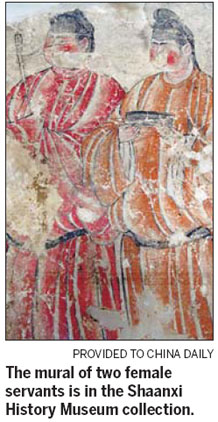
Women of the Tang Dynasty

The Tang Dynasty (AD 618-907) is widely acknowledged as one of the most glorious periods in Chinese history. Even today, many overseas Chinese neighborhoods are known as "Tang People's Streets".

The Tang Dynasty was characterized by openness, particularly with respect to women, quite unlike any other period in China. Tang people worshipped natural beauty and skinny Tang women were the exception rather than the rule.

Their unorthodox approach was also reflected in their dress.

Friday, April 15, 2011

The Enigma of Stephanie Rosenthal

We are all used to the phenomenon of the wandering Jew, and to finding a Jew in almost every nook and cranny. But who would have imagined that in the 1920s, a Polish Jewish woman was writing a best-seller in Chinese that was said to be “going like matza water” because half a million copies had been sold.

Prof. Irene Eber, an eminent scholar of Chinese literature and history and of Jews in China, was reading a fascinating travelogue by Mejlekh Ravitch, a Yiddish poet from Warsaw, written while he traveled in China for six months during 1935. Ravitch mentioned having met a landsman, one of the few women writers in the country. This discovery set Eber on a search to uncover the identity of her landsman as well.