Showing posts with label ancient society. Show all posts

Monday, December 27, 2021

8 powerful female figures of ancient Rome

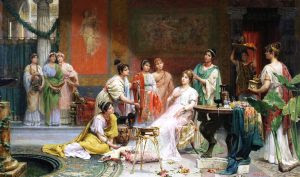
Women in ancient Rome held very few rights and by law were not considered equal to men, according to a 2018 article on The Great Courses Daily. Roman women rarely held any public office or positions of power, and instead their role was expected to be caring for children and looking after the home.

Most women in Roman society were controlled by either their father or husband. Especially among richer families, women and young girls were married off in order to form political or financial relationships, and rarely could choose their partner.

Despite this lack of rights, there is evidence of a few exceptional women who managed to attain great power and influence in ancient Rome. While some controlled events from the sidelines, others took matters into their own hands, forming conspiracies and even assassination plots to seize control of the Roman empire.


read more here @ Live Science

Monday, June 13, 2016

Silenced Women–Modern Lessons from an Ancient Murder

Silenced Women–Modern Lessons from an Ancient Murder
In the second century A.D., the pregnant wife of a prosperous Greek politician died from a vicious assault.
Appia Annia Regilla Atilia Caudicia Tertulla, or Regilla, was born into an affluent Roman family in 125 A.D.; she married the Greek politician Herodes Atticus, also from an affluent family, around 140 (when she was 15); and 20 years later, when she was 8-months pregnant with their 6th child, she died from a brutal beating which included a fatal kick to her stomach.
This is a case of domestic abuse that resulted in murder. A wife was beaten to death by the order of her husband. An unborn child, just weeks from birth, was killed by a father’s command.

Ancient Greek & Roman Women

Largely excluded from education, the women of Ancient Rome were forever subject to their fathers and husbands, to the point of having no legal rights over their own children. That’s not to say that they couldn’t become successful in business and politics, such as Eumachia of Pompeii, who was an extremely wealthy business magnate.
Aside from the wives and mothers of Roman emperors, who often held a significant amount of political power, the only official high-ranking job open to women was religious. The Vestal Virgins (who kept the sacred fire of Rome burning) were of particularly high status. As priestesses of Vesta – the goddess of the hearth, home and family – the six women would serve for 30 years and held significant power, including independence from their fathers’ rule and they could also manage their own property.

The analysis is based on a scene on a skyphos — a large ceramic cup used for the consumption of large quantities of wine — that represents a parodied depiction of the Judgment of Paris, a well-known incident from Homer’s The Iliad. 
The painted scene on the skyphos could also recall a dramatic presentation of the event, perhaps a short play staged in honor of the local deities. In this case, actors such as those portraying Aphrodite and Hermes on the cup would presumably have appeared as Africans, their affect aided by carved and painted theatrical masks.
The same inclusion of blackness holds true for several other types of scenes found on the Kabeirion skyphoi. One of the most remarkable of these presents a dramatic confrontation taken from Homer’s Odyssey, the epic that follows The Iliad.


Mummy Shows Ancient Egyptians Bleached Their Skin

Mummy Shows Ancient Egyptians Bleached Their Skin


Photo credit: Profesor Reverte Coma
Evidence that the ancient Egyptians plastered on killer cosmetics to whiten their skin has been found in a 3,500-year-old mummy head. Belonging to an anonymous woman age 20-25, the head shows tiny nodules under the cheeks and at the back of the neck that point to a possible skin disorder called exogenous ochronosis. "Such dermatosis is caused by the extensive use of skin bleaching cosmetics," ‎Despina Moissidou, an anthropologist at Nation Kapodistrian University of Athens, Greece, told Discovery News.

A Brief History Of The Menstrual Period

If stigma around menstruation exists today, you can rest assured it was much worse in earlier times throughout history. Without much knowledge about biology or the human reproductive system, ancient and medieval humans simply saw menstruation as females bleeding without being injured — a phenomenon that appeared to correspond to changes in the moon. For thousands of years, menstruating women were wrapped up in labels and misinformed religious beliefs — at times considered holy and mystical, at other times seen cursed and untouchable. Often, menstruation was completely omitted from man’s documented history, relegated to the “woman’s sphere.” So here’s a brief history of menstruation in both scientific and cultural life, considering the fact that there still remains far more to discover about the subject.
Continue reading article from Medical Daily

Sunday, March 3, 2013

Matronalia Festival

From Patheos:
Juno Capitolium was another goddess called upon by new brides and wives, for She is a goddess who protects the sanctity of marriage vows and marital relations.  A story grew up that Juno, already angry over her husband’s affairs, became even more infuriated when She learned that Jupiter had given birth to a daughter. To relieve Jupiter’s headache, Vulcan split open His head with a mallet and out arose wise Minerva. Grey-eyed Minerva was addressed as “most chaste goddess” because Her conception and birth had not resulted from sexual intercourse. Juno was so angered by this that She decided that She, too, would bear a child on Her own, without any help from Jupiter. She enlisted the help of Flora, Goddess of Flowers, who provided Juno with a sacred lily that held pollen-laced dew. This was the semen that Flora poured from the lily into Juno’s ear. This immaculate conception of Juno is celebrated on 2 May as another sort of Matronalia comparable to modern Mother’s Day. Then, on the first day of the New Year, the first day of March, Juno gave birth to Mars. 

Thursday, December 20, 2012

Ancient Female Statue Found


A 2,500-year-old statue of a woman from the late Hellenistic period has been unearthed during the excavations at the Metropolis ancient city in İzmir’s Torbalı district.

According to a written statement made by the Sabancı Foundation, new artifacts are being unearthed during the excavation of the ancient city, which has been ongoing for 22 years as part of a collaboration between the Culture and Tourism Ministry, Trakya University, the Metropolis Association, the Torbalı Municipality and sponsored by the Sabancı Foundation. 


Tuesday, February 21, 2012

Mother Goddess Image Found

From The Hindi:

The first-ever ‘Mother Goddess' image carved in sandstone rock — representing the earliest perception of idolising woman as Goddess dating back to 3 Century BC — has been found close to the Sri Chalukya Kumara Bheemeswara Swamy temple at Samarlakota near Kakinada in East Godavari district of Andhra Pradesh.


Archaeological Survey of India's Superintending Archaeologist R. Krishnaiah, told The Hindu that while conducting an exploration around the Bheemeswara Swamy temple to ascertain its origin and antiquity, their Deputy Superintending Archaeologist D. Kanna Babu discovered the stunning and unique image of a seated mother goddess (Yakshini), in a remote corner outside the temple.

The centuries old temple is revered as one of the ‘Pancharama Kshetras.' From the archaeological research point of view, the ‘mother goddess' sculpture was a rare discovery, said Mr. Krishnaiah. This find would be vital for reconstructing the cultural life of ancient Andhra, the origin and evolution of early cultural art. This idol was believed to be from the Ashoka period in 3 Century BC.

Friday, June 24, 2011

Podast: Women in Ancient Europe

Gender archaeology is a method of studying past societies through their material culture by closely examining the social construction of gender identities and relations. Gender archaeology itself is based on the ideas that even though nearly all individuals are naturally born to a biological sex (usually either male or female, although also intersex), there is nothing natural about gender, which is actually a social construct which varies between cultures and changes through time.

Gender archaeologists examine the relative positions in society of men, women, and children through identifying and studying the differences in power and authority they held, as they are manifested in material (and skeletal) remains. These differences can survive in the physical record although they are not always immediately apparent and are often open to interpretation. The relationship between the genders can also inform relationships between other social groups such as families, different classes, ages and religions.
 

Tuesday, June 7, 2011

Princess Ennigaldi's Museum

From io9:
In 1925, archaeologist Leonard Woolley discovered a curious collection of artifacts while excavating a Babylonian palace. They were from many different times and places, and yet they were neatly organized and even labeled. Woolley had discovered the world's first museum.

o who was responsible for this ancient wonder full of even more ancient wonders? That honor goes to Princess Ennigaldi, the daughter of King Nabonidus, the last king of the Neo-Babylonian Empire. As was traditional for the daughters of Mesopotamian kings, her primary duties were religious in nature, both as the high priestess of the moon god Nanna and as the administrator of a school for young priestesses. It was around 530 BCE that Ennigaldi created her museum. That comes dangerously close to being everything we know about the woman behind the world's first museum.

Sunday, February 20, 2011

John De Lisa - Looking At Ancient Cultures

From SILIve:
John De Lisa can combine modern technology with primitive artifacts.

A teacher at St. Joseph Hill Academy, he recently gave a PowerPoint presentation on what he learned last summer as the recipient of a Fulbright-Hayes Summer Seminar Abroad Scholarship.

One photograph was of a helmet mask from the Mende people of Sierra Leone, which De Lisa explained represented the queen and was worn during the initiation of young girls into the status of womanhood.

"It is believed that the spirit of the queen possesses the wearer of the mask and speaks through her, giving instruction to the initiates in the lore of the tribe and the knowledge she will need as a wife, mother, and adult member of the community," De Lisa said.

Another artifact was an Akua-Ba from the Asante people of Ghana. A woman who wants to become pregnant straps the carved, wooden fertility statuette to her back and carries it as she would a real baby. The Akua-Ba is thought to ensure not only conception but a healthy infant.

Saturday, November 27, 2010

Ancient Body Adornment

From the Bangkok Post:
What do women today have in common with those in prehistoric times? The answer is none other than a love for body ornaments _ rings, necklaces, earrings, bracelet, anklets.

"All human groups have created accessories. Body ornaments are not just about beauty, but also about beliefs," said Asst Prof Mayurie Veraprasert, a lecturer at the Archaeology Faculty, Silpakorn University, who prepared the exhibition, "Body Ornaments : Beliefs, Beauty, and Creativity", at Phufa Treasure Trove on the 4th floor of Siam Paragon. The event opening on Monday was graciously presided over by HRH Princess Maha Chakri Sirindhorn.

The exhibition, on view until December 31, features images of body ornaments worn by women in different historical periods, from Dvaravati to Ayutthaya. Some depict images of adornments on skeletons from prehistorical burial sites, as well as images of people wearing elegant accessories in the famous mural painting at Wat Phumin in Nan province. One section deals with contemporary ornaments, created by students of the Decorative Arts Faculty, Silpakorn University, and another presents a full set of exquisite ornaments on a khon character, Kumpakan, made by students at the Royal Goldsmith College. The accessories were used in a khon production, The Battle of Kumpakan, commanded by Her Majesty the Queen.


Saturday, June 26, 2010

Baby Deaths Linked to Roman Brothel

From BBC News:
Archaeologists investigating a mass burial of 97 infants at a Roman villa in the Thames Valley believe it may have been a brothel.

Tests on the site at Hambleden in Buckinghamshire suggest all died at 40 weeks gestation, very soon after birth.

Archaeologists suspect local inhabitants may have been systematically killing unwanted babies. Archaeologist Dr Jill Eyers said: "The only explanation you keep coming back to is that it's got to be a brothel."


And from the
Independent:
Alternatively, the site could have had a partly religious function with the infants being the subjects of illegal rituals or even human sacrifice. Certainly newborn infants were sometimes buried as ritual foundation deposits in Roman Britain – though never in such large numbers.

Saturday, March 27, 2010

X-Woman

From BBC News:
Scientists have identified a previously unknown type of ancient human through analysis of DNA from a finger bone unearthed in a Siberian cave.

The extinct "hominin" (human-like creature) lived in Central Asia between 48,000 and 30,000 years ago.

An international team has sequenced genetic material from the fossil showing that it is distinct from that of Neanderthals and modern humans.

Details of the find, dubbed "X-woman", have been published in Nature journal.

Ornaments were found in the same ground layer as the finger bone, including a bracelet.

Professor Chris Stringer, human origins researcher at London's Natural History Museum, called the discovery "a very exciting development".

Saturday, December 5, 2009

Korean: Ancient Girl Reconstructed

From JoonAng Daily:
At the National Palace Museum of Korea yesterday officials from the Gaya National Research Institute of Cultural Heritage in Korea unveiled the restored model of the girl from the Gaya confederacy era (42-562).

The restoration is the result of two years of interdisciplinary work that brought together experts in archaeology, forensic medicine, anatomy, genetics, chemistry and other fields - a notable step forward in Korean archaeology.

In December 2007, archaeologists discovered the complete remains of the girl and partial remains of three others in a tomb in Changnyeong County, South Gyeongsang. By the time of the discovery, there had already been a grave robbery.

Archaeologists concluded that the four were attendants of the tomb’s owner because they were positioned horizontally. The remains of the owner, however, were missing.

The work revealed that the four people - two women and two men - died in the early sixth century, either due to suffocation or poisoning. Their main diet had been rice, barley and beans as well as meat.

The girl’s age was estimated through an examination of her teeth. She apparently spent much time kneeled down and engaged in the repetitious task of cutting something with her teeth, according to the medical evaluation. She was wearing a golden earring and is believed to have been a maid, not a slave.

Sunday, November 15, 2009

Japan: Queen Himiko

From the Telegraph:
Queen Himiko is a popular character in Japanese history. She was apparently able to wield great power in the Yamatai Kingdom from around the end of the second century. Legends handed down from the time describe her as "being skilled with magic".

Japanese revere her as a heroic Boadicea-type figure who unified the kingdom after years of fighting with rival tribes, before her death around 248AD.

The precise location of Yamatai has been one of the most bitterly disputed issues in Japanese archaeology, with some claiming the kingdom was in present-day Kyushu. The latest finding supports the claim of central Japan to the queen's lands.

From Asahi:
The site of a third-century building found in the Makimuku ruins here has reignited debate over the location of Yamataikoku, a mysterious and powerful country once ruled by Queen Himiko.

The discovery, announced by the Sakurai city board of education Tuesday, has strengthened the theory that the Kinai area was home to Yamataikoku, a country described in "Gishi Wajin-den," part of the Chinese book "Sanguo zhi" (History of the Three Kingdoms) written by Chen Shou in the late third century.

Proponents of the theory say the building, estimated at 19.2 meters by 12.4 meters with a floor space of 238 square meters, could have been a central facility in Yamataikoku.
Asahi News also has a number of images.


At Kyodo News - pictures

Saturday, October 24, 2009

Lady of Pacopampa

From EnPeru:
On the highest terrace of the San Pedro mountain in what is today Chota in Cajamarca, the birth of a girl began what was to be a new episode of the Formative Period some 3000 years ago. Born in the archaeological complex that we now call San Pedro de Pacopampa, the healthy baby girl would be raised to one day lead her people.

With help from his colleagues back in Japan, he discovered that the Lady of Pacopampa had a deformation in the back part of her skull, as well as other mysterious elements such as a bluish substance and cinnabar – usually found in the burials of the most important rulers of ancient Peru.

He is certain that the girl born 3000 years ago was destined from birth to be the leader of their society, something that did indeed happen when she reached adulthood.


Wednesday, October 14, 2009

The Mysterious Death of Cleopatra - comments

The Post Mortem

Two things which struck me: (1) I think you need to know your Cleopatra as they did not go into a great deal of detail about her life or her relationships with two of Rome's most powerful men at all; (2) the background music was very annoying - at times I could not hear what they were saying; and (3) they kept highlighting certain points - repeatedly - as if trying to fill in time.

Having said all that - and spoiler alert - Pam Brown disproves the suicide theory based on: (1) the length of time between the "suicide note" reaching Octavian and the discovery of Cleopatra's body; (2) the length of time it would have taken for snake venom to work (ie: any where from a couple of hours to a couple of days) - not within a few minutes; (3) the psychology of Cleopatra herself - she was a woman who was determined to succeed, who had faced obstacles and had overcome them, who was intelligent, stubborn and resourceful; and (4) her family history - no Ptolemy had ever committed suicide - yes they often met "untimely" deaths - but usually at the hands of others.

So to the prime suspect. Yes - Octavian (later named Augustus). He had the motive, means and opportunity.

Motive: the removal of both Cleopatra and her son Caesarian. The boy was the direct offspring of Caesar whereas Octavian was a great nephew. Caesarian's claim to Rome was greater than Octavian's - he posed a direct threat to Octavian achieving his ultimate goal - restoring Rome to a dictatorship. And even though Cleopatra sent the boy away, Octavian hunted him down and killed him. And as for Cleopatra - she stood in his way of claiming Egypt for Rome. She was a thorn in his side - a woman ruling a great empire that rivaled Rome.

Means: well, he was surrounding by any number of capable lackies, willing to do any task to keep or gain Octavians favour.

Opportunity: he was there - he could easily give the order and arrive just in time to witness Cleopatra's demise.

Conclusion: the scenario of Cleopatra committing suicide was written 100 years after her death by two men who based their writings upon Octavian's own memoirs. So, to coin an old phrase - history is written by the victor. And the victor in this case was Octavian. Pam Brown believes the myth of death by snake bite was concocted by Octavian himself to not only tarnish the image of this great Queen but to cover up his murder of her. The trouble was - the myth grew - and grew!. And rather than destroy the image and reputation of Cleopatra, it only enhanced it.


So, there you have it - where fact become fiction and a woman becomes a legend.

Tuesday, October 13, 2009

The Mysterious Death of Cleopatra

Yes, tonight, ABC TV (Australia) is featuring a one hour special on this enigmatic Egyptian Queen:
Criminal profiler Pat Brown and a team of experts r-examine the suicide of Egyptian Queen Cleopatra, uncovering what they believe is evidence that she was murdered. They look at how this ancient crime could have taken place, and expose who had the motive, the means, and the opportunity to commit it.

Stay tuned - I'll post again tomorrow!

Friday, October 2, 2009

Wine - Women - & Nero

This wondrous structure - part of his magnificent Golden House palace - was described by the Roman historian Suetonius in the years following the emperor's eventual suicide in AD 68.

'All the dining rooms had ceilings of fretted ivory,' he wrote, 'the panels of which could slide back and let a rain of flowers, or of perfume from hidden sprinklers, fall on his guests.

'The chief banqueting room was circular and revolved perpetually night and day, in imitation of the motion of the celestial bodies.'

For centuries, historians have debated whether such a marvel really existed. But this week came news of an extraordinary discovery.

Digging on Rome's Palatine Hill, where emperors traditionally erected their most extravagant palaces, archaeologists unearthed a circular perimeter wall which, they believe, may have been part of the legendary building.

They also found a stone pillar some 13ft thick, and several large stone spheres which they believe may have supported a circular floor more than 50ft in diameter.

Some experts believe that the spheres were kept in constant motion by canals flowing below; others speculate that the mechanism was cranked by slaves.