Showing posts with label queens of egypt. Show all posts

Sunday, November 5, 2017

Queen Hatshepsut: Daughter of Amun, Pharaoh of Egypt

Nice article by Joshua Mark at Ancient History Encyclopedia

It is a credit to her understanding of her people and culture that she recognized the importance of presenting herself as a daughter of Amun, a living embodibment of the divine. Through her careful manipulation of religious belief she was able to legitimize her rule but the success of her incredible reign is due entirely to her personal abilities as a leader who saw what needed to be done and was able to do it well.
Her legacy is important to note, not only for women who are competing with men for positions of power, but for anyone who feels disenfranchised and powerless in society. Certainly Hatshepsut began her life with advantages, being the daughter of a king, but she refused the traditional role assigned to women and discarded even her parentage in order to become who she knew she really was: the daughter of Amun and pharoah of Egypt. 

read entire article here @ Ancient History Encyclopedia


Saturday, October 21, 2017

Early Egyptian Queen Revealed in 5,000-Year-Old Hieroglyphs


About 60 drawings and hieroglyphic inscriptions, dating back around 5,000 years, have been discovered at a site called Wadi Ameyra in Egypt’s Sinai Desert. Carved in stone, they were created by mining expeditions sent out by early Egyptian pharaohs, archaeologists say. They reveal new information on the early pharaohs. For instance, one inscription the researchers found tells of a queen named Neith-Hotep who ruled Egypt 5,000 years ago as regent to a young pharaoh named Djer. Archaeologists estimate that the earliest carvings at Wadi Ameyra date back around 5,200 years, while the most recent date to the reign of a pharaoh named Nebre, who ruled about 4,800 years ago.

read more here @ Live Science


Sunday, May 21, 2017

Building for Egypt's First Female Pharaoh Discovered

Ancient stone blocks depicting Queen Hatshepsut have been discovered on Egypt's Elephantine Island, providing insights into the early years of her reign, Egypt's Ministry of Antiquities announced this week. The blocks may have been part of a building that served as a way station for an ancient Egyptian deity.


On several of the blocks, Queen Hatshepsut was represented as a woman, according to the Ministry, suggesting that the blocks and building it came from were erected during the early part of the first female pharaoh's reign, which lasted from 1473 B.C. to 1458 B.C. Later in her reign, the queen was depicted as a male.

read more here @ Live Science


Sunday, April 9, 2017

Statue of Queen Tiye Found

A unique statue, possibly of Queen Tiye, the wife of King Amenhotep III and grandmother of King Tutankhamun, has been unearthed at her husband's funerary temple in Kom El-Hittan on Luxor's west bank.

The exciting find was made by the European-Egyptian mission, working under the umbrella of the German Archaeological Institute.  Minister of Antiquities Khaled El-Enany who visited the site to inspect the discovery, described the staute as "unique and distinghuised".

Hourig Sourouzian, head of the mission said that the statue is very well preserved and has kept is colours well.  She said the statue was founded accidentally while archaeologists were lifting up the lower part of a statue of king Amenhotep III that was buried in the sand.  "The Queen Tiye statue appeared beside the left leg of the King Amenhotep III statue," Sourouzian said. She added that the statue will be the subject of restoration work. 

read more here @ ahram online


Impressive Carved Alabaster Statue of Queen Tiye Discovered
An impressive statue, most likely of Queen Tiye, the grandmother of King Tutankhamun and wife of King Amenhotep III, has been unearthed at Amenhotep III’s funerary temple in Kom El-Hittan on Luxor's west bank, as archaeologists from Egypt's Ministry of Antiquities announced on Thursday, March 23. 


As Natalia Klimczak eports in a previous Ancient Origins article , Tiye was one of the most influential and powerful women in ancient Egypt despite her name been forgotten in the centuries that followed her death. She is believed to have lived from about 1398 BC – 1338 BC, but the story of her life is as mysterious as most of the people who lived in this period. The world she lived in collapsed with the capital city of her son Akhenaten – Amarna.

read more here @ Ancient Origins


Sunday, February 26, 2017

Another Wife of Neferefre?

A team of Czech archaeologists has discovered a tomb in an ancient Egyptian necropolis that belongs to a Pharaonic Queen, who ruled around 4,500 years ago and who was previously unknown to historians, the Egyptian Ministry of Antiquities announced on Sunday.  The tomb was found in  Abu Sir, often called the ‘site of the forgotten kings of the 5th Dynasty’.

The Express Tribune reports that the newly-discovered tomb belongs to a wife of Neferefre, who Antiquities Minister Mamdouh al-Damaty named as Khentakawess III. Two previous queens of Neferefre with the same name had already been identified, but a third queen was not known about.
Al-Damaty said it was the “first time we have discovered the name of this queen who had been unknown before the discovery of her tomb”. He added that her name and rank had been inscribed on the inner walls of the tomb. 
Read More Here @ Ancient Origins

Neithhotep - First Female Ruler of Egypt

The first known woman who can be considered an important ruler of Egypt was the wife of Narmer – Neithhotep, whose name can be translated as ''[the goddess] Neith is satisfied''. She was buried in Naquada, which suggests that she was a daughter in a long line of local rulers. She is known from the archaeological record.

Some say that Neithhotep ruled as a regent with her son, who was too young to be a real king, after Narmer died. She paved the way for more important female rulers. The women during the reign of First dynasty were important and wealthy, and their tombs prove their position. Other known names of queens from this period are Benerib, Khenthap, Herneith, and Merneith. The last one of these rose above the others – it is certain she was an Egyptian ruler.

Read More Here @ Ancient Origins

Nefertiti's Secret Grave

More on the possible discovery of the secret tomb of Nefertiti - Egypt's enigmatic Queen.


The burial chamber of King Tut has revealed many secrets over the years, but there may be a whopper yet to discover: the tomb of his mother, Queen Nefertiti.

A scan of the wall texture in King Tutankhamun's tomb reveals indentations or faint lines, which could suggest two hidden doors. Based on other aspects of the tomb's geometry, it's possible that Nefertiti is hiding behind the door, said Nicholas Reeves, an archaeologist at the University of Arizona who has proposed the theory of Queen Nefertiti's secret tomb.


Egypt has unearthed additional evidence of a secret crypt behind King Tutankhamun’s tomb. Some believe this to be the lost burial chamber of Queen Nefertiti, said to be Tutankhamun’s stepmother.

Queen Nefertiti, who died in the 14th century B.C, holds a tremendous appeal internationally, and confirmation of her burial site would be the most extraordinary archaeological find of this century for Egypt.

An examination of radar scans completed at the site last November has revealed the existence of two open spaces behind the walls of King Tutankhamun’s tomb.

The scans have pointed to some items behind the walls, different material that could be metal or could be biological.


She was married to one of the most eccentric pharaohs. But after his death she may have reigned on her own––as a man. If researchers have found her tomb, what's inside could change Middle Eastern history.

The buzz is now as loud as ever, as scans of King Tut’s tomb indicate there may be hidden chambers behind sections of walls. Questions have inevitably arisen about possible links to Nefertiti, and whether archaeologists will peek behind the walls to find room after room filled with the dazzling grave goods of the long-lost queen.


A British archaeologist says he may have discovered where ancient Egyptians buried Nefertiti, the Egyptian queen and wife of Pharaoh Akhenaten.

Nefertiti, whose famous bust immortalized her profile, has been the object of searches by archaeologists for decades with little luck. Now, Nicholas Reeves of the University of Arizona says that he has identified the location of her hidden tomb behind a wall in the Valley of Kings. In a research paper, Reeves suggests that Nefertiti may be connected to Tut's tomb through a portal.


See also images from Disclose TV


Tuesday, December 6, 2016

PLOS ONE: Queen Nefertari, the Royal Spouse of Pharaoh Ramses II: A Multidisciplinary Investigation of the Mummified Remains Found in Her Tomb (QV66)

PLOS ONE: Queen Nefertari, the Royal Spouse of Pharaoh Ramses II: A Multidisciplinary Investigation of the Mummified Remains Found in Her Tomb (QV66) 

Queen Nefertari, the favourite Royal Consort of Pharaoh Ramses II (Ancient Egypt, New Kingdom, 19th Dynasty c. 1250 BC) is famous for her beautifully decorated tomb in the Valley of the Queens. Her burial was plundered in ancient times yet still many objects were found broken in the debris when the tomb was excavated. Amongst the found objects was a pair of mummified legs. They came to the Egyptian Museum in Turin and are henceforth regarded as the remains of this famous Queen, although they were never scientifically investigated. The following multidisciplinary investigation is the first ever performed on those remains. The results (radiocarbon dating, anthropology, paleopathology, genetics, chemistry and Egyptology) all strongly speak in favour of an identification of the remains as Nefertari’s, although different explanations—albeit less likely—are considered and discussed. The legs probably belong to a lady, a fully adult individual, of about 40 years of age. The materials used for embalming are consistent with Ramesside mummification traditions and indeed all objects within the tomb robustly support the burial as of Queen Nefertari. 

Read More here @ PLOS ONE and Science Recorder and Eureka Alert

Saturday, October 15, 2016

Ancient Stone Depicting Queen Hatshepsut Discovered

Ancient Stone Depicting First Female Egyptian Pharaoh Queen Hatshepsut Discovered

"On the pillars are representations of several versions of the god Khnum, as well as other gods, such as Imi-peref 'He-who-is-in-his-house,' Nebet-menit 'Lady-of-the-mooring-post' and Min-Amun of Nubia," the Ministry of Antiquities wrote. "The building thus not only adds to our knowledge of the history of Queen Hatshepsut, but also to our understanding of the religious beliefs current on the Island of Elephantine during her reign."
Queen Hatshepsut stepped into her reign at the age of 12 years old when she wed her half-brother Thutmose II. Thutmose II died at a young age, and Hatshepsut became a guide for Thutmose III before assuming the role herself, possibly because of political threats. To keep her legitimacy as a fit ruler and not just a "great wife" of the king, Hatshepsut had to reinvent herself as a man. (The blocks refer to Queen Hatshepsut as a woman, which indicates that they're probably from the beginning of her reign, as she was referred to as a male later on.)
In her reign, she brought wealth through a successful trade expedition and grand building projects. After her death, Thutmose III erased almost all remnants of Hatshepsut, including her buildings and images. Scholars didn't learn of her existence until 1822.  

Monday, June 13, 2016

Kiya - The Most Mysterious Woman of Amarna

Kiya - The Most Mysterious Woman of Amarna | Ancient Origins

The only thing we really know for certain about Kiya is her name, written in the forms kiya, kiw, kia, kaia, and that she was a wife of Akhenaten titled The Great Beloved Wife .  Much information about Kiya was lost over time and nowadays information about her is mixed with the biographies of Nefertiti and other women of Amarna, leading to an air of mystery about who Kiya really was.
The most fascinating part of the research about Kiya is connected with the mummy of the Younger Lady discovered in tomb KV35. It was the second ''cachette'', after DB320, found with royal mummies inside. The tomb, which was reopened in 1907, was the final resting place for two women known as the Younger Lady and the Elder Lady, who were found lying next to each other.
Dr Joann Fletcher, the famous Egyptologist from York University, announced in 2004 that the Younger Lady was the beautiful Queen Nefertiti. French researcher, Marc Gabolde, in his recently published theory, follows Fletcher's opinion.

Who Was Sattjeni?

Who Was Sattjeni? Tomb Reveals Secrets About Ancient Egyptian Elite


The coffin, discovered this year in the necropolis at Qubbet el-Hawa across the Nile River from Aswan, belonged to an important local woman, Sattjeni, daughter of one governor, wife of another and mother of two more, said excavation leader Alejandro Jiménez-Serrano, an Egyptologist at the University of Jaén in Spain. Sattjeni's mummified body was buried in two cedar coffins made of wood imported from Lebanon. Though the outer coffin had degraded over the nearly 4,000 years since Sattjeni's death, her inner coffin was in excellent condition, according to Egypt's antiquities ministry, which announced the discovery May 24.

The woman behind Egypt's most powerful rulers.
The daughter of a prince and the mother of two of the most powerful governors in the Middle Kingdom of Egypt, a noblewoman known as Lady Sattjeni has been unearthed some 3,800 years after her death, in an ancient tomb in southeastern Egypt. Wrapped in linen and deposited inside a wooden coffin inside another wooden coffin, Sattjeni’s remains are still remarkably preserved, and were found alongside an inscription identifying her as the woman whose family sat directly below pharaoh Amenemhat III, who ruled ancient Egypt from 1800 to 1775 BC.


Tomb of 12th Dynasty Noblewoman Unearthed in Egypt
The tomb of a prominent lady called Sattjeni, who lived during the reign of the 12h Dynasty, was discovered by Spanish Egyptologists in the necropolis of Qubbet el-Hawa (West Aswan), Egypt. The team of researchers from the Jaén University in Spain has been working on West Aswan since 2008 and, since that year, has discovered several intact burials from different time periods. However, the most recent discovery appears as one of the most impressive. The group led by Alejandro Jimémez-Serrano discovered the tomb of Sattjeni, who appears as one of the most important women of her times. According to El Confidencial , inside the tomb the researchers discovered the remains of a woman, who was buried in two wooden coffins. The inscription allowed the identification of her name.


Tuesday, May 10, 2016

Egyptian Mummy's Symbolic Tattoos Are 1st of Their Kind


More than 3,000 years ago, an ancient Egyptian woman tattooed her body with dozens of symbols — including lotus blossoms, cows and divine eyes — that may have been linked to her religious status or her ritual practice.

Preserved in amazing detail on her mummified torso, the surviving images represent the only known examples of tattoos found on Egyptian mummies showing recognizable pictures, rather than abstract designs.

The mummy was found at a site on the west bank of the Nile River known as Deir el-Medina, a village dating to between 1550 B.C. and 1080 B.C. that housed artisans and workers who built the royal tombs in the Valley of the Kings. [In Photos: Egypt's Oldest Mummy Wrappings]


Monday, August 12, 2013

Ancient Cleopatra Coin

From Haaretz:
"Found in an archaeological dig in Bethsaida, this rare bronze coin tells of love, trade ties and globe-shaking jealousies. And what if Marc Antony had won the war?

A few thousand years is a mere blink of an eye when it comes to the vital ties between this land and Egypt, as attested by a rare coin carrying historical weight far greater than its 7.59 grams, which depicts the notorious lovers – and which emerged last year from the ruins of a first-century house at Tel Bethsaida on the Sea of Galilee.

Tel Bethsaida rises from the northern coast of the Sea of Galilee, but the coin was minted in another city by another sea – the Mediterranean port of Akko - today better known as Acre. The coin, made of bronze, is about the size of a quarter, being 21–23 millimeters in diameter (it is not perfectly round, at least not any more). Its date shows that it was minted in the last half of the year 35 or the first half of 34 BCE.

Mark Antony, the most powerful man in the world at the time, is on one side of the coin and Cleopatra graces the other. On her side are the Greek words “of the people of Ptolemais.” "

Tuesday, April 24, 2012

Cleopatra's Twins

Giuseppina Capriotti, an Egyptologist at Italy's National Research Council, found the statues of the babies  Alexander Helios (Sun) and Cleopatra Selene (Moon) in the museum that were discovered  near the temple of Dendera on the west bank of the Nile in 1918, according to Discovery News.

The researcher identified the children as Alexander Helios and Cleopatra Selene, Antony and Cleopatra's twins, following a detailed stylistic and iconographic analysis published by the Polish Centre of Mediterranean Archaeology at the University of Warsaw.

Capriotti noticed that the boy has a sun-disc on his head,‭ ‬while the girl boasts a crescent and a lunar disc ("selene" = moon). The serpents, perhaps two cobras, would also be different forms of sun and moon, she said. Both discs are decorated with the udjat-eye, also called the eye of Horus, a common symbol in Egyptian art.

Monday, August 29, 2011

In Search of Cleopatra

From CBS News:
She has been celebrated in film, immortalized in paintings and sculpture. And more than 2,000 years after she lived, Queen Cleopatra VII, who ruled the sprawling kingdom of Egypt for 22 years, is still a mesmerizing force.

"I just think it's hard to name another woman in history who is this commanding, and for that matter this enduring," said author Stacy Schiff.

So enduring that Pulitzer Prize-winning author Schiff's recent biography of Cleopatra became a bestseller.

Seems we can't get enough of a Queen who had liaisons and children with two Roman legends - Julius Caesar and his loyal general Mark Antony - and was the wealthiest person of her time.

Shiff said her riches equaled that of all the hedge fund managers of yesteryear, rolled into one.

You might be surprised to learn that Cleopatra didn't come from a long line of Egyptians. She was descended from the Greek General Ptolemy, who served under Alexander the Great.

Saturday, August 20, 2011

Queen Hatshepsut's Flacon

The corpus delicti is a plain flacon from among the possessions of Pharaoh Hatshepsut, who lived around 1450 B.C., which is on exhibit in the permanent collection of the Egyptian Museum of the University of Bonn. For three and a half millennia, the vessel may have held a deadly secret. This is what the Head of the collection, Michael Höveler-Müller and Dr. Helmut Wiedenfeld from the university's Pharmacology Institute just discovered. After two years of research it is now clear that the flacon did not hold a perfume; instead, it was a kind of skin care lotion or even medication for a monarch suffering from eczema. In addition, the pharmacologists found a strongly carcinogenic substance. Was Hatshepsut killed by her medicine?

When Michael Höveler-Müller became the curator of the Egyptian Museum of the University of Bonn in 2009, it occurred to him to examine the interior of the vessel that, according to an inscription, belonged to Pharaoh Hatshepsut. Its neck had been blocked with what was generally considered "dirt," but Höveler-Müller suspected that it might also be the original clay stopper. So possibly, some of the original contents might still be inside. In Dr. Helmut Wiedenfeld from the Pharmacy Institute, he found just the right partner, to get to the bottom of this question and of the flacon.

At the Radiology Clinic of the Bonn Universitätsklinikum, the flacon was subjected to a CAT scan. Here, the Egyptologist's suspicion was confirmed – not only was the closure intact, but the vessel also held residue of a dried-up liquid. In the summer of 2009, Professor Dr. Friedrich Bootz from the Klinik und Poliklinik für Hals-, Nasen- und Ohrenheilkunde (laryngology, rhinology and otology) of the University of Bonn took samples, using an endoscope.

Sunday, June 12, 2011

In Search of Cleopatra's Tomb

An old artcile but an update to: One Step Closer to Cleopatra (2009), comes this artcile from al-Ahram Weekly (May 2010):
At Taposiris Magna, where the ruins of the Osiris Temple and few Graeco-Roman tombs emerge from the sand, a dozen journalists, photographers and TV cameramen gathered to witness the revelations of the latest search there carried by an Egyptian-Dominican team.
 
He went on to say that the ancient temple site might hide the tomb of the legendary lovers Queen Cleopatra VII and Mark Anthony as it was a perfect place to hide their corpses, especially since Egypt was in a very bad political situation at the time of the war with Octavian -- later the Roman Emperor Augustine.
 
"Searching for the tomb of Cleopatra and Mark Anthony is very exciting," Hawass said. He pointed out that his fondness for Cleopatra blossomed in his early youth, when at 16 years old he began to study Graeco-Roman archaeology in the Faculty of Art's Greek and Roman Department at the University of Alexandria. He once asked Fawzi El-Fakharani, professor of Greek and Roman archaeology, about the place that he thought might be the location of the tomb of Cleopatra. Fakharani told him at the time: "To our knowledge and information Cleopatra was buried in a tomb beside her palace, which is now submerged under the Mediterranean Sea."
 
In the meantime, three new articles relating to the continued search from this year:

Ancient Egyptian Royal Women

From Discovery News: the tomb of Ankhesenamun, wife of King Tut may have been located.
Born as Ankhesenpaaten around 1348 BC, she was the third daughter of the Pharaoh Akhenaten and Nefertiti.  She probably changed her name into Ankhesenamun when she became the Great Royal Wife of Tutankhamun, most likely her half brother, at the age of 13.  If KV64 is indeed Ankhesenamun’s tomb, new light might be shed on the family lineage of King Tut, especially if the Queen’s mummy is found.  “I hope this will be an intact tomb for Queen Ankhesenamun,” Hawass said.
From al-Ahram Weekly: the mortuary temple of Deir Al-Bahri, known in ancient times as the "Most Holy of Holies".
Hatshepsut, as the offspring of the Great Royal Wife Ahmose, was the only lawful heir to the throne of Tuthmosis I. Custom, however, prevented her as a member of the female sex from succeeding as Pharaoh. So she took the only step open to her: she married her half-brother Tuthmosis II.


From Finding Dulcinea: a profile of Nefertiti, wife of King Akhenaton, queen of Egypt’s 18th dynasty and a legendary beauty.
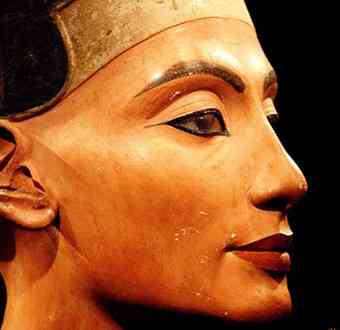
As wife of King Akhenaten, Nefertiti was queen of Egypt’s 18th dynasty and played a prominent role in Egyptian worship of the sun god Aton or Aten. Her name means “the beautiful one has come,” and her legendary beauty is still evident in Egyptian reliefs and statuary.

Again from Discovery News: Archaeologists have unearthed the intact sarcophagus of Egypt's Queen Behenu inside her 4,000-year-old burial chamber near her pyramid in Saqqara.

French archaeologists working at Saqqara have unearthed the burial chamber of a 4,000-year-old queen, Dr. Zahi Hawass, secretary general of the Supreme Council of Antiquities (SCA), announced today. Badly destroyed, the 33-by 16-foot burial chamber belonged to Queen Behenu, wife of either King Pepi I or Pepi II of the Sixth Dynasty. It was discovered as sand was removed from Behenu's pyramid in South Saqqara, west of the pyramid of King Pepi I.


Saturday, May 7, 2011

Cleopatra - Art Throughout The Ages

The Greek writer Plutarch first wrote about her in a book called Parallel Lives sometime around 100 AD. He said she met Antony "at the very time when women have the most brilliant beauty and are at the acme of intellectual power". The Roman historian Cassius Dio went further. She was, he said: "a woman of surpassing beauty".

But neither actually saw her and were writing long after her death. They spawned an enduring myth that has been sustained ever since by books, ballets, operas, films and paintings. She remains one of the most famous women in history.

William Shakespeare and George Bernard Shaw both wrote plays about her famous romances, and these have inspired a continuing flow of other dramatic portrayals.

Most great actresses seem to have played Cleopatra at some stage in their careers and she has featured in films since the dawn of the silver screen.

Wednesday, March 23, 2011

Egyptian Queen Has Wart

King Tut's grandmother, the powerful and beautiful Queen Tiye, might have had an unattractive flat wart on her forehead, according to a mummy expert.

Located between the eyes, the small protuberance was found on the mummy of the so-called Elder Lady (KV35EL). Boasting long reddish hair falling across her shoulders, the mummy was identified in February 2010 by DNA testing as Queen Tiye, the daughter of Yuya and Thuya, wife of Amenhotep III, and mother of Akhenaten.

The skin growth had gone unnoticed until Mercedes González, director of the Instituto de Estudios Científicos en Momias in Madrid, spotted it looking at the mummy during a visit to the Cairo Museum.