Tuesday, April 24, 2012

The First Stiletto


The ancient Greeks depicted Aphrodite in elevator shoes. Centuries later, Venetian courtesans clopped around in towering chopines, while during the reign of Louis XIV, red heels were a mark of nobility. But it was after World War II that the stiletto took hold. Soldiers who spent years abroad dreaming of high-heeled pinups, one historian wrote, came home to wives whose wartime work required more sensible shoes. As women returned to domestic life, higher heels could, and did, become all the rage. From the 1950s’ froth of experimentation, the stiletto was born.


Where Is Lyudmila Putina?


She will soon become Russia's First Lady for an unprecedented third time - but mystery is surrounding exactly who, and where, is Lyudmila Putina.

As her Kremlin strongman husband Vladimir prepares to once more take up his nation's Presidency, speculation is mounting as to why she is never seen by his side.

Some say an affair with spy-turned-lingerie model Anna Chapman, which has been strongly denied, is the reason the former Aeroflot-hostess is now rarely seen out in public.

Other tongues say he is still seeing former Olympic gold medallist Alina Kabayeva, claims also heavily rebutted, but who he was alleged to have fathered a child with.

A third theory is his 54-year-old love is 'locked away' in a £1million state-built guest house in the grounds of the ancient Yelizarov monastery outside Pskov - close to Estonia's border.


Treasures of Mary Queen of Scots


Rare treasures linked to Mary Queen of Scots are to be brought together for the first time for the biggest ever celebration of her life and legacy.

The National Museum of Scotland, in Edinburgh, will be showcasing rarely seen jewellery, portraits, documents and other personal possessions in a one-off exhibition which will only be staged in the capital, in the summer of 2013.
Curators are also promising it will shed new light on one of the most enigmatic figures in Scottish history.
George Dalgleish, keeper of Scottish history and archaeology at the museum, said: “I know that this will prove a hugely popular exhibition as there is a continuing fascination with her life story which has over decades been the subject of many books, plays and films.

Cleopatra's Twins

Giuseppina Capriotti, an Egyptologist at Italy's National Research Council, found the statues of the babies  Alexander Helios (Sun) and Cleopatra Selene (Moon) in the museum that were discovered  near the temple of Dendera on the west bank of the Nile in 1918, according to Discovery News.

The researcher identified the children as Alexander Helios and Cleopatra Selene, Antony and Cleopatra's twins, following a detailed stylistic and iconographic analysis published by the Polish Centre of Mediterranean Archaeology at the University of Warsaw.

Capriotti noticed that the boy has a sun-disc on his head,‭ ‬while the girl boasts a crescent and a lunar disc ("selene" = moon). The serpents, perhaps two cobras, would also be different forms of sun and moon, she said. Both discs are decorated with the udjat-eye, also called the eye of Horus, a common symbol in Egyptian art.

Wednesday, April 18, 2012

End To Foot Binding In China

From the Blaze:
Believe it or not there are still some Chinese women alive who practiced the ancient, incredibly bizarre tradition of binding their feet to prevent them from growing.

The feet of girls as young as 5 would be broken and bound tightly with cotton strips, forcing their four smallest toes to gradually fold under the soles to create a so-called 3-inch golden lotus, once idealized as the epitome of beauty.

Chinese men were hot for tiny Chinese lady feet, for some reason.

But not any more. Today there are only about 30 women alive in China who did this when they were younger.

See also a more in depth article in the LA Times.

Ancient Female Gladiator


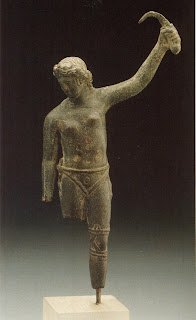
A small bronze statue dating back nearly 2,000 years may be that of a female gladiator, a victorious one at that, suggests a new study.


If confirmed the statue would represent only the second depiction of a woman gladiator known to exist.

The gladiator statue shows a topless woman, wearing only a loincloth and a bandage around her left knee. Her hair is long, although neat, and in the air she raises what the researcher, Alfonso Manas of the University of Granada, believes is a sica, a short curved sword used by gladiators. The gesture she gives is a "salute to the people, to the crowd," Manas said, an action done by victorious gladiators at the end of a fight.

The female fighter is looking down at the ground, presumably at her fallen opponent.


It’s not known where the statue was originally found, though it is currently in the Museum für Kunst und Gewerbein Hamburg, Germany.  

The rarity of such statues likely reflects the idea that female gladiators in ancient Rome were scarce. They were banned by Emperor Septimius Severus in A.D. 200 with only about a dozen references to them in ancient writing surviving to present day. The only other known depiction of them is a carved relief from the site of Halicarnassus (now in the British Museum) that shows two female gladiators fighting. There have been claims made in the past of burials of female gladiators being uncovered, but none has attracted widespread support among scholars.  

Indonesian Women Settle Madagascar

From the Jakarta Post:

A new research report shows that 30 women of Indonesian descent settled in Madagascar about 1,200 years ago, raising the possibility that the island nation was settled through a small, perhaps even unintended, transoceanic crossing, instead of a large-scale planned colonization.


The study titled “A small cohort of Island Southeast Asian women founded Madagascar” published by Proceedings of the Royal Society B reveals that Malagasy, a term that represents people living in the island located off the east coast of Africa, have biological and linguistic connections not only to east African populations but also to Southeast Asia, particularly Indonesia.

Herawati Sudoyo, a senior research fellow of the Eijkman Institute for Molecular Biology in Jakarta said on Monday that Malagasy people descended from the East and West as their ancestors came from both Africa and Indonesia.

Sunday, April 15, 2012

Lambayeque Priestess Found


Researchers at the Chotuna-Chornancap archaeological digs near the Peruvian city of Chiclayo have found the funerary remains of a woman who was a priestess of the Lambayeque or Sican culture, said the project director, Carlos Wester La Torre.

The preliminary conclusion of physical anthropologist Mario Millones is that this was a woman between 25-30 years old who lived during the second half of the 13th century A.D. in the waning days of that culture on Peru’s northern coast, whose most important historical figure was the Lord of Sipan, considered the Tutankhamun of America, in the 3rd century A.D.

The research, promoted by Peru’s Culture Ministry, got started eight months ago with an excavation that two months later came upon the tomb, but it wasn’t until a few days ago that the sex and age of the priestess were determined.

Friday, April 13, 2012

Jharkhand Women Still Witchcraft Victims

From the Daily Pioneer:
In a shocking revelation, a report released by Jharkhand Human Rights Movement 2001-2011, says every three days a woman becomes victim of crime related to witchcraft in Jharkhand. Jharkhand has reported 1,157 cases of murder between the year 1991 to 2010, where a woman was branded a witch and killed.

The report says that every third day a woman is persecuted under the garb of witchcraft. According to the facts and figures of Jharkhand State Legal Authority 175 women were branded as ‘witch’ and subjected to atrocities every year in Jharkhand.

Being the State capital, Ranchi registered the maximum number of cases of witchcraft. About 250 cases of witchcraft were registered in Ranchi during the past decade. On the other hand Godda, a backward district as compared to Ranchi registered only 11 cases.

Witchcraft is a never ending story in Jharkhand. Illiteracy, lack of awareness and medical facilities are the major reasons behind this. Ojhas (witch doctors) play an important role in this medieval practice.