Showing posts with label noble women. Show all posts

Sunday, April 30, 2017

Noblewomen in the Wars of the Roses by Lauren Johnson

I chanced upon this rather informative blog post by Lauren Johnson (October 2013) regarding the status of noblewomen who lived through those turbulent times known as The Wars of the Roses. It formed part of her masters thesis The impact of the Wars of the Roses on Noblewomen, 1450-1509 (October 2007).

Here is a little teaser:

However, for every man directly involved in the Wars of the Roses there were numerous female relatives who were not only themselves affected by the conflict, but played an active part in it. 
On the contrary, efforts to claw lands back to one’s family by battling through the law courts or pleading with prominent powerholders were deemed essential to those involved, and at a time when many men found themselves on the wrong side of the law or battlefield, and thus lost their authority (or their life), it fell to their wives and mothers to try to save their estates.
Read more of this and other interesting posts @ Lauren's Blog

Sunday, March 19, 2017

Medieval Mongolian Noblewoman Found In Compost Pit

Couple unearth remains of 'rich' female buried up to 1,000 years ago with her rare Chinese bronze mirror.

Natalia Filina, 31, and her husband were digging in their garden when they hit stones. In the hole they were digging as a compost pit, they found not only a skeleton but also a bronze mirror some 9.9 centimetres in diameter and 0.5cm thick. Police called in the Institute of Mongolian, Buddhist and Tibetan Studies in Ulan-Ude, and experts found additional remains. 

The medieval woman was lying in a wooden coffin made of log, covered with birch bark. The bronze mirror is believed to date to the 10th to 13th centuries, which perhaps indicates the age of the burial. Detailed tests will be carried out to determine when she lived.

Read Article from December 2015 @ The Siberian Times

Monday, February 27, 2017

Lady of Dai

A Chinese woman was preserved for around 2,100 years and is baffling scientists. She is called the Lady of Dai, and is considered to be one of the best-preserved mummies ever found.
Her skin is still soft, her legs and arms can bend, her internal organs are still intact. She has even retained her Type-A blood. Somehow she still has her own eyelashes and hair.
The Lady of Dai is also known as Xin Zhui. She lived during the Han dynasty from 206 BC through 220 AD and was the wife of the Marquis of Dai.
Her tomb was found inside a hill known as Mawangdui, located in Changsha, Hunan, China. The burial site was found in 1971 when workers were digging an air raid shelter.
Read More Here @ the Vintage News

Saturday, October 15, 2016

Ancient Bling In Tomb of Chinese Woman

Ancient Bling: Exquisite Jewelry Found in Tomb of Chinese Woman

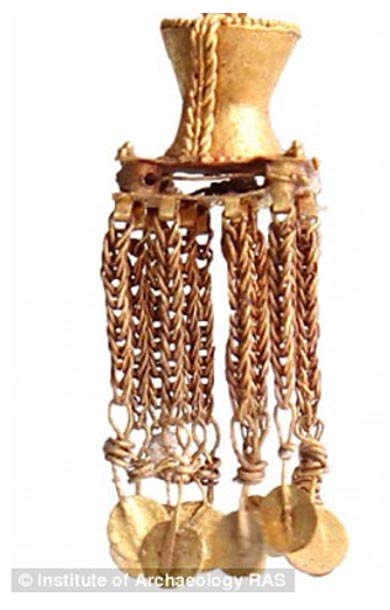
Around 1,500 years ago, at a time when China was divided, a woman named Farong was laid to rest wearing fantastic jewelry, which included a necklace of 5,000 beads and "exquisite" earrings, archaeologists report.
Her tomb was discovered in 2011 in Datong City, China, by a team of archaeologists with the Datong Municipal Institute of Archaeology who were surveying the area before a construction project. The researchers excavated the tomb, conserved the artifacts and reconstructed the necklace.
Her epitaph, found by the tomb entrance, reads simply, "Han Farong, the wife of Magistrate Cui Zhen" (as translated in the journal article). In China, the surname is traditionally written first and the given name second.
While no other burials were found in Farong's tomb, the archaeologists did discover two other tombs nearby that are in the process of being studied.
Read more at Yahoo! News


Wednesday, July 13, 2016

Archaeologists Unearth Thracian Princess Grave

Archaeologists Unearth Thracian Princess Grave Rich with Jewelry and Mythic Meaning | Ancient Origins
The remains of an ancient Thracian noblewoman that was ritually dismembered has been unearthed along with bronze and silver jewelry buried with her in a rock tomb in the Rhodope Mountains in Bulgaria.

Researchers are speculating the “Thracian princess,” as she is being called, was torn apart after death during ceremonies linked to the Orphic mysteries about 2,300 years ago. Dismemberment was not a mark of disfavor but rather an honor accorded to Thracian nobility and clerics.

The woman had a Greek silver coin that was possibly placed under her tongue as an obol or offering to Charon, the mythical figure of Greece, Rome and Thrace who ferried the dead across the rivers Styx and Acheron into their afterlife in Hades.

The body of the woman was in five pieces with her skull propped up on two rocks and sitting on a silver tiara, says the blog Archaeology in Bulgaria. The ancient people hewed her grave into the rock of the mountains. The archaeologist who discovered the burial, Assistant Professor Lyubin Leshtakov of the National Institute and Museum of Archaeology in Sofia, speculates there may be a necropolis or rock mausoleum there and hopes to find more graves, the blog states.
Continue reading entire article at Ancient Origins

Saturday, July 2, 2016

Unique Tomb of Viking Power Couple

Unique Tomb Found in Denmark Contains Remains of Viking Power Couple - History in the Headlines
A large burial ground located at HÃ¥rup in southwest Denmark is the site of the latest striking find from the Viking world. The wooden building, originally discovered in 2012 by engineers building a highway, was later identified as a 10th-century Viking tomb known as a dødehus (death house). Judging from the grave markings and items found with the remains, archaeologists have concluded that the man and woman buried in the tomb were likely noble–or at least highly distinguished–and had international connections.

The unique wooden structure found in Hårup and identified as a Viking dødehus, or death house, measures some 13 by 42 feet and contains three graves dating to 950 A.D. In the main part of the building, archaeologists found the remains of a man and a woman; the third grave, which appears to have been added later, contained the remains of a second man.
Read More at HISTORY

Tuesday, August 25, 2015

Priceless treasure hoard found in 1st century grave of Sarmatian woman in Russia

Priceless treasure hoard found in 1st century grave of Sarmatian woman in Russia | Ancient Origins


Archaeologists doing exploratory digging for an airport in Russia have found the grave of an apparent noblewoman with very valuable items, including a sword and knives, gold and silver jewelry, elaborately decorated clothing, a bronze mirror and a decorated bronze bucket. The 1st century AD grave is of the Sarmatian people, whose women are believed to have inspired Greek accounts of the warrior-women Amazons.


“It is interesting that there are two burials in this mound,” archaeologist Roman Mimokhod told the Mail the Russian Academy of Science's Institute of Archaeology. “One obviously belonged to a man and was totally looted. We found only some fragments of crockery and scattered bones. We will check the bones, but we are almost sure it was some noble man. The second burial belonged to the woman. We believe that it was a double burial of some noble Sarmatian and his wife.”

He said the discovery of the arrowheads is indirect confirmation of ancient historians' relating that Sarmatian women were involved in hostilities and battle. In addition, there was a harness, indicating she may have been a horse rider.

Tuesday, September 20, 2011

Ancient Thracian Burial

From Novinite:
The archeological team, led by Daniela Agre, has discovered a treasure during digs at a Thracian mound near the southern village of Borisovo, in the vicinity of the town of Elhovo.

The precious items were placed in the tomb of a wealthy Thracian woman and are from the end of the 1st – beginning of the 2nd century AD, the Bulgarian 24 Chassa (24 Hours) daily.

They include a set of luxury bronze dishes, a large round plate and a caldron, all decorated with ivy leaves. There is also a vessel, looking like a small bucket with a lid, which the archeologists say has no analogue in finds in Bulgaria, and a bronze box for toiletries with incrusted bronze busts of satyrs.

The team, however, is the most enthusiastic about another discovery, according to 24 Chassa – a set of ornaments from the chariot of the buried woman. Illegal treasure hunters have dug and nearly destroyed the chariot, but were unable to find the ornaments, which had, actually, been their goal.

Thursday, March 5, 2009

Egyptian Royal Granddaughter

From Times Online:
"Archaeologists have unearthed the 3,000-year-old tomb of an Egyptian noblewoman in the necropolis of Saqqara, south of Cairo. The Japanese team believes that the tomb belongs to Isisnofret, granddaughter of Ramses II, the 19th Dynasty pharaoh who reigned over Egypt from 1304BC to 1237BC.

The tomb contained a broken limestone sarcophagus bearing the name of Isisnofret, three mummies and fragments of funerary objects.

The archaeologists’ team leader, Sakuji Yoshimura, said that the find was made near the tomb of Prince Khaemwaset, a son of Ramses II. “Prince Khaemwaset had a daughter named Isisnofret [and] because of the proximity of the newly discovered tomb . . . it is possible that [it] is the daughter of Khaemwaset,” he said.

However, Zahi Hawass, who heads the Egyptian Supreme Council for Antiquities, said he believed the tomb dated from the 18th dynasty because of the style of construction."


And from IOL:
"Japanese archaeologists have unearthed an Egyptian noblewoman's 3 000 year-old tomb in the necropolis of Saqqara south of Cairo, the antiquities department said on Tuesday.

The Japanese team believes the tomb belongs to Isisnofret, a granddaughter of Ramses II, the famed 19th Dynasty pharaoh who reigned over Egypt for about 68 years from 1304 to 1237 BC, and who is said to have lived to the age of 90.

The tomb contained a broken limestone sarcophagus bearing the name of Isisnofret and the title "noble woman", three mummies and fragments of funerary objects, the department said in a statement.

Isisnofret's last resting place is in an area of Saqqara where a team from Waseda University were excavating the tomb of Prince Khaemwaset, a son of Ramses II, it quoted Japanese team leader Sakuji Yoshimura as saying."


And from Yahoo News:
"Japanese archaeologists have unearthed an Egyptian noblewoman's 3,000 year-old tomb in the necropolis of Saqqara south of Cairo, the antiquities department said on Tuesday.

The Japanese team believes the tomb belongs to Isisnofret, a granddaughter of Ramses II, the famed 19th Dynasty pharaoh who reigned over Egypt for about 68 years from 1304 to 1237 BC, and who is said to have lived to the age of 90.

The tomb contained a broken limestone sarcophagus bearing the name of Isisnofret and the title "noble woman", three mummies and fragments of funerary objects, the department said in a statement.

Isisnofret's last resting place is in an area of Saqqara where a team from Waseda University were excavating the tomb of Prince Khaemwaset, a son of Ramses II, it quoted Japanese team leader Sakuji Yoshimura as saying.

"Prince Khaemwaset had a daughter named Isisnofret (and) because of the proximity of the newly discovered tomb to that of the prince, it is possible that the owner of the sarcophagus is the daughter of Khaemwaset," he said.

However, Egyptian antiquities chief Zahi Hawass told AFP he believes the tomb dates from the 18th dynasty instead of the 19th, because of the style of construction.

Hawass also dismissed the "similarities in the names" saying that there were many women called Isisnofret in ancient Egypt."


Wednesday, May 23, 2007

Alice of Jerusalem-Champagne

Alice (Alix) of Jerusalem-Champagne (d.1246)
Queen of Cyprus, Regent of Jerusalem

Alice was the daughter of Queen Isabella and her second husband Henry of Champagne. She was the sister of Philippa of Champagne, and half sister of Maria of Montferrat, and Sibylla and Melisende of Lusignan.

Alice married (1208) Hugh, son of Amalric of Cyprus/Amalric II of Jerusalem (also her step-brother as his father was her mother's fourth husband), the arrangements being made by her grandmother Maria Comnena and dowry provided by Blanche of Navarre, Countess of Champagne.

Alice was the mother of Henry of Cyprus, and Isabella and at least one other daughter. Her husband Hugh took over government of Cyprus (1210/11) from his sister Burgundia and her husband Gautier de Montbeliard, who were regents during his minority. Both she and her husband were crowned in Nicosia.

Although there is no evidence that their marriage was stormy, her husband Hugh was a young man with a fiery temper, and his relations with the papacy, his vassals, and the church were constantly stormy. Her husband was devoted to providing firm government and order in Cyprus. Hugh went to Acre with troops from Cyprus (Sept 1217) and left for Tripoli with the crusading army (3 Nov 1217) under King Andras (Andrew) of Hungary. After the sudden death of her husband Hugh at Tripoli (10 Jan 1218), Alice acted as regent for her 8 month old son Henry in Cyprus (1218). Alice was also the aunt of Yolanda (1225), the daughter of her half-sister Maria of Montferrat, and titular Queen of Jerusalem.

Alice entrusted the government of Cyprus to her uncle Philip of Ibelin, but relations between the two were far from happy, and she constantly insisted that her wishes not taken into consideration. The open breach was not far in the coming (1223), and Alice retired angry to Tripoli. It was in Tripoli that Alice met and married Bohemond V, the eldest surviving son of Bohemond IV of Antioch. Alice attempted to appoint her new husband as "Bailli" (Constable) - but this was not accepted by the nobles. She then offered the position to Amalric of Barlais, however, John of Ibelin was confirmed in his appointment as "Bailli" of Cyprus (1227).

In Jerusalem, Frederick II, Holy Roman Emperor was recognized as suzerain but not regent of Cyprus (1228) in his capacity as the husband of the young Queen Yolanda. On the death of Yolanda, Alice travelled to Acre to put forward her claim to Crown of Jerusalem (1229). By now Alice was divorced (1229) on grounds of consanguinity (she and Bohemond were third cousins), and her claims to the throne of Jerusalem were rejected. Alice became reconciled with her Ibelin cousins. She married Ralph, Count of Soissons (1240). As she was the great-aunt of King Conrad of Germany, who succeeded to the throne of Jerusalem but who had failed to come East to accept throne, Alice was entrusted with regency of Jerusalem (1243) - she was then aged 50. The regency passed to her son and heir Henry, King of Cyprus, on her death (1246).

~~~ Melisende (first pub:1998 - Women of History)