Showing posts with label american history. Show all posts

Thursday, September 15, 2016

Victoria Woodhull - Candidate For US President

From: The Times Leader:
Nearly a century and a half before Hillary Clinton, a fiery activist from Ohio became the first woman nominated for U.S. president.
Victoria Woodhull’s varied and colorful life makes her difficult to pigeonhole. The suffragist, medium, businesswoman, stockbroker and newspaper publisher was “Mrs. Satan” to some, a visionary champion of women’s and children’s rights to others.
She rode motorcycles, preached “free love” and followed the guidance of an ancient Greek orator she believed had presented himself to her as a spirit guide.
The Equal Rights Party nominated Woodhull to face incumbent Republican Ulysses S. Grant in 1872 and Democrat Horace Greeley, nearly 50 years before women had the right to vote. At 34, she was a few months shy of the required age, but most historians still view her nomination and run as the first.
Woodhull lost, of course, but by how much is unclear.

Read rest of article here at The Times Leader

Tuesday, January 3, 2012

Books for 2012

In The Wicked Wives by Gus Pelagatti, we are given the opportunity to look into the lives of a group of both women and men that were responsible for the murders of the women's husbands in the 1930s. The story is based on a true set of crimes, and the strange and unethical reasons understate how little it takes for someone to cross over to the side of murder. During this time in Philadelphia, the scandal resulted in seventeen wives being arrested for murdering their husbands. It would take one man to stand up for the victims and uncover the acts that would bring justice.


Medical historian Louise Foxcroft explains in her new book, Calories and Corsets: A History of Dieting over 2,000 Years. Foxcroft fixed on the topic of weight-loss schemes after speaking to a friend who's a medic. "She said that whenever she gives talks, as soon as she mentions diet drugs, everybody in the audience perks up. I thought that was so interesting, so I decided to see if I could use the history of dieting to throw light on the assumptions we make about our health."


A Train in Winter is the story of brave women hailing from villages and cities of France united in their hatred and defiance against their Nazi occupiers. The book is based on interviews with these women, their families and brings to surface the historical archives and documents held by World War II resistance organisations covering this darkest chapter of human history. When Moorehead began writing this book, seven of the women were still alive and she talked to the ones whose health allowed them to. Moorehead has heavy relied upon interviews with survivors and their relatives giving this overlooked corner of history a new urgency and meaning.


Monday, September 26, 2011

Quakers: Burqa Wearers of the 17th Century

In 1630, a certain oatmeal maker was examined by the highest church court in England, accused of preaching without a licence. Before an audience of bishops, he kept his hat firmly on his head. Doffing it momentarily to a secular representative, he turned again to the bishops, crying: "But as ye are rags of the Beast, lo! – I put it on again." Refusal to observe "hat honour" – the custom of removing one's headgear in the presence of a social superior – was a way of saying, in the most confrontational manner: "I reject your authority." (In the case of the oatmeal maker, this was an especially radical rejection: the bishops were agents of Antichrist.) It was a gender-specific affront, since hat-doffing was a peculiarly masculine form of humiliation.

Hat dishonour and burqa-wearing are not, of course, the same thing at all. But they do both illustrate the symbolic power of head-covering, and its relationship to political "headship". Twenty years or so after the case of the oatmeal maker, following civil war and the collapse of traditional pillars of social stability (the monarchy, and the church courts), the early Quakers also famously rejected hat honour. This was a prophetic sign not only that unjust inequalities were being dissolved, but that men were subject to the authority of God alone. Keeping one's head covered was a provocative statement of dissent towards the entire system of deference and consent which apparently held together English society.

Thursday, September 1, 2011

Female Companionship 1880s - 1890s

As in most mining camps, Juneau and Douglas had its "girls" who "provided relaxation and companionship" for the male population, whether they were miners or businessmen.

Booming Alaska mining towns, such as Nome and Fairbanks, had their stockades to confine the girls and their cribs to a specific area. Ketchikan designated Creek Street as the red light district. But in early Juneau there was no street of sin. Most prostitutes worked the saloons on Front Street. It was in later years, especially after 1912, when the Alaska Juneau mill was under construction and in the years it operated, that most of the prostitutes congregated on South Franklin Street. Over in Douglas, most of the fallen doves operated in dwellings clustered along the beach in that part of town. Many frequented the dance halls and saloons in town.

Juneau and Douglas apparently tolerated this profession. I found only one criminal case in Alaska from 1884 to after 1900 in which prostitution was the sole crime. It was filed against Joseph Gregory of Sitka who was charged in 1892 with "setting up a house of ill fame for purposes of prostitution." But except for the necessary papers to bring the charge before the court, the case file is empty. Why wasn't Gregory fined or jailed? Others were not so lucky when liquor was involved.

Saturday, August 27, 2011

Anniversary of 19th Amendment

Today is the 91st anniversary of the 19th amendment to the US Constitution taking effect, giving women the right to vote. It's a milestone in the Women's Suffrage Movement in the United States and one that still resonates with modern women.

Saturday, August 6, 2011

The Missing 400 Roswell Women

From 11 Alive:
This is the 150th year since the beginning of the American Civil War. So much conflict history surrounds Atlanta and North Georgia.

Just down the road from a myriad of strip shopping centers in Atlanta and Roswell is a story of unimaginable suffering.

The Allenbrook residence in Roswell, owned by the family of Roswell King, served as the home of the Ivy Woolen Mills Superintendant.

In 1864, the mills were churning out 191,000 yards of cloth and 30,000 yards of "Roswell grey" uniforms made by hundreds of white and black women.

General Sherman ordered General Gerrard to arrest the 400 women and their 300 children and charge them with treason, he said " let them foot it."

The Union soldiers rounded up the southern women and quarantined them in Roswell's Square until early August. Then they marched with children in tow 10 miles to Marietta.

In Cobb County, women and children were put on railcars shipped north of the Ohio River with nine days of rations and dumped.

Many died, many were never seen again.

Saturday, July 23, 2011

Women Survivors of The Alamo

In a July 10 column, reader Richard Villanueva asked if there were other female survivors of the siege and battle of the Alamo besides his great-great-great-grandmother Andrea Castañon Villanueva. Known as Madam Candelaria, the innkeeper's wife lived more than 100 years and became legendary for telling generations of reporters and tourists her stories of having nursed Texian defenders.

Like several figures associated with this engagement, Madam Candelaria is not considered by some historians to have been a survivor of the Alamo because she came and went at will, rather than being confined to the compound from Feb. 23, 1836, when Mexican troops first fired on the fort, through the March 6 battle.

However, historian Dora Elizondo Guerra counts her among seven women survivors, all related to men fighting with the Texians.

Guerra, a former librarian at the DRT Library on the Alamo grounds, recently researched the battle's noncombatants. Her list corresponds closely to the individuals named in the Handbook of Texas entry on Alamo noncombatants.

Tuesday, June 14, 2011

The Woman Who Started The US Civil War

From Salon:

When Harriet Beecher Stowe published "Uncle Tom's Cabin" in 1852, the American slave trade was a thriving institution. The courts condoned it and, as Southerners were quick to claim, so did the Constitution and the Bible. Twelve American presidents had been slave owners, and the abolitionist movement was fragmented and marginal.

But Stowe, a seminal figure in American liberalism, had a knack for making radical concepts palatable to the general public, and her novel became one of the first genuine pop culture phenomena in American history. Within 10 years of its publication, the United States devolved into civil war. And as historian David S. Reynolds argues in "Mightier Than the Sword," a new book that explores Stowe's life and the global impact of her work, it was "Uncle Tom's Cabin" that catalyzed the conflict.


Monday, June 13, 2011

Mysterious Life of Lydia Bryant

About two years ago Susan Sherwin was indulging in a favorite pastime — looking at headstones at Longview Memorial Park where she works — when a pair of dates made her do a double-take: Lydia Bryant 1845-1972.

To help piece together this mystery, Sherwin turned to Sandy Rountree, whose prodigious volunteer research created the annual Memorial Day page in The Daily News. Rountree began looking into Bryant's background to hopefully learn her true age.

"I didn't think it would be hard," Rountree said. "Little did I know it would take two years."

Tuesday, June 7, 2011

Book: Women & Slavery In America

From News Wise:
Women and Slavery in America: A Documentary History, edited by Catherine M. Lewis and J. Richard Lewis has been published by the University of Arkansas Press.

The edited collection offers readers an opportunity to examine the establishment, growth and evolution of slavery in the United States as it impacted women — enslaved and free, African American and white, wealthy and poor, northern and southern. The primary documents — including newspaper articles, broadsides, cartoons, pamphlets, speeches, photographs, memoirs, and editorials — are organized thematically and represent cultural, political, religious, economic and social perspectives on this dark and complex period in American history.

Sunday, May 15, 2011

Confederate Women - Two Stories

Recently, folks here recognized a lady not too well-known when her burial place in Fairmount Cemetery was singled out for special honors by the local chapter of the Sons of Confederate Veterans.

Mamie Ann Yeary is a special person to folks researching Civil War materials, records and documents.

Despite being handicapped throughout her life, over the years she compiled a fantastic volume of personal stories told by veterans of the conflict.

The book, published in 1912, is titled "Reminiscences of the Boys in Gray, 1861-1865." It's 904 pages and contains memoirs submitted to her by Confederate veterans living in Texas at the time of its writing.


Another woman who did more than her share during that brutal war was Isabelle (Belle) Boyd, an actress and Confederate spy. Although she was a native Virginian, her varied career brought her to Texas at least twice.

Her first trip to the Lone Star State came when she performed on stage at Houston and Galveston theaters. Later, she settled for a time in Dallas.

In 1861, Belle shot and killed a Union soldier who broke into her home.

Saturday, May 7, 2011

Four Women Western Writers

From New West:
When we did the Western Literature Association survey of Most Important Authors, very few women made the list. Willa Cather got her fair share of votes. Mari Sandoz was the next favorite, followed by Leslie Silko and Mary Austin. After that came such names as Amy Tan, Sandra Cisneros, Pam Houston, Terry Tempest Williams and Ann Zwinger. With the exception of Cather, none had sufficient support to be called "important".

For my list of significant Western women writers, I chose the four I find most unforgettable, four women I have spent many evenings with and who belong in the library of any well-read Westerner.
  • Mary Hunter Austin
  • Willa Catha
  • Mari Sandoz
  • Dorothy Jackson

Friday, May 6, 2011

The Woman in the Sunbonnet

From RGJ.com:
If it weren't for the courageous, long suffering pioneer women who left their families to come West in the mid1800s, Nevada's earliest history, particularly around Dayton, might have been lost.

Although Abner Blackburn, a pack train guide for Mormon pioneers, documented his adventures in the 1840s, including finding Nevada's first gold at the mouth of a nondescript desert canyon (Gold Cañon) in 1849; it was the ladies who recorded daily life on a 2,000-plus mile journey from home.

Historians say Lucena Pfuffer Parsons's diary is one of the most geographically accurate, comprehensive histories of the Western migration.

The hand-written journal of her 1850-1851 journey from Wisconsin to Salt Lake City, Gold Cañon, Utah Territory, (Nevada), onto Oakland, California, is preserved in the Stanford University Special Collections Library.

Lucena's diary lay hidden until her oldest daughter Ellen Maria, the first white child born in Oakland, Calif., discovered it in 1928.

Thursday, April 21, 2011

Film - The Conspirator

From Gateway:
"The Conspirator" is the story of Mary Surratt (Robin Wright), the only woman charged as a co-conspirator in the killing of President Lincoln, and the mother of John Surratt, one of the eight conspirators that included John Wilkes Booth. The 28-year-old Fredrick Aiken is a Union solider who recently returned from the war and is just beginning to practice law. His mentor, Reverdy Johnson (Tom Wilkinson) asks him to take the case. He is reluctant at first but soon begins to see the injustices in Surratt's military tribunal.

This movie isn't just about the execution of Surratt. Though it plays like a legal thriller, you never get that David and Goliath feel. History has told us how this story ends, and it's fairly clear from almost the first courtroom scene that Aiken has no chance of winning.

Saturday, March 26, 2011

Remembering The Triangle Fire

It was a warm spring Saturday when dozens of immigrant girls and women leapt to their deaths — some with their clothes on fire, some holding hands — as horrified onlookers watched the Triangle Shirtwaist factory burn.

The March 25, 1911, fire that killed 146 workers became a touchstone for the organized labor movement, spurred laws that required fire drills and shed light on the lives of young immigrant workers near the turn of the century.

The 100th anniversary comes as public workers in Wisconsin, Ohio and elsewhere protest efforts to limit collective bargaining rights in response to state budget woes. Labor leaders and others say one need only look to the Triangle fire to see why unions are crucial.


Monday, March 14, 2011

American WASPS

From Utah News:
Within months after the Japanese attack on Pearl Harbor on Dec. 7, 1941, the U.S. Army Air Force, faced with an acute shortage of male pilots, decided to use women in domestic aviation to relieve their male counterparts for combat.

This was a first for the military. They knew little about women’s adaptability, attitudes, strength or psychological bearings. So they turned to world-renowned pilot Jacqueline Cochran, who created in-country ferrying and training programs including aerial navigation, target towing, assimilated bombing missions and conveyance.

Cochran had broken international speed and altitude records. President of the Ninety-Nines, an international organization of women pilots, she was a member of the Wings for Britain, delivered military aircraft from America to England and became the first woman to pilot a bomber across the North Atlantic.

Actively recruited, 25,000 young women stepped forward to volunteer, and about 1,800 were accepted into the program. Learning to fly “the Army way,” 1,074 graduated into the Women Air Force Service Pilots, or WASPS.

Wednesday, February 23, 2011

Memorial: Triangle Waist Company Factory Fire

From the New York Times:
In the Cemetery of the Evergreens on the border of Brooklyn and Queens, there is a haunting stone monument to the garment workers who died in the Triangle shirtwaist factory fire of 1911 but were never identified. It contains the bas-relief figure of a kneeling woman, her head bowed, seemingly mourning not only the deaths, but also the fact that those buried below were so badly charred that relatives could not recognize them.

Almost a century after the fire, the five women and one man, all buried in coffins under the Evergreens monument, remained unknown to the public at large, though relatives and descendants knew that a loved one had never returned from the burning blouse factory.

Now those six have been identified, largely through the persistence of a researcher, Michael Hirsch, who became obsessed with learning all he could about the victims after he discovered that one of those killed, Lizzie Adler, a 24-year-old greenhorn from Romania, had lived on his block in the East Village.

Saturday, February 12, 2011

WWII's Female Computers

From CNN News:
It was 2003 and Erickson was interviewing sisters Shirley Blumberg Melvin and Doris Blumberg Polsky for her documentary, "Neighbor Ladies," about a woman-owned real estate agency that helped to peacefully integrate a Philadelphia neighborhood. The twins, long-retired by then, reluctantly mentioned a different sort of job they'd held during World War II: Female "computers."

Computer, at that point, was a job title, not a machine. Long before the sisters were businesswomen, community activists, mothers or grandmothers, they were recruited by the U.S. military to do ballistics research. They worked six days a week, sometimes pulling double or triple shifts, along with dozens of other women.

The weapons trajectories they calculated were passed out to soldiers in the field and bombardiers in the air. Some of their colleagues went on to program the earliest of general-purpose computers, the ENIAC.

It wasn't factory work, but they were "Rosies" nonetheless, filling jobs that men would've taken if they hadn't been at war or wrapped up in other military research.

Friday, January 14, 2011

Wiyohpiyata: Lakota Images of the Contested West


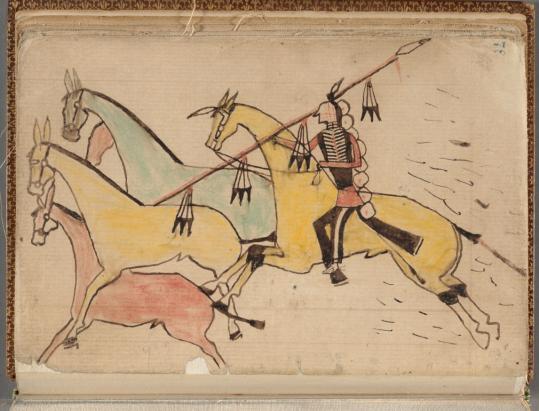
About five years ago, the librarians at Harvard University’s Houghton Library realized they had something special on their hands: a Plains Indian ledger book, filled with drawings made by Lakota Sioux of their battle exploits. Ledger drawings — pictographic art made by Plains Indians in the 19th century, often in accounting books acquired from Euro-Americans — are not uncommon artifacts, but it is unusual to find them bound in their original context.

The book, a goldmine of a historic document, launched research resulting in “Wiyohpiyata: Lakota Images of the Contested West,’’ an exhibit at Harvard’s Peabody Museum of Archaeology and Ethnology co-curated by the museum’s Castle McLaughlin and Butch Thunder Hawk, a Lakota artist who teaches at the United Tribes Technical College in Bismarck, N.D. It’s a riveting dip into Lakota warrior culture, which imbued warfare with spirituality, illustrating how one particular band of Lakota weathered the history of westward expansion sweeping across the Plains, pitting native warriors against US forces.


Sunday, December 26, 2010

Confederate Girlhoods: A Women's History of Early Springfield

For the most part, history is written by men and about men. So, it was refreshing and enlightening for me to participate in a roundtable discussion at the Carnegie Midtown Library of a new book about a history of Springfield written from the perspective of women.

The book, "Confederate Girlhoods: A Women's History of Early Springfield," Missouri, was published by Moon City Press, part of the English Department at Missouri State University. It brings together in one volume many of the letters, memoirs, family histories, stories, journals, photographs and newspaper clippings in the Campbell-McCammon Collection at The History Museum for Springfield-Greene County.

The Campbell-McCammon women reveal their "struggles, disappointments, joys, courage, determination, and sorrow," writes Greene County Associate Commissioner Roseann Bentley in her foreword to the book. At a time when about the only things available to women were teaching, marriage, and writing the women stood resolutely for temperance, preservation of historical places, education, business opportunities, dignity and honor for the dead, entrepreneurship and improving the lives of women.