Monday, April 22, 2019

How Women Are Leading the Sudanese Revolution

From Common Dreams
Since December 2018, protests in Sudan that sparked over the tripled price of bread have turned into nationwide protests against the nearly three-decade rule regime of Omar Al Bashir. 

Bashir’s government has used repressive tactics and measures to quell the protests. More than 40 protesters have been killed, hundreds detained and tortured.

The brutal response did not stop women from placing themselves firmly at the heart of the protests.
They lead the march chanting a Zagrouda, an ululation commonly used by women in the Arab world to express celebration.

During the month of March, women wore the traditional white thobe in support of the protests and women’s rights. Social media platforms filled with pictures of female protesters wearing the white robe, using the hashtag #whitemarch  (#مارس_الابيض)

Women who protest regularly face police brutality. Authorities have fired tear gas and live ammunition and have even threatened with rape. Women have also reportedly been beaten, their faces have been branded and their hair cut off inside detention centers. Every day new footage of Sudanese women getting beaten and humiliated circulates on social media.

read more here @ Common Dreams

What We Thought We Knew About Gender In Ancient Egypt Could Be Wrong

From IFLScience
According to a study published in the journal Bioarchaeology of Marginalized People, the teeth of a 4,000-year-old woman show distinct patterns suggesting she was a craftsperson. Many have assumed this profession was restricted to men at the time. 

The oddity was discovered during a routine analysis of a collection of bones held at the University of Alberta. Like others in the collection, those of the woman were excavated in Mendes, an ancient Egyptian city in what is now Tell El-Ruba. But while the others were given a burial style that suggests they were middle class, she was found in a more elaborate wooden coffin, complete with a bronze mirror, alabaster vessels, and cosmetics. 

But that was not all that was unusual.

read more here @ IFLScience

An Ancient Roman Convert to Judaism Who Became a “Mother of the Synagogues” » Mosaic

From Mosaic
In the first centuries of the Common Era, many Roman Jews buried their dead in elaborate catacombs, many of which can still be seen today. One sarcophagus bears the name of Beturia Paulina, whom the inscription—from the 1st century CE—describes as having converted to Judaism sixteen years prior to her death at age eighty-six. Carly Silver writes:

Based on her name, [Beturia Paulina] likely grew up worshiping the gods of the Roman empire. Her epitaph was written in Greek transliterated into Latin. . . . As many converts to Judaism do today, Beturia Paulina adopted a name from the Jewish tradition. The epitaph mentions her as nominae Sara, or “(going) by the name of Sara.” . . . .
Perhaps most intriguingly of all, Beturia Paulina received the title of mater synagogarum Campi et Volumni, or “mother of the synagogues of Campus and Volumnius.” This terminology is multifaceted. For one thing, it implies that the idea of the synagogue . . . as a gathering place for people of the Jewish faith existed throughout Italy. And networks of synagogues existed throughout Rome itself, creating links among communities of the faithful. Campus, or “field,” probably refers to the geographic location of one center of worship, perhaps the synagogue near the Field of Mars. [Most likely, the second] synagogue was named for an individual or family called Volumnius. . . .
So Beturia Paulina was clearly closely associated with multiple synagogues in Rome. But what does her title, “mother of the synagogues,” refer to? The late historian Louis Feldman suggested that such monikers were given to women—independently of men—who gave generously to the synagogues in question. [Another] scholar, Bernadette Brooten, posited that their contributions very well might have gone beyond the monetary. Perhaps these women worked actively in these communities as leaders.

Saturday, April 6, 2019

“A girl without education is nothing in the world”

By the time she was 13 years old, Vumilia had supported herself through primary school by collecting and selling firewood. Now she faced an even greater challenge. After weeks of anxiety, Vumilia left home at 4.30 a.m. to walk the 10 km to secondary school; she had no pencils, no uniform and no money to pay her school fees.

Twelve-year-old Husna had no choice but to leave school to work, helping to support her grandmother and siblings on her US$14 a month working as a housemaid. Husna would wonder what lay ahead of her: “I was imagining that my life would be horrible. Because even if I stopped being a maid,where would I go? What would I do?”

Catherine also saw a bleak future. After the death of her father, her uncles took her family’s land. Some days Catherine would manage to go to school; on others she would sell food by the roadside. “I would see other children studying and all the time I would just look at their exercise books and try to learn. I was imagining my future as going into a big hole where no one could help me. A girl without education is nothing in the world. Education is everything.”

Vumilia, Husna and Catherine all live in Tanzania in East Africa. With an economy based largely on agriculture, Tanzania has among the lowest rate of secondary school enrolment in Africa. Many girls from poor, rural families can’t afford the cost of going to secondary school and leave home to become ‘house girls’ in urban centres. There, they sometimes experience abuse and exploitation, returning home infected with HIV, or pregnant. Sadly, Catherine’s prediction of a desperate future is all too accurate.

Image result for camfedFortunately for Vumilia, Husna and Catherine, they are now among over 40,000 Tanzanian girls who in the past decade have been helped into secondary education by the non-profit organisation Camfed (Campaign for Female Education), with whom the REAL team has a research partnership.

read more from University of Cambridge

Sunday, March 31, 2019

Lucetta Scaraffia resigns from Vatican women's magazine over pressure

The founder and staff of an all-female monthly Vatican publication have stepped down en masse, citing what they call a newly difficult work environment and a Vatican attempt to undercut the women’s voices on sensitive issues, including sexual abuse of nuns.

“The whole newsroom has resigned,” Lucetta Scaraffia, who launched Women Church World seven years ago, said in a phone interview.

Scaraffia was known as a comparatively liberal voice inside the city-state’s ancient walls, advocating for a larger role for women in the church and, more recently, devoting editorial space to the long-hidden issue of the abuse of nuns by clergy members.

But Scaraffia said she perceived discomfort with her publication’s work, and she noted that the Vatican’s newspaper, L’Osservatore Romano, had been publishing pieces that contradicted the Women Church World editorial line. She said her publication’s editorial freedom had also been threatened with an “attempt” to put L’Osservatore Romano’s new top editor, Andrea Monda, in charge of Women Church World.

Saturday, March 16, 2019

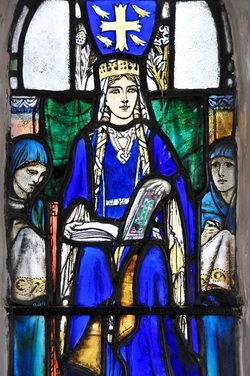
Shoulder bone of Scots hero St Margaret removed by archaeologists

From The Scotsman
Image result for st margaret of scotland
Part of St Margaret’s shoulder bone has been removed from its reliquary by archaeologists seeking to find out more about the life of one of Scotland’s most venerated figures.

The experts will use 3D scanning technology to try to discover more about the 11th century Queen of Scotland’s lifestyle, as well as producing an exact replica which people can hold without fear of breaking an ancient artefact. St Margaret, known as the Pearl of Scotland, led a pious lifestyle and gave much help to the poor, as well as introducing refinements to the country, such as the first use of knives and forks. Now, Lauren Gill from the University of Glasgow and Martin Lane from Cardiff Metropolitan University have had the opportunity to begin researching the holy relic which is kept in an ornate reliquary at St Margaret’s RC Memorial Church in Dunfermline.

After being made a saint by Pope Innocent IV, a shrine was built at Dunfermline where she laid intact until the 16th century when Mary, Queen of Scots asked for her head to be sent to her, to bring her help as she gave birth to her son who would become James VI. Her head was then taken to a Jesuit College in Douai, France, but was never seen again after the French Revolution. As the Reformation threatened to destroy Catholic churches and abbeys the rest of her body had been secreted away in the 16th century, ultimately being taken to Escorial Monastery by Philip II of Spain.

read more here 


One year after her assassination, Marielle Franco’s spirit energizes Rio’s struggles for justice

One year on from the brutal assassination of Rio de Janeiro city council member Marielle Franco, enduring questions about who ordered the hit have become a rallying cry for the marginalized groups she championed.

A 38-year-old black gay politician who was born in Rio’s poverty-stricken Maré favela, Franco was a tireless opponent of the city’s use of heavily armed paramilitary militias. The militias police the city’s sprawling favelas, and have often been accused of violently terrorizing and murdering the city’s poor and LGBT citizens.

This week, two former police officers with connections to President Jair Bolsonaro were charged with killing Franco. One suspect, Ronnie Lessa, lived in the same condominium where Bolsonaro owns a home. The other, Elcio Vieira de Queiroz, has a photo of himself embracing Bolsonaro on his Facebook page. And according to police, the daughter of one of the suspects had dated one of Bolsonaro’s sons, who are both politicians themselves.
Image result for marielle franco
Activists allege that the former policemen were likely employed as contract killers on behalf of the militias, which Bolsonaro and his sons strongly support. Bolsonaro’s failure to condemn Franco’s murder — as well as his numerous comments and policy decisions targeting women, gays, and black Brazilians — have infuriated the late council member’s supporters.

read more here

Monday, March 11, 2019

Russian archaeological find solves 13th-century mystery

From Phys Org News
Rescue archaeology work conducted in the city centre of Yaroslavl prior to installing a new sewer system has turned up an ancient leaden seal from the turn of the 13th century. It once belonged to the spouse of Vladimir Grand-Prince Constantine Vsevolovodich and the mother of the first Grand-Prince of Yaroslavl (Vasilij Vsevolodovich, Duke Of Yaroslavl). Thanks to this find, we finally know the name of the Grand-Duchess—her name was Maria (or quite possibly: Marina Olgovna Princess Of Kursk, 1211-1279).

"In Ancient Rus, everyone in a position of authority—Grand-Princes and Princesses, and the upper ranks of the clergy—had their own seal, which was affixed to all official documents and decrees. We have several thousand such seals from the pre-Mongolian era—but to find one with a female owner is very remarkable indeed. Scientists are only aware of a few dozen examples," said Dr. Pyotr Gaidukov, Deputy director of the Institute of Archaeology.

Dr. Gaidukov is a leading authority on stamps and seals of Ancient Rus, and is responsible for the attribution of the latest find.

Russian archaeological find solves 13th-century mystery

The seal was found in Yaroslavl during preliminary work for putting through a new sewerage system to the Metropolitan bishop Chambers (Mitropolichy Palaty)—the oldest structure in the city. Yaroslavl's city centre has only recently marked its thousandth anniversary—it is a Federal-level Heritage Site that also falls under UNESCO Heritage Protection.

This special status means that any building work in the centre of the city must first undergo archaeological inspection.

Read more 

Kenya: Married Women Get Nod to Inherit Their Fathers' Land

A court ruling asserting that married women qualify to inherit properties of their fathers and should not be excluded during distribution has stirred debate between defenders of women's and men's rights.

The ruling was made by the Environment and Land Court in Nyeri, and stopped a woman from disinheriting her step-daughters. Justice Lucy Waithaka held that married daughters are also entitled to inherit their father's estate, contrary to customary law and many traditions in the country. "Even children born out of wedlock have a right to inherit their parents' property," she added.