Sunday, November 5, 2017

Rose Bertin: The Most Famous French Fashion Designer

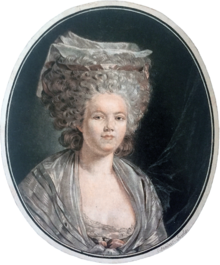
Image resultMarie-Jeanne Rose Bertin was the first most famous French fashion designer best-known as the dressmaker and milliner to Queen Marie Antoinette.  Rose was introduced to the Queen in 1772. After the coronation of King Louis XVI, Bertin showed twice a week in Marie Antoinette’s home and presented her the newest creations.

The Queen fell in love with Rose’s creations; she adored every detail which she designed, and in short time, they became good friends. The French women began to pouf their hairs in the 18th century and started to wear oversized gowns with many luxurious details. In that fashion, Bertin designed her own poufs and exaggerated them a little, for example, she made poufs for the Queen which were three feet high.

read more here:


Mathematician Emmy Noether Should Be Your Hero

From the Smithsonian:
Amalie Emmy Noether, born on this day in 1882, has been called a “creative mathematical genius.” She battled sexism throughout her career and just, frankly, loved math—something not many of us can say about ourselves. 

Working at a time when physics and mathematics were transforming, Noether’s best-remembered work on mathematical constants drew on Einstein’s 1915 general theory of relativity, which completely changed those disciplines. It’s known today as Noether’s theorem.

read more here:

Burial Chamber of Princess Possibly Found in Ancient Egypt Pyramid

Inside a 3,800-year-old pyramid at the site of Dahshur in Egypt, archaeologists have discovered a burial chamber that may have held the mummy of a princess named Hatshepset. A wooden box inscribed with hieroglyphs was also found within the chamber.  The discoveries provide clues that may help archaeologists determine why a pharaoh named Ameny Qemau has two pyramids at Dahshur.
The wooden box is inscribed with "Hatshepset," which likely does not refer to the pharaoh Hatshepsut but rather someone else with a similar name, the researchers said. Last month, another inscription, written on an alabaster block, was also found in the pyramid. That inscription bears the name of pharaoh Ameny Qemau (also spelled Qemaw), who ruled Egypt for a brief period around 1790 B.C. It's the second pyramid that has an inscription bearing the name Ameny Qemau that is known from Dahshur. The other Ameny Qemau pyramid was discovered in 1957 and is located nearly 2,000 feet (about 600 meters) away from the recently discovered pyramid.
read more here @ Live Science

Pregnancy complication took the life of this woman from Ancient Troy

From CBS News:
Death during pregnancy or childbirth would have been common in the ancient world, but these stories are often invisible in the archaeological record. However, in a new study of ancient DNA, researchers reported evidence of a woman who died of a pregnancy complication — specifically, a fatal bacterial infection — 800 years ago at Troy.
The woman was about 30 years old when she died, in the 13th century A.D. She was buried in a stone-lined grave at a Byzantine-era farming community’s cemetery in Troy, the ancient city located in what is now northwest Turkey, immortalized by Homer in the “Iliad.”
“It looks like the bug that caused her disease was in a different niche than what we see associated with human infections today… We speculate that human infections in the ancient world were acquired from a pool of bacteria that moved readily between humans, livestock and the environment.”
read more here @ CBS News

Promoting the rights of girls and women

Article from The Daily Star:
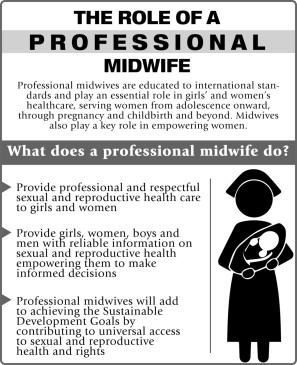
The situation for girls and women in Bangladesh is changing for the better, especially in terms of economic participation. The past decades have brought in significant improvements, including in terms of labour force participation or access to better sexual and reproductive health care, as evidenced by a drop in maternal mortality ratios. However for women from poor, marginalized communities, and those living in remote locations, reproductive health related morbidity and mortality remains a serious challenge.
One pivotal approach to achieving the SDGs is the development of a cadre of professional midwives and integrating them into the national health system. Professional midwives are globally recognized as experts on sexual and reproductive and as champions of rights of women and girls. Professional midwives combine ancient traditions of advocating for, and nurturing women, with modern science and technology.
read more here @ The Daily Star

Stone Age Woman Had Modern-Looking Face

The pretty face of a woman who lived more than 13,000 years ago in what is now Thailand, and is considered a likely descendant of the first humans to populate Southeast Asia, is seeing the light of day.

Scientists have created a digital reconstuction of the woman's face based on skeletal remains found in 2002 in the Tham Lod rock shelter in northwest Thailand. Though fragmented, the remains included the bones of the skull and teeth. 

A Thai research team, led by Rasmi Shoocongdej, a professor of archaeology at Silpakorn University in Bangkok, established that the bones belonged to a woman who was probably between 25 and 35 years old and 5 feet tall (152 centimeters). 

read more here @ Live Science

Carbon dating confirms ‘Penang Woman’ is 5,710 years old

The human skeleton excavated at Guar Kepah in the north of Seberang Perai and dubbed “Penang Woman” is 5,710 years old based on radiocarbon dating, local archaeologist Professor Datuk Mokhtar Saidin said.
“The radiocarbon dating confirmed the skeleton is about 5,710 years plus or minus 30 years Before Present, BP,” he told Malay Mail Online in an interview yesterday.
The skeleton is the first and only remaining Neolithic skeleton found in a shell midden in Malaysia.
read more here @ Malay Mail Online

Searching for Truth in Bones: The Mysterious Relics of Mary Magdalene


Mary Magdalene is one of the most fascinating people from the times of Jesus. Although every year there are more and more people who follow her as if she were a super-heroine, her story has been misunderstood for centuries. But modern discoveries about her are helping to put her back in the right place in history. Her relics are located in different parts of the world and are a link between this mysterious woman and her modern followers.
The role Mary Magdalene played in Jesus’ life is still uncertain, however, it seems that she was an important companion. We don't know too many things about her life, but even the bible confirms the strong bond between Mary and Jesus - much stronger than between his other students. It is well depicted in the scene when Mary Magdalene recognizes him after the resurrection, according to John (20:17): ''Jesus said to her, “Do not cling to me, for I have not yet ascended to the Father; but go to my brothers and say to them, ‘I am ascending to my Father and your Father, to my God and your God.’”

read more here @ Ancient Origins

Ingenious Girl Makes Idiom Dictionary Illustrated with Paper-cuttings


A 17-year-old girl who was diagnosed with nephrotic syndrome at the age of 9 has devoted great efforts to making an unusual idiom dictionary illustrated with paper-cuttings since her summer vacation.  The ingenious girl Liu Yu comes from Chengdu, capital of southwest China's Sichuan Province.
"Currently, people have attached great importance to traditional culture. I think idioms are an aspect of our culture and it is more interesting to use paper-cuttings to explain idioms. Meanwhile, the art form can be passed down," Liu said.
In the process of making the dictionary, she chose some idioms that are easy to understand for young children and she also noted the source of the idioms and some examples.
To date, she has made paper-cuttings of 103 idioms and she is expected to complete the dictionary by the end of next year. The young woman hopes that some publishing houses will help her publish it.