Sunday, November 17, 2019

Poisoning Agnes Sorel

From CrimeReads
On a cold winter’s day, twenty-eight-year-old Agnes Sorel, the most beautiful woman in France, lay dying in the tidy stone manor house of the Abbey of Jumièges, some eighty miles northwest of Paris. She often traveled there to give moral support to her lover of many years, King Charles VII of France, in his ongoing campaign against English invaders. But this journey had an added impetus. Though the details are unclear, Agnes urgently wanted to warn the king of a plot against him. Whatever she told him, however, her royal lover didn’t take it seriously.
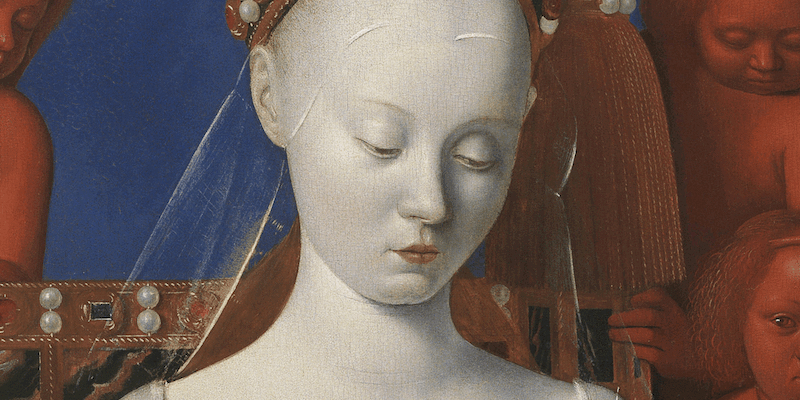

Shortly afterward, she went into premature labor and gave birth to her fourth child with the king. While her other three pregnancies had produced full-term, healthy offspring, this child died soon after. Now, on February 9, 1450, Agnes was tortured by a “flux of the belly”—nonstop diarrhea. After two or three days of agony, she whispered of her ravaged body, “It is a little thing and soiled, and smelling of our frailty,” and closed her eyes forever.

Rumors flew immediately that the Lady of Beauty, as Agnes was known, had been poisoned. A 2005 exhumation of Agnes’s mortal remains has revealed off-the-charts levels of mercury poisoning—between ten thousand and a hundred thousand times higher than normal.

read more @ CrimeReads

Hyde Park bridge named for abolitionist, suffragist Grimke sisters

From Universal Hub
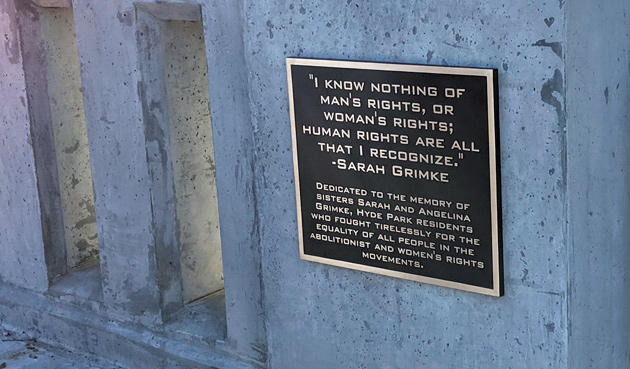
Sign with inspirational quote from Sarah GrimkeCity officials and local historians and residents gathered at the former Dana Avenue Bridge in Hyde Park this morning to officially rename it as the Grimke Sisters Bridge in honor of two 19th-century sisters who fought for both the abolition of slavery and for women's rights to vote - and who on March 7, 1870 led a march of women to Hyde Park Town Hall to vote in the town elections, the first time women voted in the US - although the town then discarded their ballots.

The sisters, children of a prominent South Carolina slave owner, fought for ideals "that were dangerously radical, even among reformers," such as that all people are equal and deserve the same rights as white men, Catherine Allgor, president of the Massachusetts Historical Society, said. At a time when "racism ran deep in the United States," even among white reformers, "they were attacked on all sides, they were denounced in pulpits all up and down the East Coast," she said.

She added that Sarah Grimke specified she was not asking for special treatment by men. "All I ask from our brethren is that they take our feet off our necks," words later made famous by then lawyer Ruth Bader Ginsburg.

read more here @ Universal Hub

Abortion Is an Unwinnable Argument

From The Atlantic
In 1956, two American physicians, J. A. Presley and W. E. Brown, colleagues at the University of Arkansas School of Medicine, decided that four recent admissions to their hospital were significant enough to warrant a published report. “Lysol-Induced Criminal Abortion” appeared in the journal Obstetrics & Gynecology. It describes four women who were admitted to the hospital in extreme distress, all of them having had “criminal abortions” with what the doctors believed to be an unusual agent: Lysol. The powerful cleaner had been pumped into their wombs. Three of them survived, and one of them died.

Image result for lysol abortion

We will never know how many women had abortions via this method, or how many died because of it. Why was Lysol, with its strong, unpleasant smell and its corrosive effect on skin, so often used? Because its early formulation contained cresol, a phenol compound that induced abortion; because it was easily available, a household product that aroused no suspicion when women bought it; and because for more than three decades, Lysol advertised the product as an effective form of birth control, advising women to douche with it in diluted form after sex, thus powerfully linking the product to the notion of family planning.


read more here @ The Atlantic

The Quandary Regarding Female Genital Mutilation Persists in Kenya

From IR INSIDER
A ritualistic practice dating back to Ancient Egyptian Civilization around the 5th century BCE, female genital mutilation (FGM) has risen among the most hotly contested human rights predicaments over the past hundred years. From vehement condemnation on the part of the international community, to fervent support in practicing countries of retaining a longstanding tradition, legal measures taken to cut or continue the custom have been largely indecisive, ineffective and ambiguous amongst nations of the developing world.

In 2011, the Government of Kenya felt it time to become an exception to this ambiguity. The Kenyan government passed the Prohibition of Female Genital Mutilation Act, unconditionally banning FGM in all parts of the state. Violation of this law carries an obligatory three-year prison sentence for all parties implicated. By prohibiting mutilation, this legislation is perceived by many as a long-awaited escape route for girls and women being coerced into pure barbarism, on the sole basis of tradition. 

Tatu Kamau, a female Kenyan physician, publicly objects to this law and the logic behind it. Currently, Kamau is appealing to the high courts of Kenya, arguing the option of FGM should be made open to females above the age of 18. According to Kamau, once reaching adulthood, the female has a fundamental right to do what she wishes with her body. Nobody, she argues, including the government, should have the authority to make decisions that “infringe on a woman’s right to exercise her cultural beliefs.”

read more here @ IR INSIDER

Will feminism be a crime in Mohammed bin Salman's Saudi Arabia?

This week, feminism in Saudi Arabia was declared to be a crime punishable by imprisonment and lashing. 

The Saudi state security agency’s video announcement defined feminism as an extremist position, imported from the West to assert that men and women have equal rights in economic, social and political matters. 

According to this definition, feminists allegedly aim to eradicate differences between the sexes, abolish marriage and family, and encourage same-sex unions. The Saudi definition lumped feminism in with other forms of “extremism”, including atheism, homosexuality and promiscuity. 

10 Prohibitions for Women in Saudi Arabia That Are Hard to Believe

Facing a backlash, the Saudi regime soon declared that the video had been the result of an employee’s mistaken interpretation, but it is unlikely that such an outrageous announcement was a mistake. 

Could it have been an attempt to embarrass the crown prince by the old deep state of his rivals? Or could there be government employees who genuinely believe that feminism is akin to terrorism? We may never find out, but the confusion reflects the contradictions that beset this regime, amid its ostensible attempts at reform and promote women’s empowerment.

read more here @ Middle East Eye

Sunday, November 3, 2019

POLL - 81% back idea of Japan having female emperor

From Kyodo News

A whopping 81.9 percent of respondents to a Kyodo News survey over the weekend said they are in favor of the idea of Japan having a female emperor, while 13.5 percent indicated they are opposed.

Concerns persist over the stability of Japan's imperial succession, as the 1947 Imperial House Law stipulates that only males of the patrilineage can ascend the throne.

Following the enthronement of Emperor Naruhito, 59, the family now has only three heirs -- the emperor's younger brother Crown Prince Fumihito, 53; the crown prince's son Prince Hisahito, 13; and Prince Hitachi (Masahito), 83, the uncle of the emperor.


Emperor Naruhito and Empress Masako have a daughter -- Princess Aiko, 17 -- and there are other females in the imperial family, but the Imperial House Law requires women to abandon their imperial status after marrying commoners. 

Regarding whether to allow heirs of female lineage to ascend the throne, 70.0 percent in the poll supported the idea, while 21.9 percent were against it.


read more here @ Kyodo News

'Little Miss Sumo' wrestles sexism in Japan's ancient sport

From Reuters
A young wrestler dubbed “Little Miss Sumo” is fighting sexism in the ancient Japanese sport, hoping to inspire other women to step into the ring and elevate sumo to Olympic status.

Hiyori Kon is the focus of a new Netflix documentary “Little Miss Sumo”, which tracked her attempts to take on sporting inequality in a society that lags on all manner of women’s rights.

Popularly regarded as Japan’s national sport, sumo pits two giant wrestlers, clad only in loinclothes, in a test of brawn and skill waged - with crouches and charges - inside a ring floored with clay and edged with straw bales.

Image result for little miss sumo trailer

But tradition in a sport that began more than 1,500 years ago forbids women from entering the ring as the space is sacred and any female presence is considered a pollutant.

“Even if you are faced with someone who is big and strong - it’s not something to run away from, but engage with - like in the sumo way,” said 22-year-old Kon when asked how other wannabe but wary women wrestlers should take up the sport.

read more here @ Reuters

Scientists reconstruct face of 1,000-year-old Viking warrior woman

Scientists have re-created the face of a female Viking warrior who lived more than 1,000 years ago. 

The woman is based on a skeleton found in a Viking graveyard in Solør, Norway, and is now preserved in Oslo's Museum of Cultural History.

While the remains had already been identified as female, the burial site had not been considered that of a warrior 'simply because the occupant was a woman', archaelogist Ella Al-Shamahi told The Guardian

But now British scientists have brought the female warrior to life using cutting-edge facial recognition technology. 

read more here @ Daily Mail Online

Scientists reconstructed the face of the female warrior who lived more than 1,000 years ago by anatomically working from the muscles and layering of the skin

Saturday, November 2, 2019

Why is Emily Wilding Davison remembered as the first suffragette martyr?

“She paid ‘the price of freedom’. Glad to pay it — glad though it brought her to death (..) the first woman martyr who has gone to death for this cause.” In the context of the women’s suffrage campaign who do you think was the subject of this eulogy? Was it Emily Wilding Davison, the centenary of whose death is being honoured this June?

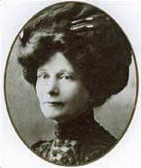
Mary Jane Clarke.jpgUnlike Emily Davison, Mary Clarke was not merely a member of the WSPU, but one of its inner circle, fully involved in the campaign from its early days, twice imprisoned after taking part in deputations, and, from mid-1909, based in Brighton as a paid organizer. Her final imprisonment came at the end of November 1910; she had thrown a stone through the window of a London police station. On 23 December, on her release from Holloway, she spoke at a WSPU ‘welcome’ luncheon and two days later, aged 48, died of a brain hemorrhage attributed to the strain of her prison sentence. Her sister, Emmeline, was at her side when she died.

read more here @ OUP Blog