Saturday, December 30, 2017

Mistress, Miss, Mrs or Ms: Untangling the shifting history of titles

In a paper published in the autumn issue of History Workshop Journal Dr Amy Erickson unravels the fascinating history of the titles used to address women. Her research reveals the subtle and surprising shifts that have taken place in the usage of those ubiquitous M-words. 

It seems that it was not society’s desire to mark either a woman’s availability for marriage (in the case of ‘Miss’), or to mark the socially superior status of marriage (‘Mrs’) which led to the use of titles to distinguish female marital status. Rather, socially ambitious young single women used ‘Miss’ as a means to identify their gentility, as distinct from the mere businesswoman or upper servant.

“’Those who objected to ‘Miss’ and ‘Mrs’ argue that they define a woman by which man she belongs to. If a woman is ‘Miss’, it is her father; if she is addressed as ‘Mrs’, she belongs to her husband,” says Erickson. “It’s curious that the use of Ms is often criticised today as not 'standing for' anything. In fact, it has an impeccable historical pedigree since it was one of several abbreviations for Mistress in the 17th and 18th centuries, and effectively represents a return to the state which prevailed for some 300 years with the use of Mrs for adult women – only now it applies to everyone and not just the social elite.”

read more here @ University of Cambridge

Friday, December 29, 2017

New Renaissance: how Florence is freeing its great female artists

From The Guardian:

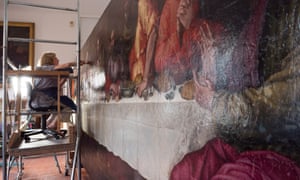
Unfairly neglected … Rossella Lari restores The Last Supper by Plautilla Nelli.
Rossella Lari restores The Last Supper by Plautilla Nelli.
Ask most people to name a female artist, and chances are they will come up with a contemporary figure: Tracey Emin, Rachel Whiteread or Paula Rego. Or they’ll name a 20th-century artist such as Frida Kahlo, or Georgia O’Keeffe. What they won’t do, though, is name one of the 16th- or 17th-century women who painted during and in the years following the Renaissance. Nelli is one of many female artists – including Artemisia Gentileschi, one of the most accomplished followers of Caravaggio, and Marietta Robusti who learned from her father Tintoretto – that history has unfairly neglected.

Now, though – nearly half a millennium on – that is beginning to change. AWA, which was established in 2009 by US philanthropist Jane Fortune, is committed to rediscovering all the works by women that lie forgotten in the museum attics and churches of Florence: at least 2,000 so far. When a painting is found, crowdfunding and special appeals pay for its restoration.

read more here @ The Guardian and here @ AWA (Advancing Women Artists)


Tuesday, December 26, 2017

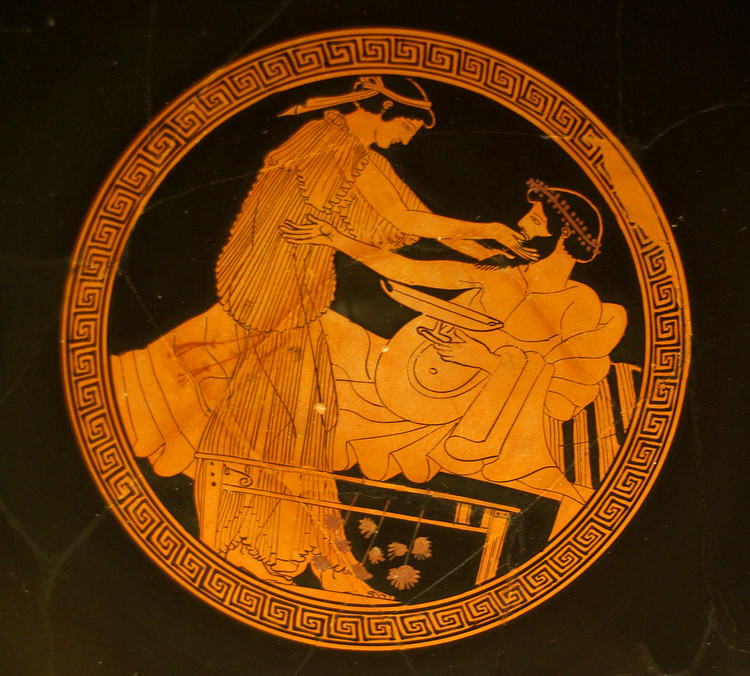
Elite companions: sex work in ancient Athens

When the Athenian politician Pericles delivered his famous Funeral Oration at the end of the first year of the Peloponnesian War (431-404 BC), commemorating those who had fallen during the course of the year, a rumour emerged that his companion, Aspasia was the real author. Other hetairai, like Neaira, were put into the trade as children and trained for a life of satisfying wealthy clients. 

The lives of other girls and women reveal the hardships they faced. In addition to hetairai, there were those who worked their whole lives (until they were of no further use) in brothels. The price of women varied according to their age and condition and the quality (or lack thereof) of the business. As the hetairai were trained in the skills required to please men, women in brothels were sometimes modified to suit certain male tastes.

read more here @ The Conversation

Celebrating Mary Somerville: the Queen of Science

Mary Fairfax Somerville: despite little formal education, she was determined to understand the natural world.When the Royal Bank of Scotland (RBS) issues its new ten-pound note towards the end of 2017, the 19th century’s “Queen of Science” will surely inspire new generations in her homeland. But the legacy of self-taught mathematician Mary Fairfax Somerville reaches way beyond Scotland: she was a brilliant translator of science for the public and a passionate advocate for women’s education.

The RBS’s new polymer note shows Mary as a young woman; but she was 50 years old by the time she shot to fame in 1831, after the publication of her cutting-edge Mechanism of the Heavens. Academics were astounded: it was said that no more than five men in Britain were capable of writing such a demanding book, based as it was on the work of leading French mathematician Pierre-Simon Laplace. It was a phenomenal achievement for a woman who taught herself science and mathematics at a time when most universities did not admit females. Mechanism of the Heavenswas not just a momentary curiosity; it was used as a textbook in Cambridge’s advanced mathematical astronomy classes for the next century.

read more here @ Cosmos Magazine


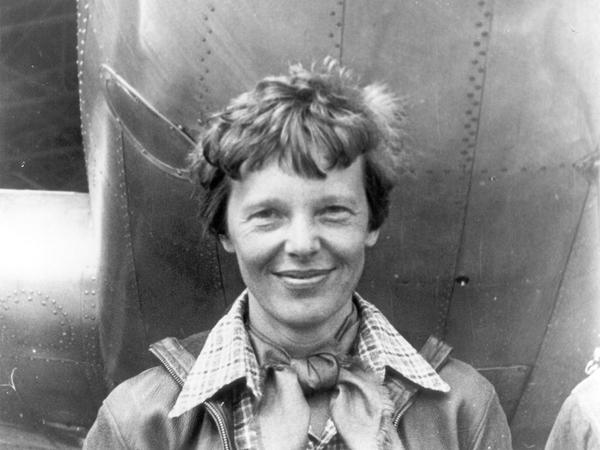
Forensic Dogs In Search For Amelia Earhart

"Forensic dogs have been able to detect graves that are thousands of years old,” Pettigrew said. “So finding something 80 years old doesn't sound to me like a stretch."

Pettigrew said the dogs "alerted at the very spot" where the search organizers theorize Earhart expired, but a subsequent dig found no leftover bones. The crew collected soil samples at the site in a long shot bid to extract remnant DNA of the presumed castaway.

This summer's expedition was organized and led by Tom King, an archaeologist, author and TIGHAR board member from Silver Spring, Maryland. Besides the dog handlers and land-based excavation, King recruited an underwater search team.

read more here @ KUOW

Centuries-old ovarian tumour discovered

Archaeologists excavating a graveyard in Portugal have discovered an ovarian tumour that is hundreds of years old. 

The type of tumour, known as a teratoma, often contains a range of body tissues, such as hair and teeth, that form when cells that should become eggs instead develop into other tissues.

It was discovered at a graveyard next to the Church and Convent of Carmo, which is believed to have been used between the early 1400s and 1755, when it was badly damaged in an earthquake.

The discovery was made during excavation work of 42 graves in 2010 and 2011 but the tumour was only recently identified.


read more here @ The Independent

Sunday, December 24, 2017

The Ruthless Conquerer Who Cross-Dressed Her Way to Infamy

From OZY:

After 20 years of roaming the Americas brawling, gambling and murdering close to a dozen people, the man known as Alonso Díaz Ramírez de Guzmán had one last option. Having often turned to the church for sanctuary when waist-deep in trouble, and now facing execution, the soldier and explorer chose the nuclear option: admitting to the bishop that he was actually a woman.

Now known as Catalina de Erauso, a mesmerizing and confusing figure in Basque history, the prisoner not only avoided being executed but also got to meet the pope. Given the protection of Peru’s Bishop Agustín de Carvajal following an examination that determined she was not only a woman but also a virgin, Erauso was sent back to Spain, where she wrote a MEMOIR that remains eye-poppingly off-putting to this day.

read more here

@ OZY


Two Ancient Teenage Girls

For more than 12,000 years, the adolescent girl’s bones lay deep in a Mexican cave. Now analysis of her skeleton is revealing details of her harsh existence in the early Americas — which probably included pregnancy and childbirth before death at a young age.

The bones show that the girl, whom researchers nicknamed Naia, is likely to have travelled long distances on foot, but didn’t carry much on her journeys. The skeleton also reveals that Naia experienced severe and repeated nutritional stress that scarred her bones and teeth, according to results presented on 30 March at a meeting of the Society for American Archaeology in Vancouver, Canada.

For that work, divers examined Naia in the water-filled cavern in the Yucatán Peninsula where she was discovered in 2007. But intruders subsequently tampered with her remains. To prevent further meddling, the bones were gently carried out of the cave in 2014 and 2016 — which also gave scientists easier access to the specimens.


On a ranch near the Santa Maria River in northern Chihuahua, researchers have unearthed more than 18,000 artifacts, including thousands of stone flakes, cores, and hammers, along with 370 projectile points, and a dozen stone ovens.

rancho-santa-maria-skullBut the most surprising find has been the grave of a teenage girl, who was interred among the rocks, alone and unadorned, some 3,200 years ago.

Her remains, researchers say, may help unlock the history of the people who brought agriculture to this arid region, and who were the first known farmers of corn in the Chihuahuan Desert.


Archareologist Discover More About Peru's Moche Priestesses

Excavated tombs of Peru’s Moche priestesses provide archaeologists with troves of artifacts, dataFrom Phys Org:
When archaeologists unearthed a large chamber tomb in San José de Moro, a ceremonial center of pre-Columbian Moche civilization on the northern coast of Peru, they found the remains of a woman who had been laid to rest with lavish offerings, befitting a priestess or a queen or both.

The discovery of the splendid burial shattered archaeologists' notions about the Moche, which until recently had been perceived as a society ruled by male warriors, said Peruvian archaeologist Luis Castillo, the 2016 Robert F. Kennedy Visiting Professor in Latin American Studies Lecture.

The royal tomb, the eighth found in 25 years, was discovered by the San José de Moro Archaeological Program, which is shepherded by Pontifical Catholic University of Peru and headed by Castillo. All eight tombs showcased women wearing rich headdresses and beaded necklaces, and surrounded by sacrifice victims and exquisite relics including silver goblets.

Called the priestesses of San José de Moro, they highlight the prominent role of women in Moche society.

"These women were among the most important individuals in their society," said Castillo. "Their elaborate burials are narratives of their lives, and the ornaments they were buried with are indicators of their high status."

read more here