Monday, October 7, 2013
Six Century Old Murder Hunt Begins In Fife

Friday, January 21, 2011
Why We Should Always Give The Crown To A Women.
Given the impatience with which the Coalition has set about reforming everything from local government to the NHS, perhaps it’s not surprising that ministers have now got their teeth into the monarchy.
As the Mail reported earlier this week, it is considering amending the 1701 Act of Settlement so that a first-born girl can succeed the throne. Which means that if Prince William and Kate Middleton’s first child is a daughter, that baby would be our future queen.
Constitutional conservatives are up in arms — yet throughout our long royal history, the female of the species has generally proved far more competent than the male.
Saturday, January 1, 2011
Film: Rebel Queen
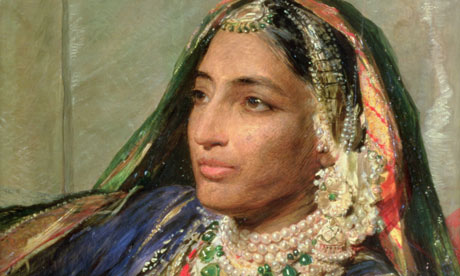
The film Rebel Queen tells the remarkable story of the last Sikh ruler of Lahore – a fearless Maharani who waged two wars against British rule in India. She is an inspiring figure for young Asian women today.
An Indian woman wearing a crinoline over her traditional clothes, and emeralds and pearls under her bonnet, walks in Kensington Gardens in 1861. She is the last Sikh queen of Lahore, the capital of the Punjab empire, and her name is Jindan Kaur. She died two years later, in 1863, and was buried in west London.
Maharani Jindan Kaur's life – much of which was spent raging against the British empire for cheating her out of the Punjab, then a vast country stretching from the Khyber Pass to Kashmir – is the subject of a film called Rebel Queen, which premiered at New York's International Sikh film festival and is set to be shown in the UK in February.
Thursday, December 16, 2010
Henri IV of France Identified
The skeletons of kings and queens lying in mass graves in the Royal Basilica of Saint-Denis in Paris could finally have the solemn funeral ceremonies they deserve, say experts in the Christmas issue published in the British Medical Journal.
Many of the graves in the Royal Basilica were destroyed by revolutionaries in 1793 and very few remains of the mummified bodies have been preserved and identified.
Dr Philippe Charlier led the scientific breakthrough that has identified the head of the French King, Henri IV.
A team of scientists from different fields of expertise including anthropology, pathology, forensic medicine and genetic studies worked together to make the identification.
Henri IV was known as the "green gallant" because of his attractiveness to women or "good King Henry" because of his popularity amongst his people.
Despite his popularity, Henri IV was assassinated in Paris at the age of 57 on 14 May 1610 by Francois Ravaillac, a fanatical Catholic. Along with the bodies of other French kings and queens, his remains lay in the graves of the Basilica of Saint-Denis, before the graves were desecrated and the corpses mutilated in the wake of the French Revolution.
The authors conclude that "similar methods could be used to identify all the other kings' and queens' skeletons lying in the mass grave of the basilica, so that they can be returned to their original tombs."
Monday, November 1, 2010
Review: The Man Who Believed He Was King of France
Thursday, May 14, 2009
Marriage and the Habsburgs
Members of the powerful Habsburg royal family ruled Spain for centuries until the dynasty died out at the beginning of the 18th century.
Now, a new study suggests the reason for their decline lies not in the stars but in themselves -- and their unfortunate habit of marrying their own relatives.
Ultimately, the genetic havoc caused by inbreeding appears to have doomed the Spanish Habsburgs to oblivion via infertility, scientists report in a research paper released last month.
"Inbreeding was a major cause responsible for the extinction of this dynasty" and also contributed to the deaths of many Habsburg children, said study co-author Francisco C. Ceballos, a researcher at the Universidad de Santiago de Compostela in Spain.
The study suggests that successive inbreeding contributed to the genetic diseases that turned the last Habsburg king, Charles II, into a mental and physical cripple who was unable to have children. Charles II reigned from 1665 until his death in 1700 at the age of 38.
The findings appear in a recent issue of the journal PLoS ONE.
Today, the Habsburgs are most well known for their domination of Europe over three centuries -- Charles II ruled not only Spain but Italy and much of what is now the Netherlands -- and for their oddly protruding jaws.
In Spain, the Habsburgs ruled from 1516 until 1700, when Charles II died without offspring, despite two marriages.
The family faced a challenge because they needed to marry Catholic spouses of equal rank -- a rarity -- and because dynastic marriages were used to keep territories within the family's grasp, explained Alan Sked, a historian at the London School of Economics and Political Science.
In their study, Ceballos and colleagues examined the Habsburg family tree through more than 3,000 people, going back 16 generations. They aimed to figure out how inbreeding -- cousins marrying cousins, for example, and uncles marrying nieces -- may have affected the family's health.
The team found that the final Habsburg ruler, Charles II, had a high chance of developing genetic abnormalities due to inbreeding. Indeed, he was physically stunted and suffered from a variety of intestinal and blood ailments, so much so that his subjects dubbed him "El Hechizado," or "The Hexed."
The study also suggests that interbreeding weakened the family's health so much that it contributed to an extraordinarily high death rate among children. From 1527-1661, 10 of 34 children in the Spanish Habsburg family died before the age of 1, and another seven died before they were 10. The researchers note that the death rate was much higher than would even be expected for children born in that era.
Overall, the Habsburgs' habit of inbreeding led to family members sharing up to 20 percent of identical genomic material, the researchers said.
The conclusion that inbreeding may have hurt the Habsburg family's health is a reasonable one because the odds of genetic disease rise when people marry their relatives, according to Andrew J. Bohonak, an associate professor of biology at San Diego State University.
Possibly as a result, "there are social taboos against inbreeding in most human societies," he said. "One of the few places you see these taboos avoided is in some of the royal families of old."
What would have happened if the Habsburgs hadn't married each other? Sked, the historian, said "there would have been changes in alliances, boundaries and policies. Most of all, the Habsburgs would have produced more capable and intelligent rulers."
Thursday, March 27, 2008
Richard I - I told you so
Now the "I told you so" part, courtesy of Helen Castor in an article - "Why Richard I Shared His Bed With the King of France" - (10th March 2008) for The Guardian:
"For the past half-century, Richard the Lionheart - that buff, bronzed warrior who hardly saw his wife and had no children - has been something of a gay icon. As a presence on the silver screen (most famously in the shape of the young Anthony Hopkins in The Lion in Winter) his homosexuality has rarely been in doubt.
English history isn't short of gay or bisexual monarchs - Edward II, James I, possibly William II - but the historical evidence for counting Richard I among their number rests on one contemporary document concerning his relationship with King Philip II of France. In 1187, a chronicler reports, the two men were so close that "at night the bed did not separate them".
Now, however, as the BBC prepares to air a new Lionheart docu-drama, the king's biographer, Professor John Gillingham, has pointed out that Richard's ostentatious bed-sharing with the French king was the product of a political alliance rather than a lovers' tryst.
Gillingham's suggestion that this was "an accepted political act, nothing sexual about it" might strain modern credulity - but we should remember that diplomacy has always been intensely personal, if not downright physical. Only this week, Jonathan Powell's account of the Northern Irish peace process has highlighted the significance of Tony Blair's decision to shake hands with Gerry Adams - the press of prime ministerial flesh on republican palm a powerful gesture of political intent.
In centuries past, a wider range of body parts might come into diplomatic play. Medieval rulers, for example, routinely greeted one another with a kiss (the biblically sanctioned "kiss of peace"). Richard's decision to share a mattress with Philip was the ultimate public demonstration of trust in an age when PR had to rely on word-of-mouth rather than the lenses of the international media.
And it worked, in the context of a monarchy where privacy was relative and political life didn't stop at the bedroom door. The king held court in his bedchamber, and his favourite servants slept at the foot of his bed. World leaders don't, any more, feel the need to ratify a treaty by getting into bed with each other - though, interestingly, that's still the language we use when we talk of sealing a deal. Perhaps we should just be grateful that, these days, the "special relationship" between the UK and the US doesn't involve seeing Bush and Brown in their underpants.
· Helen Castor is a medieval historian and author of Blood & Roses: the Paston Family and the Wars of the Roses."
So, those who would disagree riddle me this - why was it that only Richard was labeled gay and not Philip???