Showing posts with label childbirth. Show all posts

Saturday, June 25, 2022

Outrage: U.S. Supreme Court Takes Away Federal Constitutional Right to Abortion

The fears of millions were realized today, as the U.S. Supreme Court ended the federal constitutional protection of abortion — robbing people of the fundamental right to control their own bodies.

In a decision with devastating consequences, the court overturned Roe v. Wade — throwing out the 1973 decision that recognized abortion as a constitutional right, and handing politicians across the country the power to make decisions about our bodies, our lives, and our futures.

This historic action means the Supreme Court — now dominated by justices hostile to our freedom — is reneging on a constitutional right it previously granted.

Across the Country, Life-changing Implications
With the federal constitutional protection of our right to abortion now ended, states in more than half the country stand poised to ban abortion. That would leave 36 million women of reproductive age, plus even more people who can become pregnant, without access to abortion.
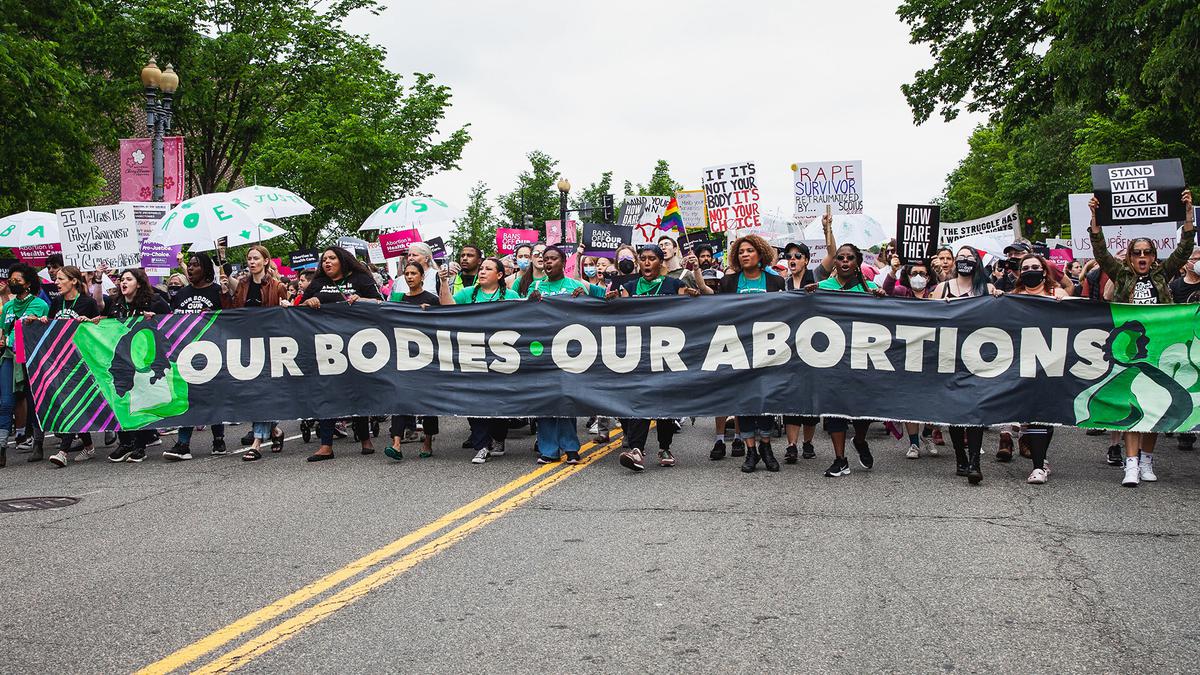

Through this ruling, the Supreme Court will force an unknowable number of people to choose between either traveling hundreds or perhaps thousands of miles for care, or remaining pregnant.

Make no mistake: This decision goes beyond abortion. This wrongful ruling is about power and control. What rights will this court take away next? Who has power over you, who has the authority to make decisions for you, and who can control how your future is going to be? It goes against the will of the American people and overturns nearly 50 years of precedent.
A Shameful Day

We’re outraged — and ready to fight like hell.
Everyone’s body is their own, and theirs alone. You must have the freedom and power to control your body and life. That means no judge, no politician, no ban should ever block your personal medical decisions or set the course for your life. Abortion access should not be based on your ZIP code, income level, or immigration status.

Abortion bans do the most harm in Black, Latino, and Indigenous communities and other communities of color, which already face barriers to health care and economic opportunity because of this country's legacy of systemic racism and discrimination. The court's ruling will add further insult to health disparities that have long plagued too many communities.

We’re Fighting Back
We vow this: The Supreme Court’s shameful decision won’t stop us. We will rebuild and reclaim the freedom that is ours.

It’s already crystal clear that these politicians plan to completely end access to abortion, one state at a time. For decades, narrow-minded politicians have built a coordinated strategy toward this moment. And politicians aim to outlaw abortion across the United States, no matter where you live. Texas and Mississippi are just the opening fronts in a campaign to destroy abortion access across the country.

Generations before ours fought tirelessly to gain and protect our rights. With this ruling, the next generation will have fewer rights — unless we fight on. Every day in every way, all of us must stop at nothing to make sure people have access to the essential health care they need to control their bodies and build their futures.

This is far from over. We have strength in numbers and power in our united voices.

Saturday, December 12, 2020

Abortion and Contraception in the Middle Ages

Today, conversations around abortion in modern Christianity tend to take as a given the longstanding moral, religious and legal prohibition of the practice. Stereotypes of medical knowledge in the ancient and medieval worlds sustain the misguided notion that abortive and contraceptive pharmaceuticals and surgeries could not have existed in the pre-modern past.

This could not be further from the truth.

While official legal and religious opinions condemned the practice, often citing the health of women, a wealth of medical treatises produced by and for wealthy Christian women across the Middle Ages betray a radically different history—one in which women had a host of pharmaceutical contraceptives, various practices for inducing miscarriages, and surgical procedures for the termination of pregnancies. When it came to saving a woman’s life, Christian physicians unhesitatingly recommended these procedures.


read more here @ Scientific American


Saturday, May 6, 2017

Birth Control and Abortion in the Middle Ages

The use of birth control and abortion have a long history, and a long history of being contentious. The idea that pregnancies can be prevented or stopped has raised ethical and moral issues, and, like today, in the Middle Ages you will find many opinions about what should or shouldn’t be done. However, the medieval period might be unique in that it is perhaps the only time when you can read the same author in one work condemning the use of birth control and in another giving directions on how to use it.


In the end, much of the knowledge about birth control practices in the Middle Ages is lost to history – these were issues that women had to deal with on their own, and they could usually only turn to other women for help and guidance. Some could try a medical treatment that had limited chances of success, but many would have realized that an unwanted pregnancy was something that had to be managed and/or hidden. The fate of children born in this way varied – some might have been placed in the care of another family or given to a monastery, but others might also be killed and disposed of. It may have been that in the Middle Ages the most dangerous time for an unwanted child was just after birth.

read entire article here @ Medievalist 

read also "Abortion in the Middle Ages c500 - 900" by Zubin Mistry

Saturday, July 2, 2016

'The World's Oldest Profession'

'The World's Oldest Profession' May Not Be What You Think

Next to prostitution, wet-nursing (being hired to breastfeed another woman’s child) is perhaps one of the world’s oldest professions for women; nearly every advanced civilization employed some version of it. There are countless examples: a Sumerian lullaby from 3000 BC makes mention of a nursemaid suckling; King Tut built a lavish tomb to honor his own wet nurse; Islamic law views two children having suckled milk from the same woman as a lifelong form of kinship equal to that of a blood relative; ancient Romans could bring their hungry infants to the Columna Lactaria for a nursing; and in the medieval kingdom of Castile, wet nurses for royal children were hired for one or two decades and became governesses after weaning.

Continue reading Huffington Post article by Jennifer Grayson


Tuesday, November 12, 2013

Helena Wright and The Sex Factor In Marriage

Helena Rosa Wright
From a rather interesting article by Paul Spicer at the Mail Online with the headline of "Desperate wives and the man known as Derek who fathered 500 children with women whose war hero husbands were too shell-shocked to make love" :
These days there are sophisticated and scientific solutions to the dismal problem of childlessness — IVF, Viagra and well-established egg and sperm donor services. We think of these as recent advantages and give thanks for the modern age.

But what only very few people are aware of is that long before sperm donation was practically or ethically possible, in the early 20th century a secret sperm donation service existed for those women most in need.

Helena Wright was a renowned doctor, best-selling author, campaigner and educator who overcame the establishment to pioneer contraceptive medicine in England and throughout the world. Kind, intelligent, funny and attractive, Helena had a way with words and a devoted set of friends. She adored men and spent her life helping women.

She had a great hit in America and Europe with a book called The Sex Factor In Marriage, which financed her innovative medical practice. She opened two London clinics: one for very privileged women in Knightsbridge, one for the poor in Notting Hill.

And it was from these offices that she undertook perhaps her greatest work: to assist hundreds of women whose husbands had returned from World War I unable to father children.


And this from the Spectator with its headline "A secret sperm donor service in post-first world war London":
Between 1914 and 1918 one million Englishmen were killed in France and Belgium. Thousands more were wounded, gassed or shellshocked in the trenches. The appalling losses of the war left many women widowed and led to a shortage of potential husbands, a gender imbalance compounded by the Spanish flu epidemic of 1918. They were known as ‘the mateless multitude’.

Among the men lucky enough to return home to wives after the war, many were un-able to perform sexually, whether because of direct injury or shellshock — what we’d call post-traumatic stress disorder. It was a tremendously delicate subject — witness D.H. Lawrence’s decision to make Clifford Chatterley ‘only half a man’, deprived of his virility by war; this aspect of the novel was considered to be the cruel breaking of a taboo.

No wonder, then, that by 1918 Helena Wright had many hundreds of women on her books who had confided to her that they needed help. These women loved their husbands and would never have left them, but they also craved children. What they needed was a sperm donor, before such a thing existed.


More on Helen Wright:
Helena Wright on wikipedia
Helena Rosa Wright on the Margaret Sanger Papers Project


Further Reading:
"Freedom to choose: the life and work of Dr. Helena Wright, pioneer of contraception" by Dr Barbara Evans


Monday, November 19, 2012

18th Century Birthing Chair

From io9:
From the ancient times until the 1800s, many women gave birth with the aid of parturition chairs, specially designed seats that allowed women to sit upright or recline while giving birth. This particular chair had padded leather rests for the mother's legs, but the parturition chairs came in a number of flavors. Some had extendable leg rests that aren't a far cry from modern gynecological stirrups. Others were much simpler, simply giving those assisting with the birth easy access to the infant while the mother remained somewhat upright.


Wednesday, August 29, 2012

Obstetric Fistula - Ignored

It’s estimated that up to 3.5 million women currently suffer from fistulas , with somewhere from 50,000 to 130,000 new cases each year–and most of them go untreated. Because many of these happen in rural areas lacking health care providers, it’s difficult to get at exact numbers, and there is little push to obtain them. A woman quoted in Kristof and WuDunn’s “Half the Sky,”  an Australian gynecologist who has worked in Ethiopia for more than 30 years, notes that women with fistulas “are the women most to be pitied in the world…They’re alone in the world, ashamed of their injuries. For lepers, or AIDS victims, there are organizations that help. But nobody knows about these women or helps them.”

To support the World Wide Fistula Fund, click on the WWFF Logo ->> 

Monday, August 13, 2012

Breasts: A Natural and Unnatural History


Environmental journalist Florence Williams says that "Breasts are bellwethers for the changing health of people.”

It was after reading a news article about the effects of chemicals on breast milk that Florence set out to  investigate the natural and unnatural history of breasts.
Her book presents the findings of her forensic investigation of the evolutionary, social, sexual and historical knowledge on breasts.

They are, says Florence Williams, author of new book 'Breasts: A Natural and Unnatural History', "bikinied, bared, flaunted, measured, inflated, sexted, YouTubed, suckled, pierced, tattooed, tassled and in every way fetishised".


Thursday, June 21, 2012

Beware The "Medicine Man"

From CBN:
Every 12 seconds, a baby girl is aborted in India. That's about 7,000 girls killed every day just because they are females. 

The United Nations now calls India the most dangerous place on earth for a girl. So why are these parents taking such action? 

CBN News went searching for answers in a remote village of Rajasthan in northeast India. In rural villages and big cities, millions of families are turning to men like Kilash Boria to help eliminate their girl children. For more than two decades, Boria's father was known around Rajasthan as the medicine man. He created a secret brew that he'd give to pregnant women to help abort their babies. 

Abortion is legal in India. Sex-selective abortion, however, is illegal but widely common. The impact is devastating, with census figures showing the child sex ratios getting worse. In 2001, there were 927 girls for every 1,000 boys. Now the girls in that ratio are down to 914. In some parts of the Indian state of Punjab, the ratio is as low as 300 girls.

Obit: First IVF Mum Passes Away

From the Mail Online:

The mother of the world’s first test-tube baby has died at the age of 64.

Lesley Brown made medical history nearly 34 years ago  when she gave birth to Louise.

Mrs Brown and her husband John had been trying for a baby for nine years when they signed up to what was then an experimental procedure, in vitro fertilisation.

She became pregnant at the first attempt, and 5lb 12oz Louise Joy Brown was born by caesarean section at Oldham General Hospital at 11.47pm on July 25, 1978.

The event, which gave hope to countless infertile couples, captured the imagination of the world after it was reported exclusively by the Daily Mail under the headline The Lovely Louise.

Four years later Mrs Brown, who couldn’t become pregnant naturally because her fallopian tubes were blocked, conceived a second daughter, Natalie, by IVF.


Saturday, May 26, 2012

Birdhurst Lodge - One Woman's Tale

From the Independant:
Nowadays, it seems incredible that women should have had to hide their 'shame' – a Victorian word still in common currency in the 1950s – in such forbidding institutions, austere relics of 19th-century workhouses and 18th-century penitentiaries. Even worse were the cases of unmarried mothers discovered in mental asylums in the 1970s, having been incarcerated there for decades, thanks to the post-war influence of such notorious experts as the child psychiatrist John Bowlby who condemned "the neurotic character" of the "socially unacceptable" unmarried mother.

The turnover at Birdhurst Lodge was brisk, with each woman's stay limited to three months: six weeks before the birth and six weeks afterwards. The timing was partly to give the mothers a chance to bond with their babies before deciding whether to have them adopted, but also a calculated move to let enough time elapse to make sure the babies were developmentally healthy, since adoptive couples did not want disabled children. The official stigma surrounding illegitimacy, together with queues of childless couples wanting to adopt in the days before fertility treatment, meant that the mother-and-baby homes that were widely established in Britain between the two world wars by the main churches and the Salvation Army were seen to be neatly solving two societal problems at once: they effectively operated as baby farms. And of course it made economic sense, since the adoptive parents would donate money to the religious charities running such homes.

See also: 

Sunday, November 27, 2011

Call The Midwife

From the Guardian:
Bedpans, surgical gloves and cries of pain may not sound likely ingredients for the BBC's Sunday evening costume drama slot, but Call the Midwife is a series that aims to take the audience into new territory – childbirth 1950s-style.

Leading female talent drawn from several generations of British stars – including Vanessa Redgrave, Pam Ferris, Jenny Agutter and Miranda Hart – will come together in the new year to tell of the joys and hardships of a group of midwives working in London's East End in the 50s. The drama will be the first to put childbirth, and its place in social history, at the heart of a television serial.

On screen and off, it is a very female production. Screenwriter Heidi Thomas, who adapted the hit serial Cranford – a Sunday night triumph that the makers of Call the Midwife hope to emulate – says there are some in the television industry who have asked her whether she thinks men will watch the new drama. Her response is forthright. "They may well watch, but people don't ask whether enough women will watch Top Gear."

Other female members of the team on Call the Midwife include Eve Stewart, who earned an Oscar nomination for production design on The King's Speech and has now recreated East End street scenes for the new serial.

Sunday, September 18, 2011

China: Hospital Births Saving Babies

From the Herald Tribune:
New data show that encouraging Chinese women to give birth in the hospital has contributed to a sharp drop in infant deaths over a 12-year period.

A study released Friday in The Lancet, a British medical journal, says that newborn deaths fell 62 percent between 1996 and 2008 based on analysis of 1.5 million births.

The study, co-authored by researchers from Peking University and the London School of Hygiene and Tropical Medicine, said more babies survived mainly because women were increasingly giving birth in hospitals or clinics.

"In 1988, less than half of all women in China gave birth in hospital, but only 20 years later, hospital births have become almost universal," it said.

Tuesday, September 6, 2011

India: Ganesh Madal Supports The Girl Child

If many Ganesh Mandals have adopted the popular sentiment of the Anna Hazare movement against corruption to decorate Ganpati pandals, there are others that have picked up social causes which are in news these days. One mandal, for instance, the Rashtriya Sattoti Haud Mandal at Kasba Peth, has taken up female foeticide as the theme and is trying to create awareness on the importance of saving the girl child.

The mandal also felicitated eight couples who either have a single child, a girl, or two girl children. The mandal has used several ideas to drive home the point. For instance, a woman is shown near the pram of an infant. “It is the mother who is responsible for educating her daughter. Through proper upbringing, a mother can inculcate self-esteem in a girl child and make her independent.” said Sandeep Bangar, president of the mandal.

Sunday, August 7, 2011

Les Enfants X - The Sous X Law

From the Independent:
The rights of a child to know its parents are written into international law, but in France that doesn't mean very much.

Here is one of the few countries in Europe where children can be born without officially having any parents. The result is generations of Les Enfants X, and enough sorrow to fill the Seine.

The roots of the tradition of women having the right to give birth in secret lie deep in French history. The practice was codified during the Revolution, which introduced the principle that abandoned infants would become charges of the state, or pupilles de l'état.

For most of its history, the law has been aimed at shielding the mothers of illegitimate children, and at discouraging infanticide, abortion and the use of any sort of contraceptive practice.

Monday, December 27, 2010

Lucy Anne Ward (1856 - 1935)

Founder of Outback Maternity Home

Lucy was born six years after her parents first arrived in Australia from England. She became a milliner and operated a shop in North Adelaide, South Australia. Aged 22yo Lucy married Henry Ward. She left city life and travelled by horse and buggy to Willachra - 400km away. She and her husband had to clear the land, fence it and build their house - times were hard so they both took extra work wherever they could.

For the birth of Lucy's first daughter Lucy Evelyn (1880) there was probably no doctor and only assistance from her mother-in-law. She gave birth to another daughter (1882) who died (1885). She adopted her baby niece after the death of its mother but it later died aged 5yo - Lucy was aged 33yo. She had no more children of her own but adopted two more babies.

When relatives in the Hawker district decided to leave, Lucy and Henry bought the house. Lucy was not a trained nurse, but she acquired considerable practical knowledge through her own experiences and in the homes of other women. Lucy began to take in women far from any kind of help. With the difficulties of travel, many of these women from outlying areas often needed to stay for several weeks, and often brought their other young children with them. Since the ability to pay was never an issue, finances were not easy. Lucy cooked, cleaned, carted water, washed, and supplied milk and butter from her own dairy.

Soon the demand became greater than the house could accommodate, and so Henry built extra rooms, and "the Gables", as the house became known, was registered as a Lying-in Home (1909) under the State Children Act (1895). When a severe influenza epidemic struck (1910), Lucy set up tents to accommodate the many local people who fell ill and sought her help.

Three years after the opening of the Hawker Hospital (1928), as the Gables had become, 72yo Lucy recorded her last patient. Over 30 years, she helped deliver between 400-500 babies.


Sunday, December 5, 2010

Business Backlash to Parental Leave

From the Courier Mail:
WOMEN of child-bearing age are in the firing line as struggling small businesses baulk at the cost of implementing the Gillard Government's paid parental leave scheme.
Dozens of cases of pregnant women being bullied and unfairly sacked have already been lodged with authorities, fuelling fears of widespread discrimination once paid parental leave starts on January 1.

Business groups warn that the onerous cost of administering payments will force some employers to think again about hiring women.

Queensland's Chamber of Commerce and Industry boss David Goodwin said small businesses - already hurting from the financial downturn - could not absorb the costs of filling out ''welfare papers'' and changing payroll systems. Some small businesses ''probably'' won't hire women of child-bearing age.


Side Note: Whilst paid parental leave is a bonus to all women who plan on starting a family from 1st January 2011, there are many women out there who have done it hard. Older women - who have had their families - should take advantage of the situation. Where once age may have been a barrier to employment, for some women it may now be a blessing in disguise.

Saturday, December 4, 2010

Oral Contraception: a History of Social Reform, Empowerment and Health Concern


The article below was written by Matt Phillips and submitted to Women of History.  Issues concerning fertility and childbirth are important to all women, and the advances made over time should not be taken lightly.

Many thanks to Matt for his most welcome contribution.


Despite its relatively short history, oral contraception has had a tremendous impact on numerous aspects of modern society. However, its role in recent movements that won women legal equality stands out more than any other outcome. Nevertheless, this modern method of birth control, which is the most popular today, represents just one in a long succession of contraceptive devices that enable women to enjoy physical intimacy while decreasing the risk of pregnancy.

One of the most striking aspects of birth control is the history it has. Although many tend to view contraception as a fairly modern development, historians point out that individuals attempted to control family size in Mesopotamian and early Egyptian times. However, these methods were generally lacking in safety and sophistication, involving infanticide or the use of questionable barrier mixtures that sometimes contained materials like honey or animal excrement. Prolonged lactation and spermicidal chemicals were also used in ancient societies to prevent pregnancy. The ancient Chinese even produced a chemical women could ingest to produce sterility.

However, historically recent developments show social motives behind the use of contraception, while past fertility control generally centered on practical issues like the economic strain another child would bring. During the 19th century in the United States, women’s medical care was passed from midwives to male doctors. At that time, because of the social, economic and religious climate, few male doctors were willing to sanction the use of contraception and give them that power, an illustration of the general opinion regarding women’s rights at the time. Although the use of condoms gained acceptance and popularity after WWI, it wasn’t until February 15, 1961 that women gained full control over their fertility, with the FDA approval of Enovid, an oral contraceptive, for public contraceptive use.

The popularity of this drug increased rapidly after its introduction as it gave women more control of their fertility than they ever had before. Its introduction also coincided with the great social restructuring that was occurring at the time. Many women looked to these pills as a way to advance both socially and economically. Indeed, after the introduction of oral contraception, female college attendance and graduation saw a sharp rise. Its use signified more than just a fertility tool, but a complete reevaluation of women’s role in the workplace as well. Now that women could delay pregnancy indefinitely, long-term career goals became the focus of individuals that might have previously settled for early marriage and economic reliance on their spouse.

However, social and economic changes were not the only trends seen with these drugs. Since their introduction, cancer cases among U.S. women have also seen a jump. Although doctors now generally agree today’s forms of oral contraception, which contain far lower hormone doses, do not significantly increase the risk of cancer, other serious side effects have been seen. Specifically, the hormonal ingredient, estrogen, acts as a blood coagulator, leading to an increased risk of cardiovascular complications, among other dangers. One recent Yaz lawsuit even involves a woman who developed blood clots in her lungs after correctly using this particular product.

While modern oral contraception has empowered women with independent, discretionary control over their fertility, it has also been blamed for several direct health impacts, as well as indirect social consequences. Some opponents of the medication fear that this drug has led to a rise in sexually transmitted disease spread by encouraging physical intimacy and removing the fear of pregnancy. Despite the social strides women have made since using this contraceptive tool, critics continue to voice their opposition loudly, much like past opponents of female fertility control who denounced these practices on moral, economic and social grounds.


Sunday, October 10, 2010

Medical News: Womb Transplant

From Z News:
Infertile women may soon be able to conceive with scientists bringing womb transplant closer to reality.

After successful animal trials, doctors hope to try the transplant with a human within two years.

“This is a breakthrough, fantastic news for patients who do not have a functioning uterus and want to have children,” the Daily Express quoted Dr Cesar Diaz-Garcia, a key researcher, as saying.

“Until now no one has been able to prove pregnancy is possible after transplantation. We have overcome one of the last steps in achieving this and our aim is to get a human pregnancy using these techniques within two years,” Diaz-Garcia added.

The work has raised the prospect of creating a male pregnancy with a donor uterus and fertility treatment, however Diaz-Garcia insisted: “We are not carrying out work in this area.”

The doctor, an obstetrician who has been collaborating with researchers from the University of Valencia, Spain, predicted that in the future wombs could be harvested from people who are brain dead, living donors or even relatives to minimise the risk of rejection.

The transplanted womb would be connected to the recipient’s blood supply and would stay in place only long enough for a woman to have the children she wanted.

Any baby would have to be delivered by Caesarean section as a transplanted human womb would be unlikely to withstand natural labour.

During the C-section the womb could be removed at the same time, thereby minimising the risk of side effects from longer-term use of anti-rejection drugs.

The breakthrough is to be published in the Scandanavian Journal of Obstetrics and Gynaecology.

Sunday, August 29, 2010

Breastfeeding Battleground

The Federal Government last year released its National Breastfeeding Strategy 2010-2015, but there has been little action.

It took two years to get a breastfeeding helpline set up following a recommendation from a parliamentary inquiry in 2007. Run by the Australian Breastfeeding Association (ABA), the helpline receives 1600 calls a week.
Carey Wood, ABA spokeswoman and midwife, says women need to persist with breastfeeding.

“Give breastfeeding a go and if it doesn’t work, it’s not the end of the world,” she says. But opponents say formula is full of chemicals and additives.

Your body, your baby, your choice.