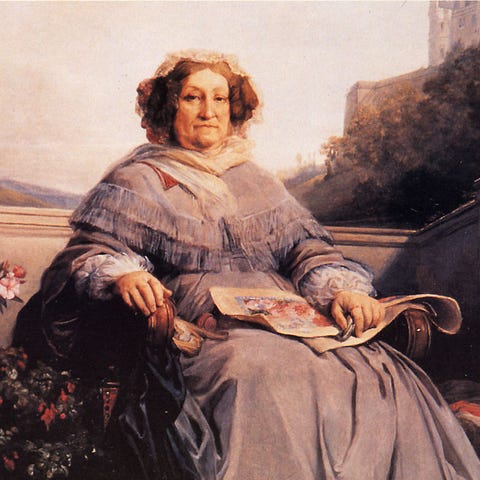
The 17th century Benedictine monk Dom Perignon may get the credit for developing the methode champenoise, but when it comes to creating the iconic sparkling wines that fill our flutes, we owe the lion's share of our thanks to the ladies.Monday, March 11, 2019
The Pioneering Women of the Champagne Industry, From Clicquot to Bollinger
The 17th century Benedictine monk Dom Perignon may get the credit for developing the methode champenoise, but when it comes to creating the iconic sparkling wines that fill our flutes, we owe the lion's share of our thanks to the ladies.Wednesday, May 30, 2012
Fortune 500's Six Amazing Women
Tuesday, January 17, 2012
History - Elizabeth Arden
Saturday, October 1, 2011
Fortune's 50 Most Powerful Women
It’s Friday and it’s lunch time, so you’re probably done with the heavy work load and already thinking about watching the most illegal move in wrestling history. Or maybe that’s just us. Either way, it’s a good time for a list, and Fortune’s 50 Most Powerful Women in Business for 2011 is worth checking out.
The issue hits newsstands Monday, but here’s a couple quick notes: Oprah Winfrey is an unfamiliar spot, having fallen 10 slots to number 16 because OWN hasn’t worked out yet, and one-third of the newcomers on the list are from India or China. Interesting, right?
Check out the list at Fortune.
Tuesday, December 28, 2010
Top Women in Technology
2010 has been an interesting year in terms of technology. We’ve seen tablets become an everyday part of living (though we’re still not sure of their purpose), 3D viewing advance dramatically, and augmented reality took off, thanks to the rise of compatible mobile applications. Alongside these tangible products, there has been much advancement in the backend of science and technology with talented scientists researching medicines, creating programs and extending their knowledge of the virtual world. Many of these projects were spearheaded by women, and I’d like to draw your attention to the top thirteen women who have impacted technology in 2010.
Sunday, December 5, 2010
Business Backlash to Parental Leave
WOMEN of child-bearing age are in the firing line as struggling small businesses baulk at the cost of implementing the Gillard Government's paid parental leave scheme.Dozens of cases of pregnant women being bullied and unfairly sacked have already been lodged with authorities, fuelling fears of widespread discrimination once paid parental leave starts on January 1.
Business groups warn that the onerous cost of administering payments will force some employers to think again about hiring women.
Queensland's Chamber of Commerce and Industry boss David Goodwin said small businesses - already hurting from the financial downturn - could not absorb the costs of filling out ''welfare papers'' and changing payroll systems. Some small businesses ''probably'' won't hire women of child-bearing age.
Friday, September 24, 2010
Financial News: Most Influential Women
Financial News is set to unveil its list of the 100 most influential women in European financial markets, which includes chief executives, managing directors and senior executives from across the industry.
Of those on the fourth annual FN100 Most Influential Women list, more than a fifth are CEOs, a third are managing directors, 10 are regional heads and 15 are heads of department. The remainder are chairmen, vice chairs, chief financial officers, chief investment officers or chief operating officers. They work in investment banking, asset management, private equity, pensions, regulation, wealth management, hedge funds and trading.
This year's list reflects the industry's continued focus on regulation, the increased role of corporate governance and scrutiny by pension funds as asset owners, as well as the hard work that has gone into restructuring companies in the wake of the financial crisis.
Sunday, September 12, 2010
New Zealand: Women Losing Grip On Power
McGregor said interim results of the Census of Women's Participation showed that for the first time since the biennial survey began in 2004, the number of women in positions of power was going backwards.
Until recently New Zealand had a female prime minister, governor- general, attorney- general and a woman at the helm of Telecom, our largest publicly listed company.
McGregor said every other year there had been incremental improvements. "It means we have hit a plateau and are probably going to slide back," she said.
"New Zealand has always had a wonderful reputation - first of all with suffrage, but also with gender equality in a number of different areas, so that's why I'm worried about the signs of regression. We are at a critical stage for women's rights and gender equality. There's been a bit of complacency born out of the fact that there was a blip when we had a number of high-fliers."
McGregor believed it was time for the baby boomer generation to step aside, and accepted that view would cause controversy. "I do think there needs to be new and radical thinking. Younger women are there and I think we need to make space for them and for their voices and their forms of activism which are different from ours."
Tuesday, August 3, 2010
Saudi Women Are Country's Biggest Assets
A large portion of the Kingdom’s wealth is in the hands of its women who are believed to be sitting on cash totaling $11.9 billion.
“The Kingdom has a veritable treasure trove of human and financial capital in the form of its women who control a large portion of the country’s wealth,” said a report released on Monday by the Cayman Islands-based asset management firm Al-Masah Capital.
Women constitute almost 45 percent of the country’s population, and have a literacy rate of 79 percent. Yet, only 65 percent of them are employed, revealing the huge potential for women employment. In fact 78.3 percent of unemployed women are university graduates.
The report, titled “The Saudi Woman — A catalyst for change,” stated that women could become a major growth driver for the country’s diversification policy with their considerable wealth, which is lying idle, being channeled into the country’s money supply.
Saudi women are not alone. Women in the Middle East controlled 22 percent or $0.7 trillion of the region’s total assets under management (AUM) in 2009. The region, consequently, ranked fifth globally in terms of AUM controlled by women.
Monday, July 26, 2010
Russia: Most Eligible List Angers Dads
THEY are young, smart and fabulously wealthy but live largely in the shadows.Now, to the fury of their billionaire fathers, they are exposed to scrutiny by the publication of Russia's first list of its most eligible women.
Compiled by the business magazine Finans, the list names the single daughters of Russia's richest tycoons.
The combined fortunes of the seven women identified total more than $17 billion.
The private lives of the rich and famous are generally considered taboo by the Russian press.
"Most (Russia's oligarchs) would be very unhappy to see their daughter's name on a list like this," said a businessman. "I know the fathers of two of the girls and they're very angry. The last thing they want is for their daughters to be viewed as commodities."
Friday, July 9, 2010
Norwegian Support For EAC Women
The Norwegian government has pledged to continue supporting East African Women Entrepreneurs in accessing European markets.
Speaking at the passing out of over 20 female participants in the East Africa Women Entrepreneurship Development programme recently, the Norwegian Ambassador, H.E Bjerg S. Leite said: “Norway's contributions must also be based on considerations related to income distribution, fundamental social standards, the environment and food security.”
He said Norway is particularly interested in seeing the progress of the development programme and have products from women enterprises reach the Norwegian, European and other markets.
Tuesday, June 29, 2010
Golden Girl of the Gulf
Amanda Staveley doesn't look like one of the world's biggest deal makers. For a start she's a tall blonde woman in her late thirties, and she's pretty glamorous as you'd expect from a former model who once dated Prince Andrew.
Perhaps more astonishing has been her route to the top - particularly as her academic career was cut short - she dropped out of Cambridge University. Her next move was to open a restaurant near the racing town of Newmarket.
It was there that she began to rub shoulders with visitors from the Gulf who were
dining there because of its proximity to the racecourse- customers included the associates of powerful rulers like Sheikh Maktoum of Dubai.Perhaps more astonishing has been her route to the top - particularly as her academic career was cut short - she dropped out of Cambridge University. Her next move was to open a restaurant near the racing town of Newmarket.
It was there that she began to rub shoulders with visitors from the Gulf who were dining there because of its proximity to the racecourse- customers included the associates of powerful rulers like Sheikh Maktoum of Dubai.
Wednesday, June 23, 2010
Women: We Won't Put Up & Shut Up
It is unlikely a little more than 200 complaints go anywhere near demonstrating the true extent of sexual harassment in the workplace. Many women will not know they can lodge a complaint and others will shrug their shoulders and deal with the behaviour as best they can. Women who eke out existences in poorly paid casual positions are never going to complain. And some women won't even know that a reference to the size of their tits is sexual harassment.
Sex Discrimination Commissioner Elizabeth Broderick has been quoted as saying there is continuing confusion about what constitutes sexual harassment. Some of this confusion may well rest in the language we use: McInnes's behaviour has been described in various accounts as ''flirtatious'', ''unbecoming'' and ''inappropriate''.
Saturday, May 29, 2010
Australia: Women in Leadership
In the session on Women in Leadership, Kate O’Reilly, founding director of Optimiss, opened by commenting that there are only eight per cent of women executives in the Australian corporate world.
And in the face of a changing global market, it is vital that Australian businesses must also change.
Rather than adopt the ‘easier’ solution to fix what isn’t perceived as broken, the panellists would like to see more challenging of the status quo and a continuation of shifting demographics.
One initiative is a new ASIC guideline, which will soon enable corporations to voluntarily quote their gender diversity. The concept is based on the successful Norwegian model, where more women are now in leader positions after the model became mandatory in 2005.
Sunday, April 25, 2010
Top 50 Women-Led Companies
The list comes at a time when women-owned firms have grown in number but still lag behind male counterparts in terms of revenue. The number of female-owned companies grew 125% between 1982 and 2002, and women currently own 10.1 million firms or about 40% of all private companies in the U.S., according to the Center for Women's Business Research. Only 3% of all women-owned firms have revenues of $1 million or more, compared with 6% of men-owned firms, the center estimates.
Female entrepreneurs may not grow companies to as high a level as men because of an inability to access funding, especially venture capital; a lack of female role models; and, possibly, persistent stereotypes that they lack financial know-how or business expertise, the center and other groups have theorized.
The List @ Wall Street Journal
Sunday, April 4, 2010
Business Council of Australia: Mentor Groups
THE lack of women in senior positions in the top 200 listed companies has prompted the Business Council of Australia to launch a mentoring scheme to help rising female stars move into chief executive jobs.
The one-year pilot scheme is designed to develop a bigger pipeline of women executives as "we're simply not seeing enough women reach senior executive roles'', BCA president Graham Bradley said yesterday.
Under the pilot scheme, promising senior woman executives who have the potential to become a CEO or chief financial officer will be mentored by a chief executive from another company.
Eleven prominent male CEOs, including Commonwealth Bank chief Ralph Norris and Woolworths' Michael Luscombe, have signed up to be mentors.
Saturday, March 20, 2010
Philippines: Most Outstanding Women
President Gloria Macapagal-Arroyo on Friday led the awarding of this year’s Most Outstanding Women, including the country’s first woman general, a diplomat and businesswomen.
In a simple ceremony, Mrs. Arroyo awarded the “Most Outstanding Woman in Entrepreneurship” to Lydia Secosana who has made Secosana bags the pioneer and leader in the bag industry.
Doris Ho-Magsaysay, president and chief executive officer of the Magsaysay Group of Companies involved in shipping, human resources and business process outsourcing, was named as the “Most Outstanding Woman in Entrepreneurship.”
Ambassador Delia Domingo Albert, the first woman who served as Foreign Affairs Secretary, is also among the awardees for her contribution to global diplomacy.
Chief Superintendent Yolanda Tanigue got a special citation for setting a record as the country’s first woman general. She is the chief of Women and Protection Center of the Directorate for Investigation and Detective Management of the Philippine National Police (PNP).
Mrs. Arroyo also led the awarding of the “Most Outstanding Filipino-Chinese Federation of Business and Professional Women of the Philippines (Fil-Chi) Member” to Rosalind Wee, who was the recipient of the 2009 Pearl S. Buck International Woman of the Year.
Myrna T. Yao, chairwoman of the National Commission on the Role of Filipino Women (NCRFW), received the Lifetime Achievement Award for being a successful businesswoman and women leader.
She pioneered the toy distribution in the Philippines in 1982 with the introduction of worldwide known Barbie dolls.
Wednesday, March 3, 2010
Korea: The Female Factor
So many women have entered public service in recent years that, in 2003, the government revised its quota system. In 1996 it had begun mandating that at least 30 percent of new hires in all government departments except the police and military be women. Now, because so many women have succeeded in competing for these jobs, it is applying the minimum 30 percent quota for men as well.
The recent surge of women in the public sector is an outcome of government efforts to expand democracy after decades of military rule, to combat economic stagnation by bringing more well-educated women into the paid work force and to check the country’s plummeting birthrate, attributed in part to the difficulties South Korean women face trying to combine careers and motherhood.
Faced with all this, it has been the government that has led the way to expand women’s rights. Since the mid-1990s, it has enacted laws addressing issues like sexual and domestic violence.
Sunday, January 17, 2010
Forbes: 20 Best Blogs
This list is full of women that I have found to be leaders, women who are consistently providing relevant and useful information to the marketing and social media industry. I appreciate each and every one of them and recommend these ladies as the Chicks Pick Best in Blog--Marketing and Social Media.
Sunday, January 3, 2010
Women Only Taxis
Taxis driven by women and exclusively serving the fairer sex are the rage in Arab capitals as women seek a safe and comfortable mode of transport.Lebanon's Banet Taxi ('Taxi Girls'), sporting signature candy-pink taxis and well-kept uniformed drivers, began in March.Now, following the Lebanese success, two Egyptian governors in Cairo and Alexandria have stirred controversy with proposals to service women-only taxis."It means isolation for women," Nehad Abul Komsan, Chairwoman of the Egyptian Center for Women's Rights told The Media Line. "It's very risky for our society. If it's an excuse to solve problems like sexual harassment or other types of violence, it's a very naïve solution for a very complicated problem."Cairo's subway network already reserves the fourth and fifth carriages for women not wishing to sit with men.In Damascus a similar women-only taxi initiative is being launched by Widad Kanafani, aiming to make transportation more secure for female passengers.Dubai has had a women-only pink taxi service since 2007 and the Roads and Transport Authority will be launching a women-only bus service in April 2010 to accommodate an increasing number of female passengers.In Jordan the Amman Municipality turned down a request to set up a taxi rank to serve women exclusively and employ female drivers with rose-colored vehicles, saying there were too many taxis in the capital already.