Showing posts with label government. Show all posts

Monday, December 27, 2021

Digs reveal seals of Hittite female administrator in SE Turkey

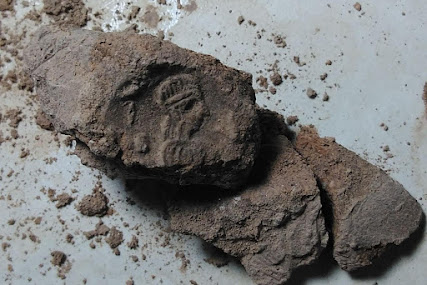
Archaeologists discovered seals and prints of a female administrator during their archaeological digs in the ancient city of Karkamış in southeastern Turkey’s Gaziantep province.

Karkamış was the most important administrative center in the region of the Hittite Empire, which ruled over Anatolia and Mesopotamia for centuries.

The findings were among dozens of clay seals belonging to the highest officials in a hierarchical order unearthed by an excavation team headed by Nicolo Marchetti, an archaeology professor at the University of Bologna in Italy, according to a statement by the Gaziantep metropolitan municipality.

It was determined that two-thirds of the Anatolian hieroglyphic seal impressions belonged to a female administrator named Matiya from the period defined as the "Late Bronze Age."

The new discoveries are expected to shed light on the role of women in state governance during the Hittite Empire.


Friday, January 17, 2014

Wanted: Adriana Rivas

Adriana Rivas with Manuel Contreras
From the Australian:
AUSTRALIA is being asked by Chile's Supreme Court to extradite a woman accused of involvement in torture and murder during Chile's 1973-1990 military dictatorship.
The court requested the extradition of Adriana Rivas overnight.
She is wanted for her role in the 1976 murder of a Communist Party leader who was held in a secret prison before he was suffocated and thrown into the ocean.
Ms Rivas was assistant to Manuel Contreras, the head of the DINA secret police during General Augusto Pinochet's dictatorship.
She moved to Australia in 1978 but was detained during a visit to Chile in 2006.

Ms Rivas was released after some months on probation and escaped to Australia.

In an interview last year with SBS, she insisted she was innocent of the charges.

From SBS: The Other 9/11

Sunday, October 30, 2011

Begum Nusrat Bhutto

From The Nation:
Born Nusrat Ispahani, the young woman from an Iranian Pakistani family, who grew to love her adopted country, rests today in the soil of Sindh.
Begum Nusrat Bhutto’s political role does not start with Ziaul Haq, but it was during his rule that her determination was forged of an unbreakable iron. With her eldest daughter, Benazir, Begum Bhutto fought fearlessly to save her husband, Shaheed Zulfikar Ali Bhutto, whose life was stolen by the most vicious military dictator in our nation’s history; a dictator, who denounced democracy, abrogated the Constitution, cynically toyed with religion, and denied the basic rights of the people.
Too strong to be easily intimidated, Begum Nusrat Bhutto was motivated by the depth of Zia's tyranny to put her heart and soul into the fight for the restoration of democracy, the Constitution and basic human rights. She stood steadfast against a usurper and dictator not out of any desire for personal gain, but out of an unwavering dedication to her principles. Many were intimidated by General Ziaul Haq and quickly acquiesced to his rule; but for Begum Nusrat Bhutto there was never a moment of doubt. The fundamental rights of the Pakistani people could not be sacrificed at the altar of dictatorship.
Dubbed the “Iron Lady of Pakistan,” Begum Bhutto was the backbone of the Movement for the Restoration of Democracy (MRD) - a coalition comprising PPP and other democratic political parties determined to restore the democratic order on which Pakistan was founded.

Women in Tunisia

From the Financial Times:

Suad Abd al-Rahim, a tall, elegant, 47-year-old Tunisian woman with dyed red curls, is no one’s idea of what an Islamist politician should look like.
Yet the businesswoman, who says she has no plans to don the Islamic headscarf, has just been elected to Tunisia’s new constituent assembly on the ticket of Nahda, the Islamist party that has emerged as the strongest political force in the country.
After 22 years of repression under the regime of Zein al-Abidine Ben Ali, the former president ousted by a popular uprising this year, Nahda has staged a powerful comeback, winning 90 out of 217 seats according to final results of this week’s election.
Now the largest party in the new assembly that will write the country’s democratic constitution, it is poised to lead a coalition government.


Sunday, September 18, 2011

New Danish PM: Helle Thorning-Schmidt

From The Hindu:
Denmark has elected its first female prime minister, ousting the right-wing government from power after 10 years of pro-market reforms and ever-stricter controls on immigration.

Near complete official results showed on Thursday that a left-leaning bloc led by Social Democrat Helle Thorning-Schmidt would gain a narrow majority in the 179-seat Parliament.

“We did it. Make no mistake. We have written history,” the 44-year-old opposition leader told jubilant supporters in Copenhagen. “Today there’s a change of guards in Denmark.”

Prime Minister Lars Loekke Rasmussen conceded defeat, saying he would present his Cabinet’s resignation Friday to Queen Margrethe, Denmark’s figurehead monarch.

“So tonight I hand over the keys to the prime minister’s office to Helle Thorning-Schmidt. And dear Helle, take good care of them. You’re only borrowing them,” Loekke Rasmussen said.

Sunday, August 7, 2011

Pakistan's First Female Foreign Minister

On July 20th, Pakistan's first female Foreign Minister was sworn in. The Political inheritance and feudalism in Southern Punjab, pushed Rabbani to enter politics in 2002, when she was 25 years old, by default as she is the daughters of a politician.

She was known for her good relations with former President, General Pervez Musharraf and Prime Minister Shawkat Aziz.

She worked as a financial affairs’ consultant in the government and when Musharraf’s rule ended in 2008, she moved from losers to winners’ ranks, and became a member of the People's Party.

She continued to work as a financial consultant for the new Prime Minister, Yousuf Raza Gilani and then became the first female minister for financial affairs in 2009.

In February 2011, Hina rose to the rank of Minister of State for Foreign Affairs, after the former Pakistani foreign minister resigned, protesting against his country's stance to give diplomatic immunity to U.S. intelligence agent accused of killing Pakistanis.

Monday, July 25, 2011

Female President for Singapore?

The recent victory of Yingluck Shinawatra, who will become Thailand’s first female prime minister, has inspired some Singaporeans to ask whether it’s also time for the prosperous city state to elect its first female president. Singapore is set to choose its new president, a largely ceremonial position, next month.

But electing a female president isn’t that easy as choosing a female member of parliament. After reviewing the minimum qualifications that a candidate must pass, it seems there will be some difficulty in finding eligible female nominees.

According to Grace Ke of the Association of Women for Action and Research, Singapore has had only one female minister in its history, and has never had a female chief justice, speaker, attorney general, Public Service Commission chairman or auditor general.

Saturday, July 23, 2011

Somali Minister For Women Abducted

Asha Osman Aqiil, Somalia's new minister for women and family affairs, was abducted by Islamist rebels late Wednesday night, the day after her appointment was announced. The abduction occurred while Aqiil was on her way to her first cabinet meeting. She was travelling in an area controlled by al Shabaab militants. Aqiil is the only woman in the new 18 member government.

Al Shabaab has a history of targeting government ministers. Last month, al Shabaab was accused of killing Interior Minister Abdi Shakur Sheikh Hassan in a suicide bomb attack. Sahra Maalin, a women's rights activist described Aqiil's abduction as a "collective punishment against Somali women and all those who believe in equality."

Since the overthrow of Dictator Mohamed Siad Barre in 1991, Somalia has not had an effective central government. Additionally, earlier in the week, the UN declared that there is famine in two of Somalia's regions under rebel control. According to the UN's Food and Agriculture Organisation, thousands have died in Somalia over the past months because of the severe drought and famine. The abduction of Asha Osman Aqiil has heightened famine aid groups' security fears as they plan to make food deliveries.

Indigenous Women in Presidential Race

Two indigenous women are seeking to make history by reaching the two top jobs in politics: Nobel Peace laureate Rigoberta Menchú, presidential candidate of the left-leaning Frente Amplio coalition and lawyer Laura Reyes, vicepresidential candidate for the Compromise, Renovation and Order party, known as CREO.

Menchú is one of the most famous faces in Guatemalan politics and this is her second attempt to run for the office. But Reyes is a newcomer, running on ticket with Eduardo Suger, a mathematician of Swiss-Guatemalan origin and founder of the private Galileo University.

Reyes, a Mayan Kaqchikel woman from the municipality of Tecpán, in the department of Chimaltenango, two hours from Guatemala City, describes herself as a resiliant woman who had to fight against the odds to have a career.

Monday, May 16, 2011

Zambia: Female President??

It is clear that many women in Zambian politics, ancient and modern played and have continued to play a crucial role in shaping Zambia’spolitical destiny.

This fact, though rarely appreciated, can be seen not only on the fading pages of Zambian political history, but also in the current skirmishing manouevres to increase the number of women in politically-sensitive decision-making roles.

Many women, and rightly so are asking for more political space to show-off their wares.

In terms of political party hierarchies, however, not many women have seen the upper echelons of power.

In modern times, one Edith Nawakwi has arisen with the clouds.  She was thrust into the lime-light during the glory-days of the Movement for Multiparty Democracy (MMD).
Hitherto an unknown marketeer at Northmead Market, Nawakwi soon became a force to reckon with by Kenneth Kaunda’s United National Independence Party (UNIP).

Notable Female Indian Politicians

For the first time in the history of our democracy, four states are being led by women chief ministers. Here’s looking at what makes the behenji different from the amma, and the didi from the school teacher .

Mamata Banerjee - the woman who ended the 34-year-old communist regime in West Bengal.

J Jayalalithaa - The actress-turned powerful politician.

Sheila Dixit - three time election winner.

Mayawati - this Dalit leader heads the most populous state in the country.

Monday, January 31, 2011

Margaret Thatcher & the Indian Mystic

The Iron Lady, who was renowned for her no-nonsense direct approach, conversed with self-proclaimed faith healer and preacher Sri Chandraswamy in 1975 in her Commons office.

And the future Prime Minister was so impressed with his apparent powers that she agreed to his request to wear a special red dress and a battered talisman around her wrist to a second meeting.

There, it is claimed the bearded guru correctly predicted that she would come to power within four years and remain there for more than a decade.

Details of the extraordinary meetings were revealed by former Indian Foreign Minister Shri Natwar Singh, who was present when they took place.

In 1975 he was India’s Deputy High Commissioner to the UK when Mr Chandraswamy arrived in London and apparently demanded a meeting with Mrs Thatcher.

Wednesday, January 26, 2011

Edmonton Revolutionary: Roberta MacAdams

The Edmonton Public School district announced Friday that it's looking for names for two new schools, one being built in Summer-side-Ellerslie in south Edmonton, the other in the Hamptons-Grange areas of west Edmonton.

Not earth-shattering news, perhaps. But for me, it offers an ideal opportunity to correct a historic injustice, to celebrate the life and contributions of an unsung Edmonton revolutionary: Roberta MacAdams

So why don't we know MacAdams's name? In part, it's because she retired from politics in 1921, after one term. At 40, she married, raised a family, excused herself from public life. She was never one of the Famous Five, who fought the Persons Case. Unlike Nellie McClung or Emily Murphy, she never wrote a book. She was never flamboyant or controversial or ideologically partisan -- just smart, brave, funny, independent and utterly competent.

Friday, January 7, 2011

Masouda Jalal: Harbinger of Equality

From Gulf News:

Afghanistan's first woman presidential candidate, Dr Masouda Jalal, helps women stand up to the male-dominated society.

Dr Masouda Jalal belongs to a growing number of women who dare to oppose deep-rooted derogatory traditions in Afghan society.

A paediatrician, along with being Afghanistan's first woman presidential candidate and the former minister of women's affairs, Dr Jalal has been working towards improving the status of women in her country. Through her organisation, the Jalal Foundation, she has empowered several women and is a beacon of hope. Her work earned her global recognition, including the UN Watch Human Rights award in 2010.

In an exclusive interview with Weekend Review, Dr Jalal talks about her organisation and life in Afghanistan.


Saturday, December 4, 2010

An Interview with Dilma Rousseff

From the Washington Post:
Four weeks ago, Brazilians elected their first female president - Dilma Rousseff, the chosen candidate of Luiz Incio Lula da Silva, Brazil's popular outgoing president. Rousseff comes to power with an unusual background: She fought in the 1960s underground against the military regime that then ruled Brazil, and she was imprisoned and tortured between 1970 and 1972. She then started in local politics and joined Lula's government in 2002 as minister of mines and energy, eventually becoming his chief of staff. On Dec. 2, in her first lengthy interview since the vote, Rousseff spoke about her plans for the next four years.

Sunday, November 14, 2010

FREE!! Aung San Suu Kyi

From BBC News:
Burma's pro-democracy leader Aung San Suu Kyi has addressed a large crowd of her supporters, a day after her release from house arrest.

"The basis of democratic freedom is freedom of speech," she said at her party's offices, Reuters reports.

Ms Suu Kyi was allowed to leave her Rangoon house when her sentence expired on Saturday. She had been detained for most of the past two decades.

World leaders and human rights groups have reacted with joy at her release.

Thursday, September 23, 2010

Swiss Women Dominate Cabinet

From BBC News:
Switzerland's parliament has voted a new minister into the government, giving the cabinet a majority of women for the first time.

The election of Simonetta Sommaruga, 50, a Social Democrat, is a historic step in a country where women only got to vote on a national level in 1971.

Ms Sommaruga becomes the fourth female in the seven-member Federal Council.  Another absent post was filled by a man - Johann Schneider-Ammann.

The seven members of the Swiss cabinet have recently always been drawn from the four leading parties.

Sunday, September 12, 2010

Politics & Afghan Olympian Robina Jalali

From the Washington Post:
Amid the warlords, ex-mujahideen fighters, hard-line clerics and shady businessmen running for a seat in the Afghan parliament, Robina Jalali, a 25-year-old candidate from Kabul, offers a more inspiring biography.

Raised during a Taliban regime that was brutal toward women, Jalali nevertheless trained as a sprinter and, after the Taliban fell, followed her passion to the Olympics. No matter that she finished second-to-last in the 100 meters in Athens in 2004 and last in Beijing in 2008. In Afghanistan, a conservative Muslim nation where many women still wear the identity-shielding burqa, Jalali's story is like a fairy tale.

Now comes the sequel: Jalali is running again - for a seat in the Wolesi Jirga, the lower house of the Afghan parliament. Though interest among women was initially sparse, a recruitment drive from the Independent Election Committee has resulted in a record 406 female candidates standing in the Sept. 18 elections for at least 64 seats reserved for women under the Afghan constitution, which guarantees them 25 percent of the 249 seats. (More than 2,000 men are running.)

Tuesday, August 10, 2010

Ireland: More Women Needed In Politics

From the Irish Times:
GREATER POLITICAL involvement by women in decisionmaking in Irish politics will help Ireland progress as a society, an academic has predicted ahead of a conference that will discuss women’s political representation.

Dr Sandra McAvoy, historian and lecturer in women’s studies at University College Cork, said Ireland had slipped internationally to 82nd in a world classification table of women’s representation in parliament.

There are 23 women in Dáil Éireann, accounting for just 13.85 per cent of seats. The figure for Seanad Éireann is only marginally better, where 12 of the 60 senators – or 20 per cent – are women, she said.

Women account for 17 per cent of members of local authorities and just 12 per cent of the members of regional authorities, while in the last general election only 82 women out of 470 candidates were women, representing the lowest number of women since 1989, she said.

“Back in 2002, I think it was estimated that it would take 360 years for women to achieve equal representation in Irish politics, but given that the proportion of women in politics has decreased since then, it’s going to take even longer,” said Dr McAvoy.

Thursday, July 22, 2010

Schwarzenegger Appoints Davis To Key Role

From Imperial Valley News:
Governor Schwarzenegger announces appointment of Geena Davis to the California Commission on the Status of Women. Actress Geena Davis, 54, of Los Angeles, has been appointed to the Commission on the Status of Women. She is an actor and has had roles in “Tootsie,” “The Fly,” “Beetlejuice,” “Earth Girls are Easy,” “Angie,” “The Long Kiss Goodnight” and “Stuart Little.” Davis received the Academy Award for Best Supporting Actress in 1989 for her role in “The Accidental Tourist” and the Golden Globe Award for Best Performance by an Actress in a Television Series - Drama in 2006 for “Commander in Chief.” She was nominated for an Academy Award and Golden Globe for her role in “Thelma and Louise” and was nominated for a Golden Globe for Best Actress for her role in “A League of Their Own.”

Davis is a member of Mensa International, founder of Geena Davis Institute on Gender in Media and its programming arm See Jane, which engages film and television creators to dramatically increase the percentages of female characters and reduce gender stereotyping in media made for children 11 and under. She is a partner with United Nations Development Fund for Women in an effort to change the way media represents women and girls, to encourage media to present and investigate issues of grave importance to women and to use a “gender” lens when reporting. This position requires Senate confirmation and the compensation is $100 per diem. Davis is a Democrat.