Showing posts with label bronze age. Show all posts

Monday, December 27, 2021

Digs reveal seals of Hittite female administrator in SE Turkey

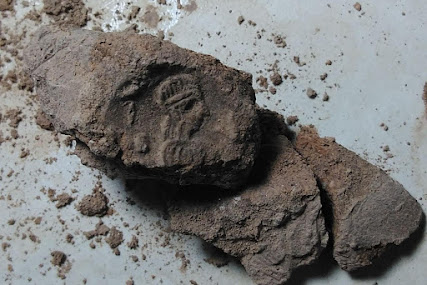
Archaeologists discovered seals and prints of a female administrator during their archaeological digs in the ancient city of Karkamış in southeastern Turkey’s Gaziantep province.

Karkamış was the most important administrative center in the region of the Hittite Empire, which ruled over Anatolia and Mesopotamia for centuries.

The findings were among dozens of clay seals belonging to the highest officials in a hierarchical order unearthed by an excavation team headed by Nicolo Marchetti, an archaeology professor at the University of Bologna in Italy, according to a statement by the Gaziantep metropolitan municipality.

It was determined that two-thirds of the Anatolian hieroglyphic seal impressions belonged to a female administrator named Matiya from the period defined as the "Late Bronze Age."

The new discoveries are expected to shed light on the role of women in state governance during the Hittite Empire.


Sunday, June 13, 2021

Bronze Age burial site of powerful woman discovered under ancient palace in Spain

Archaeologists excavating at La Almoloya, Spain, have discovered a grave filled with precious items and the remains of a woman, who may have been a ruler or powerful member of society. The woman was buried alongside a man in a large pot in around 1700 BC, beneath the floor of what may be western Europe’s earliest palace.

The majority of the grave’s objects, and particularly those of silver, were found with the woman, including a rare silver diadem, still worn on her head. Scholars argue that this was a symbol of power in El Argar society, which existed in south-eastern Spain from around 2200 to 1550 BC. Among the woman’s other grave goods were a set of silver earlobe tunnel-plugs; silver spirals that were perhaps part of her headdress; two silver bracelets; a necklace; and a silver ring on one of her fingers. In total, the burial contained about 230g of silver. The man’s objects, by contrast, were less prestigious.

read more here @ The Art Newspaper

Sunday, July 31, 2016

Facial reconstruction made of Bronze Age woman 'Ava'

Facial reconstruction made of Bronze Age woman 'Ava' - BBC News
A facial reconstruction has been made of a young woman who died more than 3,700 years ago.  The woman's bones, including a skull and teeth, were discovered at Achavanich in Caithness in 1987.  Known as "Ava", an abbreviation of Achavanich, she is the subject of a long-term research project managed by archaeologist Maya Hoole.
Forensic artist Hew Morrison, a graduate of the University of Dundee, created the reconstruction.  Ava's remains, along with other artefacts found with her, are held in the care of Caithness Horizons museum in Thurso.  Unusually, the Bronze Age woman was buried in a pit dug into solid rock and her skull is an abnormal shape which some suggest was the result of deliberate binding.
Continue reading here at BBC News

Wednesday, February 19, 2014

Discovery of Bronze Age Woman

Image from The Scotsman
From Past Horizons:
In March 2012, a GUARD Archaeology team, led by Maureen Kilpatrick, undertook a rescue excavation when a cist was inadvertently disturbed during landscaping works following the construction of an access track through Cullaird Wood in West Torbreck, south-west of Inverness in Scotland.
The cist, which was capped with a small cairn, contained the remains of a crouched inhumation burial, whose grave goods included seven fragments of flint and a plain Beaker vessel. The burial appeared consistent with a period of use in the early Bronze Age, which has recently been confirmed by radiocarbon dating of 1982-1889 cal BC provided by a sample of the human bones.
Maureen Kilpatrick, who is one of GUARD Archaeology’s Osteoarchaeologists, undertook post-excavation analysis of the human bones recovered from the cist and discovered that these were the remains of an adult female individual who had attained the age of 40 – 44 years at death.


From Herald Scotland:
THE remains of a physically active woman with poor dental hygiene, who died 4000 years ago, have been found.
The discovery, along with others, is said by experts to underline the archaeological significance of the area around Inverness, which was important for prehistoric groups from early times.
Two years ago, a team from GUARD Archaeology, which has bases in Glasgow and Edinburgh, was led by Maureen Kilpatrick to undertake a rescue excavation when a cist, or tomb-like box made of stone, was disturbed during landscaping works for an access track through Cullaird Wood.
The cist contained the remains of a crouched burial, whose grave goods included seven fragments of flint and a plain beaker vessel.


From The Scotsman:
A BRONZE Age grave uncovered in the Highlands has revealed the remains of a woman in her forties who was suffering from toothache before she died 4,000 years ago.
Osteoarchaeologist Maureen Kilpatrick analysed the bones and discovered that they belonged to a woman aged between 40 and 44.
She said: “As the radiocarbon date demonstrates, this occurred at some point between 1982BC and 1889BC.

Monday, October 8, 2012

Bronze Age Female Metalworker

Archaeologists have discovered remains of a woman believed to be a metal worker from the Bronze Age, a finding that challenges ideas about the division of labour in prehistoric times. Researchers are confident that the skeleton found in Geitzendorf, north-west Vienna, Austria belongs to a woman despite the fact that the pelvic bones are missing. 

The woman was buried with an anvil, hammers, flint chisels and some small pieces of dress jewellery. The choice of funeral artifacts hints at her being a metal worker - the first indication that women did such work thousands of years ago, the Daily Mail reported. She was between the ages of 45 and 60 when she died, researchers said.

See also: 
Ernst Lauermann, director of the prehistory department at Austria's Museum of Ancient History