Showing posts with label archaeology. Show all posts

Wednesday, January 18, 2023

Tom Felton film unearths ‘epic story’ of female archaeologist


He is one of the most recognisable actors in the world, known for his role as Draco Malfoy in the Harry Potter franchise. But now Tom Felton wants to use his platform to spotlight someone whose historical achievements have been obscured for decades.

Felton has produced his first feature film, Canyon Del Muerto, recounting the story of Ann Axtell Morris, one of the US’s first female archaeologists, who worked with the Navajo in the 1920s to uncover North America’s earliest civilisation, the Anasazi.

“It’s an epic story that hasn’t been told before,” Felton said. “Ann Morris was only recently acknowledged as a credible archaeologist, even though she set the tone for the next 100 years of young women having the opportunity to enter the field.”

The film, expected to be released this spring, also stars Felton as Morris’s husband, Earl, who is often cited as the model for George Lucas’s Indiana Jones character. It explores how Morris’s accomplishments were overshadowed by her husband’s fame and prejudices against women.

The film was the first to be granted access to shoot in the sacred and culturally significant landscape of Canyon de Chelly on Navajo tribal lands in Arizona. It has been praised by Jonathan Nez, the president of the Navajo Nation, who called it “an extraordinary showcase of our land, our people and our culture”.

Read more here at The Guardian


Monday, December 27, 2021

Digs reveal seals of Hittite female administrator in SE Turkey

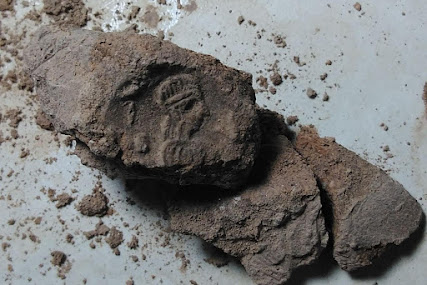
Archaeologists discovered seals and prints of a female administrator during their archaeological digs in the ancient city of Karkamış in southeastern Turkey’s Gaziantep province.

Karkamış was the most important administrative center in the region of the Hittite Empire, which ruled over Anatolia and Mesopotamia for centuries.

The findings were among dozens of clay seals belonging to the highest officials in a hierarchical order unearthed by an excavation team headed by Nicolo Marchetti, an archaeology professor at the University of Bologna in Italy, according to a statement by the Gaziantep metropolitan municipality.

It was determined that two-thirds of the Anatolian hieroglyphic seal impressions belonged to a female administrator named Matiya from the period defined as the "Late Bronze Age."

The new discoveries are expected to shed light on the role of women in state governance during the Hittite Empire.


Sunday, June 13, 2021

Bronze Age burial site of powerful woman discovered under ancient palace in Spain

Archaeologists excavating at La Almoloya, Spain, have discovered a grave filled with precious items and the remains of a woman, who may have been a ruler or powerful member of society. The woman was buried alongside a man in a large pot in around 1700 BC, beneath the floor of what may be western Europe’s earliest palace.

The majority of the grave’s objects, and particularly those of silver, were found with the woman, including a rare silver diadem, still worn on her head. Scholars argue that this was a symbol of power in El Argar society, which existed in south-eastern Spain from around 2200 to 1550 BC. Among the woman’s other grave goods were a set of silver earlobe tunnel-plugs; silver spirals that were perhaps part of her headdress; two silver bracelets; a necklace; and a silver ring on one of her fingers. In total, the burial contained about 230g of silver. The man’s objects, by contrast, were less prestigious.

read more here @ The Art Newspaper

Friday, January 1, 2021

Research into 9,000-year-old Wilamaya Patjxa burial site suggests women were big-game hunters

A new discovery of an ancient burial site shows just how much we still don’t know about ancient societies. A 9,000-year-old burial site in southern Peru potentially shows that what we’ve longed believed about gender roles in hunter-gatherer societies might be a bit off.

Anthropology professor Randall Haas and a team of experts have published a report that “challenge[s] the man-the-hunter hypothesis” concerning the division of work amongst males and females in ancient times. Published in Science Advances, the study titled “Female hunters of the early Americas” builds upon the discovery of remains and more than 20,000 artefacts in the Andean highlands at a 9,000-year-old burial site called Wilamaya Patjxa.


The study points out that in recent hunter-gatherer societies, big-game hunting has been “overwhelmingly male-biased.” But, Haas and his team have shown evidence from Wilamaya Patjxa that this may not have always been the case amongst ancient societies that would have required all-hands-on-deck to procure big-game. In addition to communal hunting, Wilamaya Patjxa findings suggests that child rearing would have been a shared task, freeing up more men, women, and children to partake in hunts.


read more here @ Art Critique

Science, art combine to reveal face of ancient Peruvian noblewoman

Peruvians’ view of their remote ancestors has taken on a new immediacy thanks to the innovative reconstruction of the face of an upper class women buried some 3,700 years ago.

“She has a great resemblance to a woman of today,” archaeologist Dayanna Carbonel told Efe, referring to the “Lady of El Paraiso,” whose tomb was discovered in 2016.

Carbonel leads the team carrying out excavations at the vast El Paraiso complex, home to the oldest known temples on the central coast of what is now Peru.


The bust, with its long face, prominent nose and cheekbones, small eyes and narrow mouth, is on display at Lima’s Andres Del Castillo Mineral Museum, which financed the reconstruction and gave Efe an exclusive first look at the result of nearly two years’ work.

Anthropometric analysis of the skeletal remains provided a basis for determining the dimensions and shape of the face of the Lady of El Paraiso, who stood just 1.5m (4ft 9in) tall and was between the ages of 20 and 25 at her death.


read more here @ La Prensa Latina Media

Wednesday, January 2, 2019

Archaeology Flashback - Siberian Tattooed Princess

Let's go back to 2012 when news of a tattooed Siberian princess made headlines. A brief recap:

The ancient mummy of a mysterious young woman, known as the Ukok Princess, is finally returning home to the Altai Republic this month. She is to be kept in a special mausoleum at the Republican National Museum in capital Gorno-Altaisk, where eventually she will be displayed in a glass sarcophagus to tourists. For the past 19 years, since her discovery, she was kept mainly at a scientific institute in Novosibirsk, apart from a period in Moscow when her remains were treated by the same scientists who preserve the body of Soviet founder Vladimir Lenin.

Archeologists even found items from her 'cosmetics bag', which lay inside her coffin next to her left hip, notably a face brush made from horse hair, and a fragment of an 'eyeliner pencil'. This was made from iron rings, inside which was vivianite, giving a deep blue-green colour on the skin.  There was also vivianite powder, derived from an iron phosphate mineral, apparently to be applied to the face. 'Analyses showed that the Pazyryk women knew and used the natural mineral blue colour called vivianite and they also produced quite complicated fat-based facial masks to protect the skin from extreme climates of high mountains.'

Known as Princess Ukok, she will be put on public display in a specially-built glass sarcophagus in Gorno-Altaisk, capital of the republic covering the Altai Mountains. Locals hope her tattooed remains - as well as her possessions including an ancient make-up bag - will become a significant tourist attraction at the Republican National Museum in a spectacular mountain region seeking to attract far more Russian and foreign visitors.

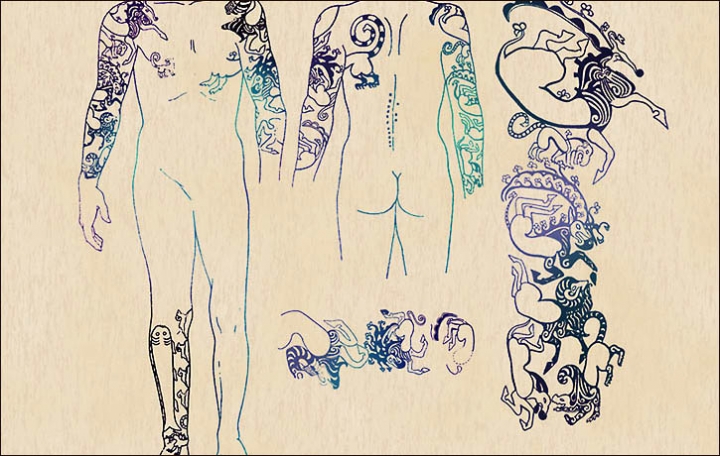
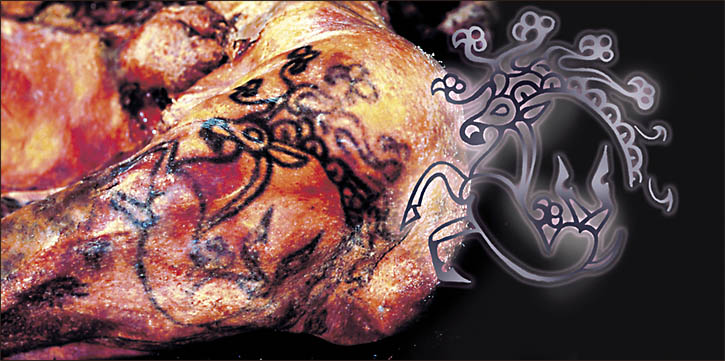
Her ancient tattoo is a showpiece of the glittering opening ceremony for the Sochi Paralympics. The tattoo featured in Sochi was from her left shoulder. It shows a mythological animal, a deer with a griffon's beak and a Capricorn's antlers. The antlers are decorated with the heads of griffons. And the same griffon's head is shown on the back of the animal'.

But local peoples from the Altai Republic, which borders Kazakhstan and Mongolia, have long objected to the fact that her burial mound was disturbed. They were also angered by a decision, after 19 years of academic research into her remains, to put her on display in a glass sarcophagus in a local museum.  Ancient beliefs say that the mummy's presence in the burial chamber was 'to bar the entrance to the kingdom of the dead'.  By removing this mummy, also known as Oochy-Bala, the elders contend that 'the entrance remains open'.  'Today, we honour the sacred beliefs of our ancestors like three millennia ago,' said one elder. 'We have been burying people according to Scythian traditions. We want respect for our traditions'.

Now Siberian scientists have discerned more about the likely circumstances of her demise, but also of her life, use of cannabis, and why she was regarded as a woman of singular importance to her mountain people.  Her use of drugs to cope with the symptoms of her illnesses evidently gave her 'an altered state of mind', leading her kinsmen to the belief that she could communicate with the spirits, the experts believe.

The MRI, conducted in Novosibirsk by eminent academics Andrey Letyagin and Andrey Savelov, showed that the 'princess' suffered from osteomyelitis, an infection of the bone or bone marrow, from childhood or adolescence.  'When she was a little over 20 years old, she became ill with another serious disease - breast cancer. It painfully destroyed her' over perhaps five years, said a summary of the medical findings in 'Science First Hand' journal by archeologist Professor Natalia Polosmak, who first found these remarkable human remains in 1993.
Princess Ukok

Elders in the region where a tattooed princess was found preserved in permafrost have re-sent a petition to Vladimir Putin demanding she be immediately reinterred. They say that since her removal the area has been hit by a series of natural disasters and insist a reburial would 'stop her anger that caused floods and earthquakes'.  Ancient beliefs dictate that her presence in the burial chamber had been to 'bar the entrance to the kingdom of the dead'. Scientists say she lived more than 2,500 years ago, meaning she was alive five centuries before the birth of Christ.

An appeal will be launched after a court this week rejected a demand by the the leader of the Teles ethnic group in the Altai Mountains to order the reburial of the world famous tattooed remains of 'Princess Ukok', dug from her tomb in 1993 by leading Russian archeologists.  Akai Kine, leader of the Teles ethnic group and president of the Spiritual Centre of the Turks, Kin Altai, demanded that the 'archeological complex' Ak-Alakha-3, where the mummy was found on the Ukok Plateau, should be recognised as a cultural heritage monument and the remains of the 'ice princess' classified as an integral part of the tomb. The 'integrity' of the burial site should be restored before her 2,500 year old remains should be reburied.

The well-preserved 25 year old woman - who probably died from breast cancer - was dug from her ice-clad tomb in 1993 by Russian archeologists, but this is the first time her remains will be publicly displayed.  The move to display the mummy in the Anokhin National Museum in Gorno-Altaisk is seen as controversial, even though the remains in a specially built sarcophagus will be viewed only twice a week for a maximum of three hours on each day to ensure she is not damaged. Earlier museum officials appeared to give assurances she would not be displayed.


Archaeology Flashback - 2015

A bit of a flashback to 2015 when reports came through of the discovery of an ancient amazon warrior princess in Kazahkstan. Here is a brief recap:

The skeleton of an ancient female warrior has been uncovered in south Kazakhstan, startling archaeologists whose 23 years of research in the region had never found records or hints of women soldiers in the region. The remains, which are perfectly preserved according to The Telegraph, are believed to belong to a woman based on the skull's shape and size — despite the huge sword and dagger found alongside her body.

The remains of an ancient female warrior still clasping a huge sword and dagger have been discovered in South Kazakhstan. Dubbed Red Sonja after the fearsome warrior woman portrayed by Brigitte Nielsen in the hit 1980s film, the skeleton was found with an impressive arsenal of weapons.  The remains, which are perfectly preserved, are thought to be thousands of years old and could date back as early as 200BC.
A dagger. Arrows. Not exactly what you’d expect in a woman’s grave from 1600 years ago. Unless she was an Amazon. The woman’s remains and the grave goods she was buried with — which includes finely crafted pots and bowls — will soon be put on display in the National Museum of Kazakhstan.  The sword was laid alongside her body, close to her left hand. The dagger was interred close to her right hand.  Archaeologists from Russia’s Institute of Archaeology determined the skeleton belongs to a woman through the size and shape of the skull.

The skeleton of a woman who lived more than 1,600 years ago and who was buried with a sword, a dagger, arrows, and pottery has been unearthed in Kazakhstan. Archaeologists say she was probably a high status person among the Kangyuy people, nomads who lived near the Syr Darya River and the Aral Sea in the southern steppes. The incredible discovery is the first evidence that women of the Kangyuy went to war.   The fact the warrior woman was buried with pots and bowls indicates she was an elite member of society who had some material wealth, says an article in The Telegraph . Researchers said she lived between the 11th century BC and the 4th century AD and determined her sex by the shape and size of her skull.

Archaeologists working in Kazakhstan have uncovered the remains of an ancient female warrior who lived sometime between the 11th century BC and 4th century AD.  Researchers from Russia’s Institute of Archaeology identified the remains as female by analyzing the shape and size of the skull. Other graves of warrior women have previously been found in the Eurasian Steppe, but this is the first one discovered in Kazakhstan. 


Sunday, November 26, 2017

Even More on St Ketevan

Following on from my post "More on St Ketevan" in 2013, come this articles from the The Hindu:
The first ancient DNA study in South Asia has revealed that a 400-year-old bone relic kept in St. Augustinian Church in Goa is likely to be a remnant of Queen Ketevan of Georgia (eastern Europe), who was born in a royal family in 1565 in the medieval period.

A team of investigators from the CSIR, the Centre for Cellular and Molecular Biology (CCMB), the Archaeological Survey of India and the Estonian BioCentre led by K. Thangaraj, CCMB, traced that the relic excavated from St. Augustinian Church complex in Goa, might belong to Georgian Queen Ketevan. The study has been published online recently in Mitochondrion journal.

For about a decade (1614 to 1624), the Queen remained in Shiraz as the prisoner of Shah Abbasi I. In 1624, the Persian emperor attempted to convert the Queen to Islamic faith. For resisting his wishes, she was tortured and strangled to death on September, 22, 1624.

From the Times of India (2017)
People in Georgia are greatly anticipating the arrival of the sacred relics, more than four centuries after these were brought to Old Goa by Augustinian Friars.

From The Quint:
Twenty-six years ago, the Government of India and Georgia, along with a posse of historians, archaeologists and priests, came together to recover a fragment of history lost in time – the mortal remains of a Georgian queen, believed to be in an old church in Goa.

The Archaeological Survey of India’s (ASI) Hyderabad Circle, after two decades of research and tests, has now concluded that the remains of Georgian Queen Ketevan were indeed at the St Augustine Church in Goa, bringing to light the 17th century connection between Georgia and the coastal state.

read more here 
@ Women of History - Mystery of Saint Ketevan
@ Women of History - Saint Ketevan

Grave of Disabled Prehistoric Woman


Human remains found buried in downtown Tempe, Arizona, are revealing a touching story about one young woman’s painful life and the community that cared for her more than 800 years ago.


The woman’s grave featured at least a half-dozen ceramic items, including a jar, a cylindrical vessel, a bowl placed near her head, another coated in the metallic mineral schist placed upside-down over her feet, and another bowl by her left side that contained a small ceramic effigy of a duck.

Regardless of what her medical history or social status really was, her treatment in death gives insights into what Cox and his colleagues describe as the bioarchaeology of care — a glimpse into how prehistoric cultures cared for their ill and infirm.

read more here @ Western Digs

Saturday, October 21, 2017

Early Egyptian Queen Revealed in 5,000-Year-Old Hieroglyphs


About 60 drawings and hieroglyphic inscriptions, dating back around 5,000 years, have been discovered at a site called Wadi Ameyra in Egypt’s Sinai Desert. Carved in stone, they were created by mining expeditions sent out by early Egyptian pharaohs, archaeologists say. They reveal new information on the early pharaohs. For instance, one inscription the researchers found tells of a queen named Neith-Hotep who ruled Egypt 5,000 years ago as regent to a young pharaoh named Djer. Archaeologists estimate that the earliest carvings at Wadi Ameyra date back around 5,200 years, while the most recent date to the reign of a pharaoh named Nebre, who ruled about 4,800 years ago.

read more here @ Live Science


Egyptian pharaoh Tutankhamun's wet nurse might have been his sister

From The Guardian comes this article on the family life of Egyptian Pharaoh, Tutankhamun:
Archaeologists believe Maia, Egyptian pharaoh Tutankhamun’s wet nurse, may have actually been his sister Meritaten.
Maia was the wet nurse of Tutankhamun, whose mummy was found in 1922 by renowned British Egyptologist Howard Carter in the Valley of Kings in Luxor along with a treasure trove of thousands of objects.
DNA tests have proven that the pharaoh Akhenaten was the father of Tutankhamun. The identity of his mother has long been a mystery, although she is not believed to be Akhenaten’s Queen Nefertiti. Some theories suggest the boy king’s mother was one of his aunts.
“Maia is none other than princess Meritaten, the sister or half-sister of Tutankhamun and the daughter of Akhenaten and Nefertiti,” Zivie said.
The mummy of Meritaten has not been found, but antiquities minister Mamduh al-Damati said on Sunday it could be in a secret chamber inTutankhamun’s tomb.

read more here @ The Guardian

Friday, June 16, 2017

Gospel of Jesus's Wife Likely a Fake

A papyrus holding text that suggests Jesus Christ was married and whose authenticity has been a matter of intense debate since it was unveiled in 2012 is almost certainly a fake.


Karen King, the Harvard professor who discovered the Gospel of Jesus's Wife and has defended its authenticity, has now conceded that the papyrus is likely a forgery and that its owner lied to her about the provenance and his own background.

The concession comes after Walter Fritz, a resident of North Port, Florida, revealed that he is the owner of the papyrus that claims Jesus had a wife. Fritz said this to Ariel Sabar, a journalist for The Atlantic who wrote an exposé published June 15.


read more here @ Live Science (17th June 2016) and Live Science (3rd February 2015)
and @ Women of History (13th July 2014) and Women of History (25th August 2015)


Monday, May 8, 2017

Mongolian mummy buried in 'Adidas boots'

Intriguing new details have emerged about a medieval mummy known for her 'Adidas' boots - which she wore more than a millennia ago. 

The body of the woman was discovered a year ago this week in the Altai mountains region of Mongolia.  And her body and possessions remained so remarkably preserved that experts are still uncovering some of the secrets they keep.

Now, scientists have discovered that the mummy suffered a significant blow to the head before her death. 

The Mongolian woman - aged between 30 and 40 - hit headlines in April 2016, thanks to her modern-looking footwear, which some likened to a pair of trainers. 


The woman was buried alongside a number of her possessions - including a handbag and four changes of clothes.  A comb and a mirror from her beauty kit were also found, along with a knife.  Her horse and a saddle with metal stirrups in such good condition that it could be used today were buried as well.

They are still seeking to verify the exact age of the burial, but they estimate it took place in the tenth century - more recently than originally thought. 


Read more here @ Daily Mail


Saturday, May 6, 2017

Women in Southern Germany Corded Ware Culture

Map of the Corded Ware culture
Women in Corded Ware Culture may have been highly mobile and may have married outside their social group, according to a study published May 25, 2016 in the open-access journal PLOS ONE by Karl-Göran Sjögren from Göteborg University, Sweden, and colleagues.


The Corded Ware Culture is archaeologically defined by material traits, such as the burial of the dead under barrows alongside characteristic cord-ornamented pottery, and existed in much of Europe from ca. 2800-2200 cal. B.C. To better understand this culture, the authors of the present study examined human bones and teeth from seven sites in Southern Germany dating from different periods of Corded Ware culture, including two large cemeteries. They used carbon dating and additional dietary isotope analysis to assess the diet and mobility of the population during this period.

read more here @ Eureka Alert and also @ PLOS One


Sunday, April 30, 2017

Iceland's "Woman In Blue"


A Viking-age (9th/ 10th century) woman grave was discovered at Ketilsstaðir, eastern Iceland, in 1938. Her skeleton was very poorly preserved and incomplete. The woman from Ketilsstaðir wore typical copper-alloy Scandinavian oval brooches, one of which was in direct contact with her face, resulting in significant soft tissue and textile preservation.  Now, researchers say that the unknown woman buried with Viking-era objects, was a child of some of the island’s earliest settlers, researchers say. Tooth development and wear suggest she was between 17 and 25 years old when she died. (read more here @ Message To Eagle)

She’s known as the Icelandic “Woman in Blue” due to the color of the apron she wore to her grave. In less romantic terms she’s a partial skeleton and one of Iceland’s earliest inhabitants. Her grave, including the skeleton and other Viking-era burial goods, was discovered in 1938 in Eastern Iceland near the town of Ketilsstaðir. During a recent annual meeting of the American Association of Physical Anthropologists, researchers presented the results of their ongoing examination and testing of the girl’s remains and the objects found buried with her.

The incomplete and poorly preserved skeletal remains belong to a young woman determined to have been between 17 and 25 years old (radiocarbon testing of the fabric and tooth show she was born around the year 900 CE and the time of her death was sometime around the year 920 CE). Based on the chemical analysis of one of her teeth, the Woman in Blue moved from the British Isles or Scandinavia to Iceland when she was between five and ten years old, a fact indicated by her change in diet from mostly land animals and plants to one that included a large amount of seafood and fish. (read more here @ New Historian)

The grave was that of a young woman, most likely in her twenties, who was believed to have moved to Iceland from Scotland at the age of five or ten. She is thought to have died around 920. Buried with her were two silver brooches and an expensive pearl necklace. One of the brooches laid pressed up against the girl’s chin, amazingly preserving part of her skin, enabling researchers to determine her age, origin as well as other information which will be presented at the exhibition. (read more here @ Iceland Magazine)

The ‘Woman in Blue’ moved to Iceland as a young child, probably from Scotland. She died at just over twenty years of age around 920.  In a marvellous struck of luck for anthropologists, one of two copper brooches that the ‘Woman in Blue’ took to her grave moved position, covering the cheek of the buried body. The result is that the woman’s jawbone and cheek have been preserved for over 1,100 years.  This material gives us today an inestimable insight into the life of our Viking-age ‘Woman in Blue’, so named as she was found buried in blue clothes of Icelandic wool. (read more here @ Iceland Monitor)

Though she was dressed in traditional Viking attire for her burial, researchers are unable to conclude whether she was Viking or hailed from Northern Europe. In addition to her clothing and the blue apron, she was also buried with an extravagant pearl necklace and two Scandinavian brooches — and one of the brooches, in an amazing twist of fate, contained the clue that opened to door to her life story. (read more here @ New York Times)

From Archaeology Magazine:
The remains of the “Woman in Blue,” discovered in 1938 in eastern Iceland, have been subjected to a battery of tests that have revealed new details about her origins and life history. Chief among these is that the woman, named after a blue-dyed apron she was buried in, appears to have come to Iceland during its early settlement period. (read more here @ Archaeology Magazine)


Thursday, April 27, 2017

Florence Nightingale's 'rubbish' amulets

A collection of ancient Egyptian amulets acquired by Florence Nightingale in the winter of 1849 when she went on an adventurous Egyptian holiday are going on display for the first time – and the curator at the World Museum in Liverpool is rather more impressed by them than the Lady of the Lamp herself was.
Five years before she sailed to Scutari, Istanbul, during the Crimean war, Nightingale travelled to Egypt at a time when mass tourism there was in its infancy. She wrote vivid letters home to her older sister, Parthenope, who later published them, but described her little amulets as “rubbish”.
“What she brought back is fascinating to us, but I think she expected to be offered ancient treasures and she was very disappointed with what was available,” he said. “Ironically we are displaying some of the objects which she did rate and was very pleased at getting hold of – which have turned out, alas, to be fakes.”
Read more here at The Guardian

Sunday, April 16, 2017

65 Byzantine Tombs Discovered in Ancient City in Turkey

From an article in January 2017 by David DeMar:
In the remains of the ancient marble-clad city of Stratonikeia in southwestern Turkey, archaeologists have found a staggering 65 tombs dating to the Byzantine era, according to the Hurryiet Daily News.
The researcher, who referred to Stratonikeia as “a living archaeological city”, called the site unique for is various characteristics, which included a high number of ancient structures surviving to the present day. The city, which would have at one time been home to the Carians of central Anatolia before the arrival of the Greeks, also holds ties to the Leleges, a pre-Hellenistic people that were said to have been allies of Troy during the Trojan War, the archaeologist said.
One of the primary finds, according to Söğüt, was the nearly four-foot-long skeleton found within a Byzantine-era tomb that had been undergoing cleaning and preservation works. The remains are thought to have belonged to a young woman who lived nearly 1,300 years in the past.


read entire article here @ the New Historian and @ Daily Sabah History

Clues to an ancient death: bacteria

Gillian Mohney made this report for ABC News in January 2017:
This woman's post-mortem was 800 years in the making, with ancient bacteria providing the critical clue for her likely cause of death, and offering a tantalizing glimpse into the lives of our forebears in the Near East.
In the 800-year-old remains of a Byzantine woman found in Turkey, in what used to be Troy, an archaeologist discovered some nodules the size of strawberries — leading to initial speculation that the woman died of tuberculosis. But the story turned out to be much more complex.
“We speculate that human infections in the ancient world were acquired from a pool of bacteria that moved readily between humans, livestock and the environment,” she said.

Read entire article here @ ABC News

Read more about ancient diseases @ the Scientific American and @ the Science Museum

Saturday, April 15, 2017

Egyptian Necklace Found in a Siberian Grave

An amazing archaeological discovery has been made in the Altai Mountains in Siberia - one that could change our perception of ancient peoples and trade:
Made of brightly coloured laminated glass, the priceless jewellery was found gracing the neck of a 25 year old woman in a remote burial mound in the Altai Mountains. Scientists say she died between 2,300 and 2,400 years ago and was a kinswoman of the famous tattooed 'Princess Ukok' (see more about her here), whose astonishing body artwork preserved in the permafrost has led to worldwide interest.
In fact, while it has been nicknamed 'Cleopatra's Necklace', the highly-coloured necklace pre-dates the exotic last Pharaoh of Ancient Egypt and originates around the time that Alexander the Great dominated the world from the Ionian Sea to the Himalayas.
The professor is confident the age of the beads is around 2,300 to 2,400 years old because other artefacts in the burial mound, such as a mirror and a knife, which are far more common to Siberia, are known to belong to this era. Yet the presence of the necklace is totally unique compared with discoveries in all previous ancient Siberian graves.
'There have been similar looking finds in Scythian mounds in Crimea, but these were just single beads - never a complete necklace', he said.
Read more about this fascinating discovery here @ The Siberian Times


Sunday, April 9, 2017

Statue of Queen Tiye Found

A unique statue, possibly of Queen Tiye, the wife of King Amenhotep III and grandmother of King Tutankhamun, has been unearthed at her husband's funerary temple in Kom El-Hittan on Luxor's west bank.

The exciting find was made by the European-Egyptian mission, working under the umbrella of the German Archaeological Institute.  Minister of Antiquities Khaled El-Enany who visited the site to inspect the discovery, described the staute as "unique and distinghuised".

Hourig Sourouzian, head of the mission said that the statue is very well preserved and has kept is colours well.  She said the statue was founded accidentally while archaeologists were lifting up the lower part of a statue of king Amenhotep III that was buried in the sand.  "The Queen Tiye statue appeared beside the left leg of the King Amenhotep III statue," Sourouzian said. She added that the statue will be the subject of restoration work. 

read more here @ ahram online


Impressive Carved Alabaster Statue of Queen Tiye Discovered
An impressive statue, most likely of Queen Tiye, the grandmother of King Tutankhamun and wife of King Amenhotep III, has been unearthed at Amenhotep III’s funerary temple in Kom El-Hittan on Luxor's west bank, as archaeologists from Egypt's Ministry of Antiquities announced on Thursday, March 23. 


As Natalia Klimczak eports in a previous Ancient Origins article , Tiye was one of the most influential and powerful women in ancient Egypt despite her name been forgotten in the centuries that followed her death. She is believed to have lived from about 1398 BC – 1338 BC, but the story of her life is as mysterious as most of the people who lived in this period. The world she lived in collapsed with the capital city of her son Akhenaten – Amarna.

read more here @ Ancient Origins