Showing posts with label 16th century. Show all posts

Sunday, March 11, 2018

The Islamic Pirate Queen - Sayyida al-Hurra

From OZY:

Talk like a pirate day Friday Hoyden: Sayyida al Hurra | Hoyden ...
Sayyida al-Hurra and her family fled Spain for Morocco, where, after marrying and burying her first husband, she succeeded him as the governor of Tétouan before remarrying — this time into royalty. When Sayyida wed Ahmed al-Wattasi, the sultan of Morocco and ruler of Fes, she became queen of Morocco. 

Holding a grudge, and feeling a great deal of shame over her fallen childhood homeland and its takeover by Ferdinand and Isabella, Sayyida became hell-bent on revenge. She reached out to the famed Barbarossa, an Ottoman admiral and among the most successful corsairs, to ally with the pirates in seizing control of the nearby seas. Sayyida and her privateers would eventually take over the Western Mediterranean during the corsairs’ and Ottomans’ reign in the early 16th century.

To this day, she’s remembered as a free and independent noblewoman who made the king of Morocco come to her to marry — the first time a royal had left the capital to wed.

read more here

Saturday, February 10, 2018

Maria Solina - The Most Famous Witch of Galicia


Witchcraft has a very special place in the culture of Spanish Galicia. One of the most famous people related to the old magical traditions is Maria Soliña, a Galician witch who lived during the 17th century. Despite her openness about supernatural practices, the intelligence of this remarkable woman allowed her to avoid the stake during the Inquisition.


We can discern the following from what little is known of this woman:

  • she was born in Cangas de Morrazo sometime in the last half of the 16th century
  • in 1617 a squadron of Turkish pirates reached the Vigo estuary, where it was the local women led the defence
  • she married Pedro Barba, a fisherman from the village, who with his brother created a viable fishing company whilst Maria held estates in her own right
  • the most important possession of the family were the rights of presentation in the Collegiate of Cangas de Morrazo and in the Church of San Cibrán de Aldán (by this right, the successors of the founder of a church could propose its sccessor when it became vacant, and in turn reap the benefits that the benefice generated rather than the Church)
  • purportedly in her 60s, she was accused of witchcraft (22nd Jan 1622) and brought before the Inquisition in Compostela (though it was said that this was merely a ruse to cover up the real reason for her imprisonment - the acquisition of her wealth and benefices, which naturally reverted to the Church)
  • she was tortured and later revealed that she was indeed a witch (or meigas)
  • she survieved the Inquisition to be released to a life of poverty
  • the date of her death is unknown


Friday, December 29, 2017

New Renaissance: how Florence is freeing its great female artists

From The Guardian:

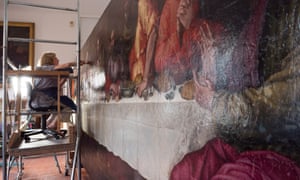
Unfairly neglected … Rossella Lari restores The Last Supper by Plautilla Nelli.
Rossella Lari restores The Last Supper by Plautilla Nelli.
Ask most people to name a female artist, and chances are they will come up with a contemporary figure: Tracey Emin, Rachel Whiteread or Paula Rego. Or they’ll name a 20th-century artist such as Frida Kahlo, or Georgia O’Keeffe. What they won’t do, though, is name one of the 16th- or 17th-century women who painted during and in the years following the Renaissance. Nelli is one of many female artists – including Artemisia Gentileschi, one of the most accomplished followers of Caravaggio, and Marietta Robusti who learned from her father Tintoretto – that history has unfairly neglected.

Now, though – nearly half a millennium on – that is beginning to change. AWA, which was established in 2009 by US philanthropist Jane Fortune, is committed to rediscovering all the works by women that lie forgotten in the museum attics and churches of Florence: at least 2,000 so far. When a painting is found, crowdfunding and special appeals pay for its restoration.

read more here @ The Guardian and here @ AWA (Advancing Women Artists)


Sunday, December 24, 2017

The Ruthless Conquerer Who Cross-Dressed Her Way to Infamy

From OZY:

After 20 years of roaming the Americas brawling, gambling and murdering close to a dozen people, the man known as Alonso Díaz Ramírez de Guzmán had one last option. Having often turned to the church for sanctuary when waist-deep in trouble, and now facing execution, the soldier and explorer chose the nuclear option: admitting to the bishop that he was actually a woman.

Now known as Catalina de Erauso, a mesmerizing and confusing figure in Basque history, the prisoner not only avoided being executed but also got to meet the pope. Given the protection of Peru’s Bishop Agustín de Carvajal following an examination that determined she was not only a woman but also a virgin, Erauso was sent back to Spain, where she wrote a MEMOIR that remains eye-poppingly off-putting to this day.

read more here

@ OZY


Sunday, November 26, 2017

Even More on St Ketevan

Following on from my post "More on St Ketevan" in 2013, come this articles from the The Hindu:
The first ancient DNA study in South Asia has revealed that a 400-year-old bone relic kept in St. Augustinian Church in Goa is likely to be a remnant of Queen Ketevan of Georgia (eastern Europe), who was born in a royal family in 1565 in the medieval period.

A team of investigators from the CSIR, the Centre for Cellular and Molecular Biology (CCMB), the Archaeological Survey of India and the Estonian BioCentre led by K. Thangaraj, CCMB, traced that the relic excavated from St. Augustinian Church complex in Goa, might belong to Georgian Queen Ketevan. The study has been published online recently in Mitochondrion journal.

For about a decade (1614 to 1624), the Queen remained in Shiraz as the prisoner of Shah Abbasi I. In 1624, the Persian emperor attempted to convert the Queen to Islamic faith. For resisting his wishes, she was tortured and strangled to death on September, 22, 1624.

From the Times of India (2017)
People in Georgia are greatly anticipating the arrival of the sacred relics, more than four centuries after these were brought to Old Goa by Augustinian Friars.

From The Quint:
Twenty-six years ago, the Government of India and Georgia, along with a posse of historians, archaeologists and priests, came together to recover a fragment of history lost in time – the mortal remains of a Georgian queen, believed to be in an old church in Goa.

The Archaeological Survey of India’s (ASI) Hyderabad Circle, after two decades of research and tests, has now concluded that the remains of Georgian Queen Ketevan were indeed at the St Augustine Church in Goa, bringing to light the 17th century connection between Georgia and the coastal state.

read more here 
@ Women of History - Mystery of Saint Ketevan
@ Women of History - Saint Ketevan

Saturday, April 15, 2017

Laura Battiferra – a Poetess for the Great Siege

Giovanni Bonello wrote a series of three articles for the Times of Malta (2012) on the poetess Laura Battiferra in relation to the Great Siege of Malta (1565).

Laura Battiferra by Agnolo Bronzino c.1560
"Laura Battiferra – Laura who? She had sunk into almost total oblivion, even though she was the wife of one of the most distinguished artists of the High Renaissance: Bartolomeo Ammannati. If one wanted to be generous, she had become an inconspicuous footnote in the history of Italian literature. The cultural explosion of feminism in more recent years has reversed the trend of gender neglect and again pushed Battiferra to the forefront."

Bonnello notes that: " Women do not generally celebrate war in poetry – only silly men do that – but then they do sometimes sing the praises and the virtues of male warriors and champions, the handsome supermen of their unacknowledged dreams, objects of unabashed hero worship or more."

Of her final days, Bonnello writes: "Battiferra spent most of the last stretch of her life in a chapel specially built for her by her husband in a rented villa in Camerata, close to the gates of Florence. Ammannati could afford that and much else besides, after a long and highly successful career as a sculptor and an architect. She passed away in November (probably the 1st), 1589, and was buried in the Ammannati chapel in the Florentine church of San Giovannino whose façade had been designed by her gifted husband."

Times of Malta: 
Laura Battiferra – a poetess for the Great Siege (July 29, 2012)
Laura Battiferra’s four poems on the Great Siege of Malta (August 5, 2012)
Poetess sings praises of Great Siege heroes August 12, 2012


About Laura Battiferra:


Books on / featuring Laura Battiferra:
  • Italian Women Writers: A Bio-bibliographical Sourcebook edited by Rinaldina Russell
  • Laura Battiferra and Her Literary Circle: An Anthology: A Bilingual Edition By Laura Battiferra degli Ammannati
  • Encyclopedia of Women in the Renaissance: Italy, France, and England edited by Diana Maury Robin, Anne R. Larsen, Carole Levin
  • Women Poets of the Italian Renaissance: Courtly Ladies and Courtesans by Laura Anna Stortoni, Mary Prentice Lillie

Sunday, July 13, 2014

A Letter From Cromwell To Henry VIII


From the Telegraph in June 2012:
A rare letter written by Thomas Cromwell attempting to speed up Henry VIII's marriage to Anne of Cleves has emerged for sale.

Unfortunately for Cromwell the king was repulsed when he finally saw his bride because she looked nothing like her portrait - and he was beheaded.

The letter, dated November 8, 1539, was sent to the clerical diplomat, Dr Nicholas Wootton.

The diplomat was in Cleves in Germany finalising arrangements for what would turn out to be the shortest of Henry's six marriages.

Cromwell had promoted the match with the staunchly Protestant Anne as a means of tightening the Reformation in England.

Sunday, November 24, 2013

Love Letter to Eung-Tae


A poetic love letter written by a mourning Korean wife that was found beside the mummified body of the woman's husband has grabbed the limelight many a time since its discovery more than a decade ago.

Archaeologists at Andong National University found a 16th century male mummy in Andong City in South Korea in 2000. Along with it was a heart-rending letter written by the dead man's pregnant wife who poured out her grief into what has become a testament of loss, lamentation and berievement.
The 5-feet-9-inches mummy was identified as that of Eung-tae, after a total of 13 letters addressed to that name were found in the tomb.


From about dot com - the Tomb of Eung Tea

Eung Tae is the name of a 16th century elite member of the Joseon Dynasty, who was buried in the traditional neoConfucian manner called LSMB by archaeologists, resulting in the excellent preservation of his corpse and his grave goods. One of approximately 100 Joseon royal tombs excavated to date, Eung Tae's tomb is rare in that it contained perfectly preserved written documents, including letters written to the 31-year-old man from his family.
Eighteen letters found within the elite tomb of the Joseon dynasty member Eung Tae provide us with an intimate glimpse of medieval life in 16th century Korea.
Eung Tae was a member of the prominent Kosung Yi clan of the Joseon Dynasty of Korea, when he died in 1586. As was traditional for elite members of society in those days, he was buried in nested pine coffins stuffed with clothing and sealed in a concrete-hard layer of lime and soil. That method led to preservation of his body and grave goods, which included 18 letters written to the deceased, detailing life and society in medieval Korea, and making fascinating reading for us today.


From Letters of Note - transcript of the letter
How could you pass away without me? Who should I and our little boy listen to and how should we live? How could you go ahead of me?

From Without Wax - another transcript of the letter

A mournful note and a pair of sandals from the 16th century have captivated South Korea. On June 1, 1586, a pregnant widow in the east wrote to her husband: "You always said you wanted to live with me until our hair turns gray. How could you pass away without me?" She left the letter in his tomb, along with shoes she'd made as a sign of love for her ailing spouse, woven from her hair and hemp bark. There they lay until the city of Andong began moving graves to make way for houses.


Monday, November 19, 2012

18th Century Birthing Chair

From io9:
From the ancient times until the 1800s, many women gave birth with the aid of parturition chairs, specially designed seats that allowed women to sit upright or recline while giving birth. This particular chair had padded leather rests for the mother's legs, but the parturition chairs came in a number of flavors. Some had extendable leg rests that aren't a far cry from modern gynecological stirrups. Others were much simpler, simply giving those assisting with the birth easy access to the infant while the mother remained somewhat upright.