Showing posts with label 18th century. Show all posts

Saturday, October 5, 2019

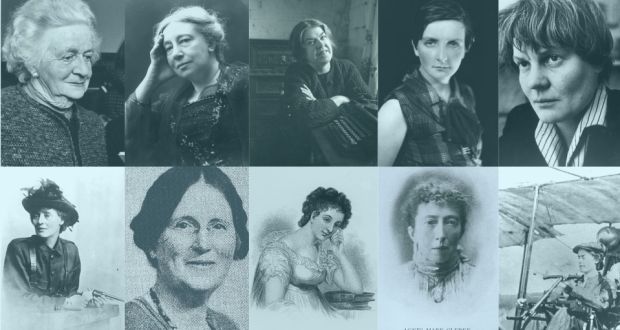
Trinity College’s new sculpture: 30 women to put on a pedestal

It has been more than 200 years coming, but better late than never: the provost of Trinity College Dublin wants the first woman to join the 40 men memorialised in marble busts in the Long Room of the Old Library. 


Worthy of honour:  all of these women, from Thekla Beere (top left) to Lillian Bland (bottom right), are ideal candidates for Trinity College Dublin's Long Room bust

Patrick Prendergast has asked for nominations for who should sit alongside Aristotle, Isaac Newton, Edmund Burke and Jonathan Swift, among others. The woman needn’t have a Trinity connection nor be Irish, just be a scholar who is no longer alive. 

To get the ball rolling, here are 30 Irish scholars, writers and thinkers worth considering for the honour. 

read more here @ Irish Times

Saturday, October 21, 2017

The forgotten 'female Lawrence of Arabia' - Gertrude Bell


In a picture taken to mark the Cairo Conference of 1921, Gertrude Bell - characteristically elegant in a fur stole and floppy hat, despite being on camel back - sits right at the heart of the action. To one side is Winston Churchill, on her other TE Lawrence, later immortalised in David Lean’s 1962 epic, Lawrence of Arabia.

Bell was his equal in every sense: the first woman to achieve a first (in modern history) from Oxford, an archaeologist, linguist, Arabist, adventurer and, possibly, spy. In her day, she was arguably the most powerful woman in the British Empire - central to the decisions that created the modern Middle East and reverberate still on the nightly news.  Yet while Lawrence is still celebrated, she has largely been forgotten.

read more her @ The Telegraph


About Gertrude Bell
  • The Extraordinary Gertrude Bell edited by Mark Jackson & Andrew Parkin
  • Gertrude Bell: Queen of the Desert, Shaper of Nations by Georgina Howell
  • Queen of the Desert: The Extraordinary Life of Gertrude Bell by Georgina Howell
  • Daughter of the Desert: The Remarkable Life of Gertrude Bell by Georgina Howell
  • Desert Queen by Janet Wallach
  • Gertrude Bell: The Lady of Iraq by H.V.F. Winstone


Written By Gertrude Bell:
  • Persian Pictures
  • Syria
  • A Woman In Arabia
  • The Hafez Poems of
  • The Desert & The Sown: Travels in Palestine and Syria
  • The Arabian Diaries, 1913-1914
  • Review of the Civil Administration in Mesopotamia
  • The Letters of Gertrude Bell - Volumes 1-2
  • Tales from the Queen of the Desert
  • The Arab of Mesopotamia

Sarah Siddons - The most famous tragedienne of the 18th century


Sarah Siddons was an actress born in Wales and was the most famous tragedienne of the 18th century, most notably for her role as Lady Macbeth, the wife of the play’s protagonist in Shakespeare’s Macbeth.
Sarah Siddons was a star. A charismatic character that enchanted everybody on and off stage. Unfortunately, her private life wasn’t as bright as her social life and acting career. In 1773, when she was only 18, Sarah married the actor, William Siddons.
They had seven children together, but Sarah outlived five of them, while her marriage ended up in an informal separation. Sarah died in 1831, at the age of 75, and was interred there in Saint Mary’s Cemetery at Paddington Green.


read more here @ The Vintage News

Monday, November 19, 2012

18th Century Birthing Chair

From io9:
From the ancient times until the 1800s, many women gave birth with the aid of parturition chairs, specially designed seats that allowed women to sit upright or recline while giving birth. This particular chair had padded leather rests for the mother's legs, but the parturition chairs came in a number of flavors. Some had extendable leg rests that aren't a far cry from modern gynecological stirrups. Others were much simpler, simply giving those assisting with the birth easy access to the infant while the mother remained somewhat upright.


Thursday, August 16, 2012

Mary Toft - Bunnies In The Oven

From the Wellcome Library:
In November 1726, a woman named Mary Toft was at the center of a public debate that included some eminent physicians of the day. Mary Toft became known as the Surrey Rabbit Breeder, based on the account that after a series of miscarriages, she began to give birth to rabbits. This continued in the presence of a Swiss anatomist connected with the court of George I, Nathanael St. Andre. St. Andre published A Short Narrative of an Extraordinary Delivery of Rabbets, and other pamphlets and broadsides followed. Toft came to London, where, after the 17th rabbit 'birth', many became convinced the matter was a hoax. Toft then confessed and St. Andre apologized.

See also the 18th century manuscripts from the Wellcome Library

And from The Curious Case of Mary Toft:
In September 1726, news reached the court of King George I of the alleged birth of several rabbits to Mary Toft (1703-1763) of Godalming, near Guildford, in Surrey.


Toft was a twenty-five year old illiterate servant, married to Joshua Toft, a journeyman clothier. According to reports, despite having had a miscarriage just a month earlier in August 1726, Mary had still appeared to be pregnant. On September 27th, she went into labour and was attended initially by her neighbour Mary Gill, and then her mother in law Ann Toft. She gave birth to something resembling a liverless cat.

The family decided to call on the help of Guildford obstetrician John Howard. He visited Mary the next day where he was presented with more animal parts which Ann Toft said she had taken from Mary during the night. The following day, Howard returned and helped deliver yet more animal parts. Over the next month Howard recorded that she began producing a rabbit's head, the legs of a cat, and, in a single day, nine dead baby rabbits.

Howard sent letters to some of England's greatest doctors and scientists and the King's secretary, informing them of the miraculous births.


Wednesday, August 8, 2012

A Danish Royal Affair


In 1769 the German outsider, Johann Struensee, arrived in Copenhagen as the physician and companion to the deranged Christian VII. By the end of that year he had not only made great political strides in a country that had the most complete absolute monarchy left in Europe, but had also become the lover of the queen, George III’s youngest sister, Caroline Mathilde. With her agreement, and the acquiescence of the king, Struensee took over the running of the state and attempted to transform Denmark into a model of enlightened absolutism. Struensee and Caroline Mathilde had a daughter; radical reforms multiplied; chaos mounted; enemies massed; violence and tragedy ensued.


Now, thanks in part to the surge of popular interest in Scandinavia, the first film to tackle the story has been released. A Royal Affair stars Alicia Vikander and Mads Mikkelsen. 

It is a beautiful film, tonally taking its cue from the historical epics of Luchino Visconti. Like these, it builds tension to gathering disaster with visual clues. The director, Nikolaj Arcel, is creditably true to the facts. At no point does he seriously deviate from the historical record. But this is a feature film not a documentary attempt to recreate the past and, like every historical fiction, it is therefore also necessarily a portrait of the present.