Showing posts with label royal women. Show all posts

Tuesday, September 7, 2021

Ludmila, the first Czech saint, grandmother of Wenceslas, martyred 1100 years ago

Saint Ludmila, the first historically documented Duchess of Bohemia, was martyred 1100 years ago this September – strangled by assassins sent by her own daughter in law. Best known today as the grandmother and educator of the Czech patron saint “good King Wenceslas”, Saint Ludmila was among the few women in history to de facto rule over Bohemia.

Princess Ludmila, as she is also known, was the wife of Bořivoj, founder of the Přemyslid dynasty. Sometime in the late 9th century, he converted to Christianity during a visit to the court of Great Moravia, and was allegedly baptised by none other than Saint Methodius, the Byzantine missionary known along with his brother Cyril as the “Apostles of the Slavs”.

Little is known for certain about Ludmila’s life before the death of her husband, other than that she was the daughter of a Sorbian prince, likely born in Mělník, central Bohemia, married Bořivoj in her teens, and had as many as six children with him.

But, says Dr Jakub Izdný of the Institute of Czech History at Charles University, author of a new book on Ludmila published ahead of the 1100-year anniversary of her death, she is the first historically known Czech woman, and quite likely the first woman to rule Bohemia.

read more here @ Radio Prague International

Sunday, January 21, 2018

The only Empress of India was a Muslim


Not many Indians realise or remember that the only Empress of India lived and died 800 years ago.

Razia Sultana – Life History, Facts, Achievements & Death

India was ruled by slave dynasty from Turkey during 1206 and 1290 AD. Qutab-ud-din Aibak was the first emperor from slave dynasty and he set up the Delhi Sultanate. His son-in-law Iltutmish succeeded him. Razia was the daughter of Iltutmish and granddaughter of Qutab-ud-din, who had begun building the Qutab Minar in Delhi and who lies buried in Lahore.


Razia Sultan ruled over India for just about four years between 1236 and 1240, but she left an indelible imprint during this short period on Indian history.


More on Razia Sultan:

Further reading:
* The Legend Makers: Some Eminent Muslim Women of India by Gouri Srivastava
* Status of Muslim Women in India edited by Hajira Kumar
* Royal Mughal Ladies and Their Contributions by Soma Mukherjee

Sunday, April 30, 2017

Matilda, Daughter of Henry I | History Extra

Another great article in History Extra, this time by historian Helen Castor on one of England's more enigmatic pseudo-Queens of England - Matilda, Empress and daughter of King Henry I of England (March 2012).


A little snippet for you - read more here @ History Extra:
Matilda’s story left a complex and ambiguous precedent in English politics. Women could pass on the throne to their male heirs, that much was clear, and no principle had been explicitly established to exclude them from the succession.
All that stood in the way of Matilda’s path to the throne, it transpired, was another coup exactly like the one that had made her father king. The result was civil war. Despite her sex, Matilda’s claim was not dismissed out of hand by the nobles she sought to rule. 

Matilda is a fascinating character - much has been written about her and her times, most notably, “Queen Emma & Queen Edith: Queenship and Women’s Power in Eleventh-Century England” by Pauline Stafford, and “The Empress Matilda: Queen Consort, Queen Mother and Lady of the English” by Majorie Chibnall.


Tuesday, December 6, 2016

PLOS ONE: Queen Nefertari, the Royal Spouse of Pharaoh Ramses II: A Multidisciplinary Investigation of the Mummified Remains Found in Her Tomb (QV66)

PLOS ONE: Queen Nefertari, the Royal Spouse of Pharaoh Ramses II: A Multidisciplinary Investigation of the Mummified Remains Found in Her Tomb (QV66) 

Queen Nefertari, the favourite Royal Consort of Pharaoh Ramses II (Ancient Egypt, New Kingdom, 19th Dynasty c. 1250 BC) is famous for her beautifully decorated tomb in the Valley of the Queens. Her burial was plundered in ancient times yet still many objects were found broken in the debris when the tomb was excavated. Amongst the found objects was a pair of mummified legs. They came to the Egyptian Museum in Turin and are henceforth regarded as the remains of this famous Queen, although they were never scientifically investigated. The following multidisciplinary investigation is the first ever performed on those remains. The results (radiocarbon dating, anthropology, paleopathology, genetics, chemistry and Egyptology) all strongly speak in favour of an identification of the remains as Nefertari’s, although different explanations—albeit less likely—are considered and discussed. The legs probably belong to a lady, a fully adult individual, of about 40 years of age. The materials used for embalming are consistent with Ramesside mummification traditions and indeed all objects within the tomb robustly support the burial as of Queen Nefertari. 

Read More here @ PLOS ONE and Science Recorder and Eureka Alert

Monday, June 13, 2016

Kiya - The Most Mysterious Woman of Amarna

Kiya - The Most Mysterious Woman of Amarna | Ancient Origins

The only thing we really know for certain about Kiya is her name, written in the forms kiya, kiw, kia, kaia, and that she was a wife of Akhenaten titled The Great Beloved Wife .  Much information about Kiya was lost over time and nowadays information about her is mixed with the biographies of Nefertiti and other women of Amarna, leading to an air of mystery about who Kiya really was.
The most fascinating part of the research about Kiya is connected with the mummy of the Younger Lady discovered in tomb KV35. It was the second ''cachette'', after DB320, found with royal mummies inside. The tomb, which was reopened in 1907, was the final resting place for two women known as the Younger Lady and the Elder Lady, who were found lying next to each other.
Dr Joann Fletcher, the famous Egyptologist from York University, announced in 2004 that the Younger Lady was the beautiful Queen Nefertiti. French researcher, Marc Gabolde, in his recently published theory, follows Fletcher's opinion.

Who Was Sattjeni?

Who Was Sattjeni? Tomb Reveals Secrets About Ancient Egyptian Elite


The coffin, discovered this year in the necropolis at Qubbet el-Hawa across the Nile River from Aswan, belonged to an important local woman, Sattjeni, daughter of one governor, wife of another and mother of two more, said excavation leader Alejandro Jiménez-Serrano, an Egyptologist at the University of Jaén in Spain. Sattjeni's mummified body was buried in two cedar coffins made of wood imported from Lebanon. Though the outer coffin had degraded over the nearly 4,000 years since Sattjeni's death, her inner coffin was in excellent condition, according to Egypt's antiquities ministry, which announced the discovery May 24.

The woman behind Egypt's most powerful rulers.
The daughter of a prince and the mother of two of the most powerful governors in the Middle Kingdom of Egypt, a noblewoman known as Lady Sattjeni has been unearthed some 3,800 years after her death, in an ancient tomb in southeastern Egypt. Wrapped in linen and deposited inside a wooden coffin inside another wooden coffin, Sattjeni’s remains are still remarkably preserved, and were found alongside an inscription identifying her as the woman whose family sat directly below pharaoh Amenemhat III, who ruled ancient Egypt from 1800 to 1775 BC.


Tomb of 12th Dynasty Noblewoman Unearthed in Egypt
The tomb of a prominent lady called Sattjeni, who lived during the reign of the 12h Dynasty, was discovered by Spanish Egyptologists in the necropolis of Qubbet el-Hawa (West Aswan), Egypt. The team of researchers from the Jaén University in Spain has been working on West Aswan since 2008 and, since that year, has discovered several intact burials from different time periods. However, the most recent discovery appears as one of the most impressive. The group led by Alejandro Jimémez-Serrano discovered the tomb of Sattjeni, who appears as one of the most important women of her times. According to El Confidencial , inside the tomb the researchers discovered the remains of a woman, who was buried in two wooden coffins. The inscription allowed the identification of her name.


Sunday, December 15, 2013

Statuette of Ankhesamon

From Hurriyet Daily News:
Image by Winifred Brunton
Egypt said Sunday it has recovered a statue of pharaoh Tutankhamun's sister looted from the southern Mallawi museum during riots by supporters of ousted president Mohamed Morsi.
 
The 32 centimetre limestone statue of Ankhesamon, sister of the famous boy king and daughter of pharaoh Akhenaten, who ruled around 1,500 BC, was stolen on August 14.
 
"The piece is one of the most important in the museum," said antiquities minister Mohamed Ibrahim in a statement.


Links to Ankhesenamun:
Ankhesenamun on wikipedia
Ankhesenamun on Ancient Egypt Online
Ankhesenamun - Ancient Egypt on St Louis University website
Ankhesenamum on Spiritweb

Sunday, November 24, 2013

Women in the Wari Empire

From Peruvian Times: Archaeologists Uncover Remains of Girl Sacrificed Some 1,500 Years Ago
Archaeologists have uncovered remains of a girl who was most probably used as a sacrifice some 1,500 years ago, according to RPP Radio.
The discovery was made in the district of Yautan, 40km inland from Casma in the Ancash region. The remains of the girl were discovered in a tomb by a group of archaeologists and students from the University of Santiago Antunez de Mayolo in Huaraz.
The archaeologists believe the girl could have been sacrificed as an offering to gods of the sea, perhaps as protection against the climate changes caused by the El Niño ocean current.
The Wari empire spanned much of modern Peru during the 8th and 9th Centuries A.D. Experts say that its capital, Huari, had a population of some 40,000 people, which would have been a major global urban center at the time. Much is still not known about the Wari, which like other pre-Hispanic civilizations, is overshadowed in Peru by the Incas.

From the Telegraph: Wari empire royal tomb discovered in Peru
Archaeologists in Peru say they have unearthed a massive royal tomb full of mummified women that provides clues about the enigmatic Wari empire that ruled the Andes long before the Incas.

From Adventure Life: Ancient Peru Brewery
Archeologists have only scratched the surface of discovery in many areas. A recent itch: the historic mountain-top city of Cerro Baúl. Here, at over 8,000 feet above sea level, an ancient brewery of the Wari Empire was found. Twenty ceramic 10 to 15 gallon vats suggest that this was much more than a Mom-and-Pop-shop. In fact, it may be the oldest large-scale brewery ever found in the Andes. It was used to produce great quantities of chicha, a fermented beverage similar to beer made from barley and berries of the pepper tree, Schinus molle.

From ABC News: Royal Peruvian tomb with scores of mummified women sheds light on Wari empire
Archaeologists in Peru have unearthed a massive royal tomb full of mummified women which provides clues about the enigmatic Wari empire that ruled the Andes long before their better-known Incan successors.
The mausoleum, unearthed a few months ago at a coastal pyramid site called El Castillo de Huarmey, 299 kilometres north of Lima, contained gold pieces, ceramics and 63 skeletons about 1,300 years old.
Researchers said the discovery will help them piece together life in the Andes centuries before the rise of the Incan empire, which was written about in detail by the conquering Spaniards.

From National Geographic: First Unlooted Royal Tomb of Its Kind Unearthed in Peru
Three queens were buried with golden treasures, human sacrifices
It was a stunning discovery: the first unlooted imperial tomb of the Wari, the ancient civilization that built South America's earliest empire between 700 and 1000 A.D. Yet it wasn't happiness that Milosz Giersz felt when he first glimpsed gold in the dim recesses of the burial chamber in northern Peru.
Giersz, an archaeologist at the University of Warsaw in Poland, realized at once that if word leaked out that his Polish-Peruvian team had discovered a 1,200-year-old "temple of the dead" filled with precious gold and silver artifacts, looters would descend on the site in droves. "I had a nightmare about the possibility," says Giersz.

Monday, November 11, 2013

Cornell Returns The Garshana Archives


From an article in the LA Times Online:
Cornell University is preparing to forfeit to Iraq a vast collection of ancient cuneiform tablets in what is expected to be one of the largest returns of antiquities by an American university.

The 10,000 inscribed clay blocks date from the 4th millenium BC and offer scholars an unmatched record of daily life in ancient Mesopotamia, the cradle of civilization.

Among the tablets is the private archive of a 21st century BC Sumerian princess in the city of Garsana that has made scholars rethink the role of women in the ancient kingdom of Ur. The administrative records show Simat-Ishtaran ruled the estate after her husband died.

During her reign, women attained remarkably high status. They supervised men, received salaries equal to their male counterparts' and worked in construction, the clay tablets reveal.


See also:

Garsana Tablets in the Cuneiform Library at Cornell University
Sumerian Shakespeare - website dedicated to Sumerian art, culture & history


More on Ancient Sumerian Women

Friday, May 17, 2013

Joan of Portugal

The following is a guest post by Laura Diaz on an intriguing woman from Spanish history.  Please enjoy!

Joan of Portugal
Joan of Portugal is one of the most misunderstood women in history as her role during her time as Queen of Spain during the late 15th Century has never truly been agreed upon. Some have described her as power-hungry, while others saw her as a victim to an unsupportive husband. Joan, sister of the King of Portugal, married into the Spanish royal family during King Henry IV's reign—brother of the future Queen Isabella the Catholic.
Joan was the second wife of Henry IV as his first three-year marriage was granted an annulment, as it had never been consummated. Seven years after their marriage, Joan finally had her first daughter, also named Joan, but her paternity was always in doubt. Detractors of the court claimed that Joan was having an affair with Beltran de la Cueva, advisor to the court, and that he was the real father. Joan and Henry denied that claim, and insisted she was the rightful heir to the throne.
During this period, Joan insisted that Henry's teenaged brother and sister, Alfonso and Isabella, forcefully be brought to the castle and away from their sick mother. Many saw this as a way of making sure her daughter's path to the crown would encounter no obstacles.
The growing state of discontent amongst the Spanish kingdom, led noblemen and peasants to support Henry's brother, Alfonso, to be the next king, alleging he was the legitimate heir to the throne. Joan forcefully opposed this using all her political connections to try and stop this growing movement.  As rumors of Joan's sexual indiscretions grew, one of the nobles terms in negotiation was that Henry banish his wife from the court to live with Bishop Fonseca, one of his greatest supporters during the conflict. Henry agreed, trying to remain in power and please those around him.
Scandal broke that Joan had a love affair with the Bishop's nephew and became pregnant with twins. This confirmed the previous rumors and, combined with the weakness of King Henry, the nobility was successful in forcing him to step out of power and name his middle brother Alfonso as King of Castile.

Alfonso's reign only lasted a few years as he mysteriously died soon after taking the thrown. A new war emerged looking for the heir to the throne. Joan once again tried to push her daughter as the legitimate heir, but all the previous conflicts had left her essentially powerless. Isabella proved to be stronger, married King Ferdinand of Aragon, and garnered the support of the nobles. She was declared Queen.
Eventually Joan died in Madrid, away from all the power she once sought. There is no evidence to prove or refute all the claims that were made about her, but it is clear that she was a divisive figure. Perhaps all she wanted was to remain in power through whatever means necessary or maybe she was just a women looking for love and supporting her family, but all in all, no one can deny she was a strong and powerful woman.
Images come from the Spanish series Isabel, a modern hit telling the story behind this amazing period of time in the Spanish court.

Links to the Spanish series "Isabel":


Sunday, February 3, 2013

From Secretary To King

From CNN:
When Peggielene Bartels went to bed on a summer night in 2008, she was an ordinary administrative assistant living in a modest one-bedroom condo just outside Washington D.C.

But a few hours later, when a persistent ringing phone woke her up in the dead of the August night, the 55-year-old found out she was much more than simply a secretary.

At the other end of the line was Bartels's cousin, from Otuam, a small fishing village on the coast of Ghana. Excited and humble, he congratulated her on being the new king of Otuam.

After the initial shock, Bartels decided to accept the kingship. Over the course of a few days, she went from being plain old Peggielene Bartels, who had worked for nearly three decades at the Ghanaian Embassy in the United States, to becoming King Peggy -- the first female king of Otuam, reigning over approximately 7,000 people.


Wednesday, August 8, 2012

A Danish Royal Affair


In 1769 the German outsider, Johann Struensee, arrived in Copenhagen as the physician and companion to the deranged Christian VII. By the end of that year he had not only made great political strides in a country that had the most complete absolute monarchy left in Europe, but had also become the lover of the queen, George III’s youngest sister, Caroline Mathilde. With her agreement, and the acquiescence of the king, Struensee took over the running of the state and attempted to transform Denmark into a model of enlightened absolutism. Struensee and Caroline Mathilde had a daughter; radical reforms multiplied; chaos mounted; enemies massed; violence and tragedy ensued.


Now, thanks in part to the surge of popular interest in Scandinavia, the first film to tackle the story has been released. A Royal Affair stars Alicia Vikander and Mads Mikkelsen. 

It is a beautiful film, tonally taking its cue from the historical epics of Luchino Visconti. Like these, it builds tension to gathering disaster with visual clues. The director, Nikolaj Arcel, is creditably true to the facts. At no point does he seriously deviate from the historical record. But this is a feature film not a documentary attempt to recreate the past and, like every historical fiction, it is therefore also necessarily a portrait of the present. 


Monday, April 9, 2012

Interview: Princess Basma Bint Saud Bin Abdulaziz

From BBC News:
Princess Basma Bint Saud Bin Abdulaziz tells the BBC there are many changes she would like to see in Saudi Arabia - but that now is not the time for women to be allowed to drive.

I speak as the daughter of King Saud, the former ruler of Saudi Arabia. My father established the first women's university in the kingdom, abolished slavery and tried to establish a constitutional monarchy that separates the position of king from that of prime minister. But I am saddened to say that my beloved country today has not fulfilled that early promise.


Our ancient culture, of which I am very proud, is renowned for its nobility and generosity, but we lack, and urgently need, fundamental civil laws with which to govern our society.

As a daughter, sister, (former) wife, mother, businesswoman and a working journalist, these are the things that I would like to see changed in Saudi Arabia.

Sunday, November 27, 2011

Change For Japanese Royal Women

From the Examiner:
The Japanese government is reportedly considering some significant changes to Imperial House Law. Specifically, they are looking at an ancient law which stipulates that if a woman in the royal family marries a commoner she is no longer an official member of the royal family.

Currently, there are only seven men out of a 23 member royal family, and five of those men are over the age of 60. The aging of the men, and the marrying of the women, present a major hurdle in keeping up with their public duties. The remaining men in the family just simply could not complete the number of engagements they currently do, without women to assist them. The anxiety around the issue has only increased with the recent hospitalization of the Emperor. Changes look likely to happen, and the most immediate effect will be to TIH Princesses Mako and Kako, both unmarried daughters of TIH Prince Akishino and Princess Kiko. Changes would also affect HIH Princess Aiko, 9 but obviously she is a ways from marrying age. Aiko remains the only child of TIH Crown Prince Naruhito and Crown Princess Masako and is not in line to inherit the throne due to the succession laws in Japan. There is currently not push to change the law since the birth of Prince Hisahito has slotted him as third in line behind his uncle and father.


Friday, September 23, 2011

Tomb of Mayan Female Ruler

A woman ruler's skeleton—her head mysteriously placed between two bowls—is one of two royal burials recently found at the Maya ruins of Nakum in Guatemala.

The roughly 2,000-year-old tomb was found underneath another, 1,300-year-old tomb filled with treasures such as jade gorgets—normally used to protect the throat—beads, and ceremonial knives.

The upper tomb's corpse had been badly destroyed by rodents within the last few centuries, but the body was clearly that of another Maya ruler-perhaps another female, based on the small size of a ring found in that tomb.
The royal burials are the first discovered in Nakum, once a densely packed Maya center. Study co-author Wiesław Koszkul and colleagues have been investigating Nakum's surroundings, known as the Cultural Triangle, for decades. (Explore an interactive map of key Maya sites.)

"We think this structure was something like a mausoleum for the royal lineage for at least 400 years," said Koszkul, of the Jagiellonian University Institute of Archaeology in Krakow, Poland.

The Maya royal-tomb discoveries are described in the September issue of the journal Antiquity.

Tuesday, September 6, 2011

HRH Princess Lalla Aicha

From AllAfrica:
French historian Charles Saint-Prot said that all Morocco's friends were saddened by the news of the death, on Sunday, of HRH Princess Lalla Aicha, "one of the leading figures in the fight for the emancipation of the Moroccan women."

The late princess made history during the historical visit of Sultan Mohammed V to Tangier in April 1947, Saint-Prot told MAP.

"Princess Lalla Aicha, who was also the first women in the Arab world to hold diplomatic positions, was a brilliant symbol of the reformist aspect of a Moroccan monarchy that has been geared towards progress," said the historian and author of the book "Mohammed V or the popular monarchy," to be published by Rocher in late 2011.

Tuesday, June 7, 2011

Princess Ennigaldi's Museum

From io9:
In 1925, archaeologist Leonard Woolley discovered a curious collection of artifacts while excavating a Babylonian palace. They were from many different times and places, and yet they were neatly organized and even labeled. Woolley had discovered the world's first museum.

o who was responsible for this ancient wonder full of even more ancient wonders? That honor goes to Princess Ennigaldi, the daughter of King Nabonidus, the last king of the Neo-Babylonian Empire. As was traditional for the daughters of Mesopotamian kings, her primary duties were religious in nature, both as the high priestess of the moon god Nanna and as the administrator of a school for young priestesses. It was around 530 BCE that Ennigaldi created her museum. That comes dangerously close to being everything we know about the woman behind the world's first museum.

Wednesday, May 18, 2011

Princess Ahmose-Meryet-Amon - Diagnosis

The coronary arteries of Princess Ahmose-Meryet-Amon - as visualised by whole body computerised tomography (CT) scanning - will feature in two presentations at the International Conference of Non-Invasive Cardiovascular Imaging (ICNC) this week in Amsterdam (15-18 May). ICNC is now one of the world's major scientific event in nuclear cardiology and cardiac CT imaging.

The Egyptian princess Ahmose-Meryet-Amon, who lived in Thebes (Luxor) between 1580 and 1550 BC and who is now known to be first person in human history with diagnosed coronary artery disease, lived on a diet rich in vegetables, fruit and a limited amount of meat from domesticated (but not fattened) animals. Wheat and barley were grown along the banks of the Nile, making bread and beer the dietary staples of this period of ancient Egypt. Tobacco and trans-fats were unknown, and lifestyle was likely to have been active.

Tuesday, May 10, 2011

Celtic Princess Grave

German archaeologists are examining a Celtic grave in the Danube heartland when they found the remains of a Celtic princess, from 2,600 years ago, buried with her gold and amber jewelry.

The princess had remained in her final resting place since about 609BC. Just months ago the German experts began to dig out the 80 tonnes of clay covering the grave to remove it bring it their offices where it could be examined.

Experts believe that the manner that she was buried, with expensive jewels, shows that she was of a high social rank. The brooches found are particularly beautiful with Celtic designs in gold and amber. According to BBC reports the remains of a child were also found in the grave. The child is presumed to be the princess'.

Saturday, January 1, 2011

Film: Rebel Queen


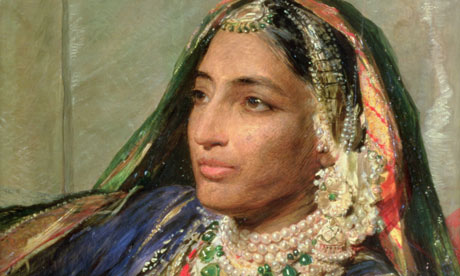
The film Rebel Queen tells the remarkable story of the last Sikh ruler of Lahore – a fearless Maharani who waged two wars against British rule in India. She is an inspiring figure for young Asian women today.

An Indian woman wearing a crinoline over her traditional clothes, and emeralds and pearls under her bonnet, walks in Kensington Gardens in 1861. She is the last Sikh queen of Lahore, the capital of the Punjab empire, and her name is Jindan Kaur. She died two years later, in 1863, and was buried in west London.

Maharani Jindan Kaur's life – much of which was spent raging against the British empire for cheating her out of the Punjab, then a vast country stretching from the Khyber Pass to Kashmir – is the subject of a film called Rebel Queen, which premiered at New York's International Sikh film festival and is set to be shown in the UK in February.