Showing posts with label 17th century. Show all posts

Friday, January 1, 2021

Ancient manuscripts reveal the role of 17th century women

More than analyzing textual and linguistic structures and interpreting ancient writings, Philology as a human science can surprise us and reveal “existing layers of a society” from the past. This was the case in a study that transcribed “Letters of Dates”, a kind of land deed, from Jundiaí, in the middle of the 17th century. At the time, amid requests for possession, widowed, married and single women they were among the “supplicants” of extensive areas, addressed to the public power of the city. The ancient manuscripts (1657), which date from the colonial period, are now filed at the Memory Center of the municipality of Jundiaí, in the interior of the State of São Paulo, and were the object of study by researcher Kathlin Carla de Morais, from the Faculty of Philosophy, Letters and Human Sciences (FFLCH) from USP.

According to the study, this intertwining of religious, political and cultural powers can be explained in this period by the fact that the city councils were the regulators of everything that happened in the region. The guidelines they followed were inspired by sources from the Portuguese judicial system, which dealt with the State’s relations with the Church and guided civil and commercial processes, based on Roman and canon law. This land concession scheme lasted until the 19th century with the Land Law (1850), which started to use the purchase and sale model for the acquisition of floors.


read more here @ Indian Education Diary

Saturday, February 10, 2018

Maria Solina - The Most Famous Witch of Galicia


Witchcraft has a very special place in the culture of Spanish Galicia. One of the most famous people related to the old magical traditions is Maria Soliña, a Galician witch who lived during the 17th century. Despite her openness about supernatural practices, the intelligence of this remarkable woman allowed her to avoid the stake during the Inquisition.


We can discern the following from what little is known of this woman:

  • she was born in Cangas de Morrazo sometime in the last half of the 16th century
  • in 1617 a squadron of Turkish pirates reached the Vigo estuary, where it was the local women led the defence
  • she married Pedro Barba, a fisherman from the village, who with his brother created a viable fishing company whilst Maria held estates in her own right
  • the most important possession of the family were the rights of presentation in the Collegiate of Cangas de Morrazo and in the Church of San Cibrán de Aldán (by this right, the successors of the founder of a church could propose its sccessor when it became vacant, and in turn reap the benefits that the benefice generated rather than the Church)
  • purportedly in her 60s, she was accused of witchcraft (22nd Jan 1622) and brought before the Inquisition in Compostela (though it was said that this was merely a ruse to cover up the real reason for her imprisonment - the acquisition of her wealth and benefices, which naturally reverted to the Church)
  • she was tortured and later revealed that she was indeed a witch (or meigas)
  • she survieved the Inquisition to be released to a life of poverty
  • the date of her death is unknown


Friday, December 29, 2017

New Renaissance: how Florence is freeing its great female artists

From The Guardian:

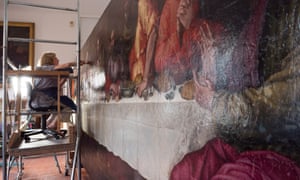
Unfairly neglected … Rossella Lari restores The Last Supper by Plautilla Nelli.
Rossella Lari restores The Last Supper by Plautilla Nelli.
Ask most people to name a female artist, and chances are they will come up with a contemporary figure: Tracey Emin, Rachel Whiteread or Paula Rego. Or they’ll name a 20th-century artist such as Frida Kahlo, or Georgia O’Keeffe. What they won’t do, though, is name one of the 16th- or 17th-century women who painted during and in the years following the Renaissance. Nelli is one of many female artists – including Artemisia Gentileschi, one of the most accomplished followers of Caravaggio, and Marietta Robusti who learned from her father Tintoretto – that history has unfairly neglected.

Now, though – nearly half a millennium on – that is beginning to change. AWA, which was established in 2009 by US philanthropist Jane Fortune, is committed to rediscovering all the works by women that lie forgotten in the museum attics and churches of Florence: at least 2,000 so far. When a painting is found, crowdfunding and special appeals pay for its restoration.

read more here @ The Guardian and here @ AWA (Advancing Women Artists)


Sunday, November 5, 2017

The witch trial that made legal history

Article in BBC News about the Pendle witch trials:

In recent years children as young as three have given evidence in court cases, but in the past children under 14 were seen as unreliable witnesses. A notorious 17th Century witch trial changed that.
Nine-year-old Jennet Device was an illegitimate beggar and would have been lost to history but for her role in one of the most disturbing trials on record. Jennet's evidence in the 1612 Pendle witch trial in Lancashire led to the execution of 10 people, including all of her own family.
Her convincing evidence was believed by the jury and after a two-day trial all her family and most of her neighbours were found guilty of causing death or harm by witchcraft.
Ultimately though, Jennet fell victim to the very precedent she set herself in 1633. Twenty years after the trial she too was accused of witchcraft along with 16 others by 10-year-old Edmund Robinson.
read more here @ BBC News

read also: Mary Sharratt's "Daughters of the Witching Hill"

Sunday, September 10, 2017

Who Was Julie d’Aubigny - aka Mademoiselle Maupin?

From OZY comes this interesting post on 
How many duels do you think you could fight in a single day? A glimpse at one badass French swordswoman in action offers a possible answer: three. After attending a royal ball dressed as a man, and romancing and then kissing another woman on the dance floor, she was challenged by three men. She proceeded to take them on one by one, and to best all three.

“Most of the more astonishing events happened before she was 20.” While researching Goddess, [Kelly] Gardiner visited every known location of one of d’Aubigny’s most notorious exploits and pored over primary sources for information about her wily subject. What she found: a woman who flouted social convention, class, gender, marriage and the law.
Read more here @ Kelly Gardiner's website and also an interview here @ NPR
Read more about Julie d’Aubigny @ wikipedia

Friday, March 3, 2017

Maria Cunitz - 17th-Century Astronomer

Urania Propitia is a remarkable volume for many reasons. Published in 1650, this work of astronomy demonstrates a command of high-level mathematics and astronomical calculation. It also reveals a deep understanding of Keplerian astronomy; its author both simplified and corrected Kepler's math for locating planetary positions. Finally, the book was written in German as well as Latin, which helped to both establish German as a language of science and make the tables accessible outside of the university. But Urania Propitia lays claim to yet another impressive quality: It was written by a woman .......an astronomer named Maria Cunitz.


Publication (paid for by Maria c.1650) of this work — the earliest high-level printed scientific book written by a woman — caused Cunitz (1610 - 1664) to be aclaimed as the most learned woman in astronomy since the Neoplatonist philosopher Hypatia of Alexandria.


Sunday, July 13, 2014

The Case of Mistress Mary Hampson


From the Daily Mail comes a harrowing tale of marital abuse from the 17th century:
A pamphlet detailing the beatings, threats and intimidation endured by a Yorkshire housewife more than 300 years ago has been uncovered by academics at the University of Huddersfield.

In the work, which dates from 1684 (A Plain and Compendious Relation of the Case of Mrs. Mary Hampson, as it Now is: And Formerly Printed for the Satisfaction of a Private Friend, But Now is Set Forth by Her Relief), a woman named Mary Hampson lists the catalogue of abuse she suffered at the hands of her overbearing and violent husband.

Although Mrs Hampson eventually escaped her abusive spouse, she first endured being beaten and starved and a violent incident involving a gun - all of which is detailed the 1684 pamphlet.

In her new book, The Case of Mistress Mary Hampson, academic Dr Jessica Malay includes the full text of the 1684 pamphlet plus extensive extra material, which examines the episode in depth and rounds out the story of Mary, who died in 1698, after a few short, final years of relative peace and prosperity.


For more on the story see:


Monday, December 23, 2013

More on St Ketevan

Further on from my post "Mystery of Saint Ketevan" in June 2011, comes this article from Past Horizons - Search for relics of martyr Queen Ketevan:

DNA analysis has confirmed that a relic discovered by archaeologists amongst the ruins of St. Augustine’s Church in Goa, southeast India, is likely to be that of 17th century Queen Ketevan from the Kingdom of Kakheti in eastern Georgia.
Since 1989, various delegations from Georgia have worked together with the Archaeological Survey of India (ASI) to locate Ketevan the Martyr’s relics within the Augustinian church which was founded in 1572. There have been several unsuccessful attempts at locating the relics, but finally the continued searching has paid dividends for the team.
As per the literary sources, the relic box of Queen Ketevan was expected to be at the second window of the chapter chapel towards the Epistle side. Therefore, this area was systematically explored in 2004 for a stone sarcophagus, which was found broken into pieces due to the collapse of the wall. Whilst clearing the rubble the team also found an arm bone. Two other bone relics were recovered from outside the second window area, within intact stone boxes.
See also this post on the "Wordcraft & Statecraft" blog: Queen Ketavan's Bones Discovered & Identified

Sunday, November 24, 2013

Debate on French Royal Head

Further on from my post "Henri IV of France Identified" back in 16th December 2010 and the post from Live Science of 14th December 2010 (Mummy Head (and Brain) Identified as Long-Lost French King), comes this series of articles now doubting the identification of the royal skull.


PhysOrg: French King Henri IV's Head Stars In Forensic Dispute:
Doubt - and a reportedly royal severed head - haunts a murky corner of forensic science these days, as researchers squabble over an unearthed packet of mummified remains thought to have belonged to King Henry IV of France.
At the heart of the macabre drama is an embalmed head with several vertebrae still attached. The remains were found in 1919 in the Royal Basilica of St. Denis outside Paris and reportedly secreted away by a civil servant. Reappearing almost a century later, the specimen still had its soft tissue and organs intact, right down to the open mouth and partially closed eyes.

From the South China Morning Post: Forensic scientists in debate over head of King Henry IV of France:
Obtaining a sample of the mummified tissue, they conducted a genetic analysis and compared it with DNA samples given by three male descendants. Analysing the Y chromosome of the three descendants, and genes that reveal matrilineal descent, they found similarities among the three descendants. But none matched the disembodied head.
The team further compared the Y chromosome taken from the mysterious head with that taken from a blood-soaked handkerchief said to contain the genetic material of Louis XVI. The two samples did not match.

From Newser: Does This Head Belong To France's Henri IV?
Forensic researchers have a royal dispute on their hands: They can't agree on whether a mummified head belongs to France's Henry IV, explains the Los Angeles Times. The question seemed settled in 2010 when a team of researchers used facial-reconstruction techniques to conclude that it was indeed "Good King Henry," who was assassinated in 1610. But now a second team of scientists says it isn't so because DNA tests don't match Henry's living relatives.

From Fox News - Live Science: Lost Kings: DNA Fails To Solve History Mysteries:
The tale of the head and the gourd, however, is not quite so straightforward. In 2010, a forensic analysis suggested the head belonged to French King Henry IV. DNA later linked the head to the blood in the gourd, leading researchers to identify the blood's owner as Henry's descendant, French King Louis XVI. Now, however, a second DNA analysis has thrown those findings into disarray, suggesting perhaps the head and the blood belong not to royalty, but to nobodies.

From The Independent: Academics Scratch Heads Over Mystery of French King's Skull:
Four academics – including two who contributed to a report in the British Medical Journal which claimed a skull found in 1919 was the head of Henri IV – have now challenged the research after new DNA tests cast doubt on the authenticity of the remains.
The original report, published in the BMJ in December 2010, saw France’s pre-eminent forensic examiner, Dr Phillipe Charlier, and his team identify the partly preserved severed head as that of the monarch, who was assassinated in 1610 and is famous for ending the country’s religious wars.

From UPI: Forensic Researchers Debate Whether Head Belongs To Henry IV:
Forensic researchers have a royal dilemma on their hands: They can't reach consensus on whether a mummified head belongs to Henry IV of France.
In 2010, a team of researchers used facial-reconstruction techniques to conclude that it was indeed "Good King Henry," who was assassinated in 1610.
The case seemed closed.
Now, a second team of scientists says it can't be the royal head, since DNA tests do not match Henry's living descendants.

Monday, November 19, 2012

18th Century Birthing Chair

From io9:
From the ancient times until the 1800s, many women gave birth with the aid of parturition chairs, specially designed seats that allowed women to sit upright or recline while giving birth. This particular chair had padded leather rests for the mother's legs, but the parturition chairs came in a number of flavors. Some had extendable leg rests that aren't a far cry from modern gynecological stirrups. Others were much simpler, simply giving those assisting with the birth easy access to the infant while the mother remained somewhat upright.