Showing posts with label fashion. Show all posts

Friday, March 3, 2017

3,000 years of beauty enhancement in China

Chinese women have been attentive to their physical appearance since the ancient times. As is common with trends related to people's personal appearance, they come and go, only to regenerate and take on new forms when the circumstances are right.

Cosmetics have been used by people all around the world to accentuate their physical features for millennia. In China, this practice of face adornment gradually spread from the ruling class to the general population.

According to historical accounts, women in China were complementing their looks with lipstick, nail polish and perfumes as far back as two or three thousand years ago. During the imperial times, upper class women and traditional yiji entertainers, similar to Japan’s geishas, were the main trendsetters.

Read More Here @ GB Times

Thursday, February 16, 2017

The Improbable Life of the Inventor of the Modern Bra

Mary Phelps, known as Polly to friends, was born in 1891 to a family that could trace its heritage to such luminaries as William Bradford, Plymouth Colony’s first governor, and Robert Fulton, the inventor of the steamboat. As New England royalty, Polly grew up in New Rochelle, New York, wanting for nothing.
It wasn’t until 1910 that Polly realized something important was missing from her life. She was busy one day preparing for a debutante ball when she looked in the mirror and realized she loathed the way a corset made her look. It bunched up her bodice and squished her breasts into a single, uncomfortable monobosom. In her memoir, The Passionate Years, she referred to it as “a box-like armour of whalebone and pink cordage.”
Like all great innovators before her, necessity was the mother of Polly’s invention. She grabbed a handkerchief, ribbon, and a needle, and before the party was off the ground, had fashioned herself a new undergarment: the modern bra.
Read More Here: Atlas Obscura

Sunday, September 4, 2016

What Not To Wear: A Short History Of Regulating Female Dress

What Not To Wear: A Short History Of Regulating Female Dress From Ancient Sparta To The Burkini

 “Let’s keep in mind that it is no more freeing to tell a woman what she can wear than to tell her what she can’t.”
Few can deny that the various burkini bans put in place by towns on the French Riviera this summer have become symbolic of thecountry’s struggle over “secular identity.” The bans have seemed particularly odd to Italian beachgoers and others around the world, who have pointed out that nuns are often seen on Italian beaches in their habit. Despite the French Conseil d’Etat’s suspension of the burkini ban, local mayors continue to say they will enforce the dress code. Cogolin Mayor Marc Etienne Lansade told CNN, ”if you don’t want to live the way we do, don’t come...If you are accepted in Rome — do like Romans do.”  As it turns out, there is an ancient history of telling women what they can and cannot wear as a means of controlling a community’s political message.

Continue reading article here at Forbes dot com

Wednesday, January 1, 2014

History of the Hennin

Nothing says “princess” like a pointy, cone-shaped hat. From kids’ costumes to medieval paintings, the cone hat—more formally known as a hennin (or henin)—is a sure sign of royalty. But here’s something you might not know about the hat that adorn the heads of pale-skinned ladies: they were actually modeled after the hats of Mongol warrior queens.

Medieval PoC points to the book Secret History of the Mongol Queens, where author Jack Weatherford writes:
The contraption struck many foreign visitors as odd, but the Mongol Empire had enjoyed such prestige that medieval women of Europe imitated it with the hennin, a large cone-shaped headdress that sat towards the back of the head rather than rising straight up from it as among the Mongols. With no good source of peacock feathers, European noblewomen generally substituted gauzy streamers flowing in the wind at the top.

Thursday, June 6, 2013

Anti-Rape Fashion

“You might find a bit of armor useful when you become queen,” Cersei Lannister recently told a female rival on Game of Thrones. But her advice could just as easily apply to women from all walks of life—particularly now, in the aftermath of a series of high-profile sexual assaults around the world. In a reflex response to the quest for a societal aegis, a number of contemporary clothing designers have found armor (or a variation thereof) useful as a form of protection for women. Most recently, three Indian engineering students designed a bra even more kick-ass than the Queen of the Seven Kingdoms’ chest plate. The so-called Society Harnessing Equipment (SHE) reportedly delivers 82 shocks in response to an unwanted touch and was designed as “retaliation against menaces in society” after last year’s gang rape in Delhi.


Tuesday, February 5, 2013

Repeal of French Trouser Law

Further to my blog post from May 2012 - France: Paris' Trouser Law - comes this update from BBC News:

The French government has overturned a 200-year-old ban on women wearing trousers.
The Minister of Women's Rights, Najat Vallaud-Belkacem, said that the ban was incompatible with modern French values and laws.
She said the law, imposed on November 17, 1800, had in effect already been rescinded because of incompatibility.
The move to formally repeal the law followed a parliamentary question asked last year.
According to the law, women needed to have the permission of local police if they wanted to "dress like a man" and wear trousers.
Though it has been ignored for decades, formally it remained on the statute books.
Ms Vallaud-Belkacem said the original law had been intended to prevent women doing certain jobs.

Wednesday, September 5, 2012

History of Nylon Stockings

From Threaded:

Nylon stockings made their debut in my hometown, Wilmington, Delaware, on October 24, 1939. That’s because Wallace Hume Carothers, the chemist who invented the synthetic material in 1935, worked for the DuPont company, which is headquartered there. In fact, the first test sale to DuPont employees’ wives took place at the company’s experimental station, just up the street from my childhood home. Not long before the 4,000 pairs of stockings sold out—in only three hours!—DuPont had had women modeling nylon hosiery at the 1939 New York World’s Fair, touting nylon as a synthetic fabric made of “carbon, water and air.” A prototype of that initial run (get it?) can be found in the Smithsonian’s collection.

Saturday, May 26, 2012

Women From the Ankle Down


Rachelle Bergstein's "Women From the Ankle Down" traces this quest through the lives of American women over the past 100 years. Ms. Bergstein, a first-time author and self-described shoe obsessive, claims that if you look at the shoes women wore—or aspired to wear—you'll understand who they were. In an effort to prove this, she takes us on a zigzagging tour through well-trodden history.
The start of the 20th century, Ms. Bergstein tells us, was a sad time for both women and their footwear. Most shoes were still stitched by hand, so there were just a few styles, mostly in black, brown and white. Cobblers had only recently started using different patterns for left and right feet. Only the very rich owned more than a few pair. A poor woman could expect to wear the same two shoes all of her adult life.

Tuesday, April 24, 2012

The First Stiletto


The ancient Greeks depicted Aphrodite in elevator shoes. Centuries later, Venetian courtesans clopped around in towering chopines, while during the reign of Louis XIV, red heels were a mark of nobility. But it was after World War II that the stiletto took hold. Soldiers who spent years abroad dreaming of high-heeled pinups, one historian wrote, came home to wives whose wartime work required more sensible shoes. As women returned to domestic life, higher heels could, and did, become all the rage. From the 1950s’ froth of experimentation, the stiletto was born.


Saturday, February 11, 2012

Madam CJ Walker

From Styleite:
Opportunities for Black people — and especially for Black women — in the years following the abolition of slavery were few and far between. But Madam CJ Walker, who was born to former slaves in 1867 as Sarah Breedlove, found a way to make herself not only a successful beauty industry entrepreneur, but also the first American woman (and the first Black person) to become a millionaire.

Walker’s rags to riches story is so great and unique that it’s been the focus of a study by the Harvard Business School, not to mention a slew of books. She was born in the Louisiana Delta just two years after the end of the Civil War and became an orphan at age 7. She and her older sister picked cotton in Mississippi for years to make ends meet, until Walker married at age 14.

Her husband died two years after her only daughter, Lelia, was born, and Walker moved with Lelia to St. Louis, where her brothers had set up shop as successful barbers. She worked as a laundress and a cook, and managed to send her daughter to the city’s public schools.

Walker succumbed to a scalp condition in the 1890s that caused her to lose most of her hair, and her official biography says she experimented with a variety of treatments until she found a pomade made by another Black entrepreneur, Annie Malone. Malone’s hair products worked so well for Walker that in 1905 she moved to Denver to sell Malone’s products, and shortly after moved back to St. Louis and married Charles James Walker, a journalist. She changed her name to CJ Walker and set out to create her own hair conditioner, which she marketed and sold under the name Madam Walker’s Wonderful Hair Grower.

Monday, May 16, 2011

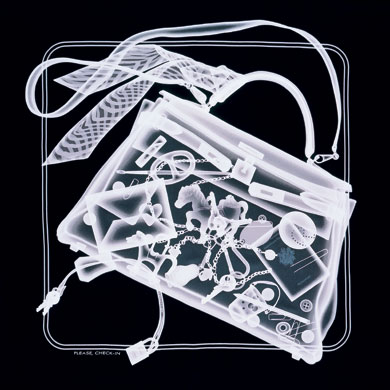
Secret Life of Handbags

From the Irish Times: 
For many women, their handbag is more than something to carry their make-up – it’s their whole life in a leather cocoon. So what do handbags say about their owners and are they really a potent symbol of women’s emancipation, writes FIONOLA MEREDITH

FOR SOME WOMEN, it provides a simple way to carry a purse, mobile phone and keys, along with a random assortment of everyday bits and pieces. But for others, the handbag is much more than that. Media commentator Yasmin Alibhai Brown may have been only slightly overstating it when she observed that handbags have become potent symbols of “politics, economics, social mobility, pre-feminist proclivities or post-feminist liberties, ethical living, advanced capitalism, the ebb of socialism and possibly the end of history”.

Now French sociologist Jean-Claude Kaufmann has written a book – Le Sac, un Petit Monde d’Amour (or The Bag, a Small World of Affection) – examining the contents and the meanings of the female handbag. Having interviewed 75 women over the course of 18 months, Kaufmann concludes that, despite its frivolous image, the handbag is actually a symbol of female emancipation.

Friday, May 6, 2011

Victorian Secrets

We tend to think of “discomfort” to describe women’s undergarments of the Victorian period. Yet there’s evidence that two other words – romantic and elegant – also come to mind when talking about the unmentionables in ladies’ wardrobes of that time period.

Members of the Centerville-Washington Township Historical Society found that to be so in preparing for their Victorian Luncheon fashion show, “Victorian Secrets,” held Saturday, April 30, at Normandy Church.

They didn’t have to look much further than their permanent collection of beautiful vintage petticoats, bloomers, nightwear and more donated by the community throughout the years. “We were amazed at the good condition of the lingerie items – some more than 100 years old,” says Ferne Reilich, society curator. “The Victorian women really knew how to make the most of their femininity.”

Those attending the show heard interesting bits of undergarment history.

Tuesday, April 12, 2011

A History of Lipstick

From The Vine:
For thousands of years the mouth has been considered the most sensual part of the face. And whether we know it or not, whether we'll admit to it or not, we women have relished in exploiting the mouth's powers by decorating and enhancing our lips. It'd be careless to view lipstick as merely seductive, however. Depending on the colour, and the shape of the lip line, lipstick is also a symbol of power, of sophistication, of rebellion, of courage, of optimism and more.

Saturday, March 26, 2011

Remembering The Triangle Fire

It was a warm spring Saturday when dozens of immigrant girls and women leapt to their deaths — some with their clothes on fire, some holding hands — as horrified onlookers watched the Triangle Shirtwaist factory burn.

The March 25, 1911, fire that killed 146 workers became a touchstone for the organized labor movement, spurred laws that required fire drills and shed light on the lives of young immigrant workers near the turn of the century.

The 100th anniversary comes as public workers in Wisconsin, Ohio and elsewhere protest efforts to limit collective bargaining rights in response to state budget woes. Labor leaders and others say one need only look to the Triangle fire to see why unions are crucial.


Monday, December 20, 2010

Fashion & Feathers

During the late 19th and early 20th centuries, Florida’s wading birds were being slaughtered by the millions to adorn fashionable women’s hats.

The rise and fall of the plume trade and Palm Beach County’s participation in it are the subjects of “Feather Wars: Surviving Fashion 1870-1920” at The Richard and Pat Johnson Palm Beach County History Museum in West Palm Beach.

The tale is illustrated with archival photographs, stuffed birds, plumed hats, guns, millinery ads and memorabilia of Theodore Roosevelt, whose conservation initiatives contributed to the demise of the trade.

Florida was one of the last great frontiers of plume hunting, because the state was settled later than most parts of the country. Plume hunters quickly made up for lost time.

Although legislation diminished the plume trade, it took war and the country’s love affair with the car to eliminate it. World War I disrupted shipping and quelled women’s interest in fancy hats. Cars did their part by not being scaled to accommodate oversized headgear.

Wednesday, December 8, 2010

Elizabethan Vizard Mask

From Arch News:
A Visard mask, was worn by gentlewomen in the 16th and possibly into the early 17th centuries. The mask was found during the renovation of an inner wall of a 16th century stone building.

The wall was approximately 4-foot thick, and the mask was found concealed within the inner hard core of the wall, which consisted of soil, straw and horse hair (for insulation). The mask was folded in half, lengthways, and placed within a small rectangular niche behind the face of the wall. Due to the conditions when found, the mask has an amount of soil and straw adhering to one half. The opposite half still has the velvet material in relatively good condition, but is in need of some conservation to prevent further damage.

Visard Mask, which covers the whole face, having holes for the eyes, a case for the nose, and a slit for the mouth, and to speak through; this kind of Mask is taken off and put in a moment of time, being only held in the Teeth by means of a round bead fastned on the inside over against the mouth.

Saturday, November 27, 2010

Ancient Body Adornment

From the Bangkok Post:
What do women today have in common with those in prehistoric times? The answer is none other than a love for body ornaments _ rings, necklaces, earrings, bracelet, anklets.

"All human groups have created accessories. Body ornaments are not just about beauty, but also about beliefs," said Asst Prof Mayurie Veraprasert, a lecturer at the Archaeology Faculty, Silpakorn University, who prepared the exhibition, "Body Ornaments : Beliefs, Beauty, and Creativity", at Phufa Treasure Trove on the 4th floor of Siam Paragon. The event opening on Monday was graciously presided over by HRH Princess Maha Chakri Sirindhorn.

The exhibition, on view until December 31, features images of body ornaments worn by women in different historical periods, from Dvaravati to Ayutthaya. Some depict images of adornments on skeletons from prehistorical burial sites, as well as images of people wearing elegant accessories in the famous mural painting at Wat Phumin in Nan province. One section deals with contemporary ornaments, created by students of the Decorative Arts Faculty, Silpakorn University, and another presents a full set of exquisite ornaments on a khon character, Kumpakan, made by students at the Royal Goldsmith College. The accessories were used in a khon production, The Battle of Kumpakan, commanded by Her Majesty the Queen.


Sunday, September 5, 2010

Every Body Counts

Fifteen Perth women ranging in sizes from eight to 16, including one sprightly 60-year-old wannabe model, will hit the catwalk for the Every Body Counts show.

The parade aims to showcase 'real women', as opposed to the typical skinny tall model that graces the average catwalk.

Each of the women chosen to participate have enjoyed a photo shoot and clothes fitting and will get the rundown on ruling the runway this weekend before hitting the stage in front of the Perth Fashion Festival crowd.

Saturday, August 21, 2010

Embracing Facial Hair

From Julie Bindel at the Guardian:
As a proud lesbian feminist I have campaigned for years against the beauty industry and cosmetic surgery. I have never worn makeup, except once, as an experiment for these pages, and for years I even refused to wear a bra – until I had to dress up in vaguely smart clothing occasionally for work.

But we all have an achilles heel, and mine is facial hair. I hate it, both on myself and other women. I have a particular terror of fuzz appearing on my face, and always carry one lone item of beauty equipment: tweezers. Luckily, I am not particularly afflicted, although in recent years I have noticed one long black hair that sprouts from my left cheek, another under my chin, and a few barely noticeable ones above my lip. The second they appear they are instantly torn asunder.

My fear of the fuzz is hardly unusual. Even in the thick of the late 1970s women's movement, I remember a close friend – a fellow lesbian and hard-line feminist – confessing, "I'm so glad I discovered electrolysis before feminism!"

Saturday, August 7, 2010

Giant Panties Outsell G-Strings

From the Daily Telegraph:
THE bottom has fallen out of the g-string market as women swap them for gigantic waist-hugging underwear.
Sales of Waistnippers brand self-proclaimed "magic" panties are soaring in Britain due to the fashion for hourglass figures. Up to twice the size of normal undies, they trim the tummy and push out the hips and breasts, The Sun reports.

Sales of the panties -- made famous by 1960s fashions on TV drama "Mad Men" -- are up 42 percent in three months.

Lingerie chain Rigby and Peller, which supplies Lady Gaga and Queen Elizabeth, said bigger panties outsell thongs two to one.

A Debenhams store spokeswoman said, "The only knickers to be seen in are sexy high-waist ones."