Wednesday, December 29, 2010

Celtic Noblewoman's Tomb

From The Local:
In a discovery described as a “milestone of archaeology,” scientists have found a 2,600-year-old aristocratic burial site at the Celtic hill fort at Heuneburg in Baden-Württemberg.

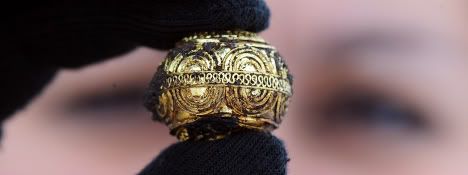
The noblewoman's tomb, dating from early Celtic times, measures four metres by five metres, and is exceptionally well-preserved. It contained gold and amber jewellery that makes possible for the first time the precise dating of an early Celtic grave.

Using heavy cranes, the excavation team lifted the entire burial chamber out of the ground as a single block of earth and placed it on a special truck so that it could be carried off for further analysis.

The dig leader and state archaeological chief Dirk Krausse labelled the find a “milestone of archaeology.”

Judging by the ornamentation in the chamber, the archaeologists believe the tomb was built for a woman from the nobility of the Heuneburg fort, though this couldn’t be said with certainty until further investigations could be made under laboratory conditions.

Tuesday, December 28, 2010

UK Museum Drama - Mary Prince

From Bernews:
The Museum of London is launching a one-hour dramatic reenactment of the life of Bermuda slave Mary Prince for visiting school children.

An actor will be portraying the Bermudian woman whose 1831 memoir helped to galvanise the abolitionist movement and end the institution of chattel slavery in in British territories two years later in a production intended to bring history to life for youngsters.

“Meet Mary in 1831 London, when the anti-slavery movement published her life story,” says a Museum of London promotional release . “Born into slavery, as a child she was the ‘pet’ of a rich white girl and as an adult she suffered hard labour working as a field slave. Although in England she was free she could not return to her husband in the Caribbean because she would become enslaved again.”

Bermudian Mary Prince is also featured in a permanent display at the museum called “London, Sugar & Slavery” which commemorates the roaring trade in humans and sugar, slave resistance and the abolition campaign and the enduring relationship between the British capital and the Caribbean.

Women Writing Torahs

Kadima, a Jewish community in Washington, wanted to buy a Torah written by a woman. After making inquiries, they learned that there were no Torahs written by women. So they decided to commission six women to write one.

Since the time that this Torah was commissioned, in 2003, several women have become Torah scribes (or sofrot) is and completed the writing of a Torah on their own.

Top Women in Technology

2010 has been an interesting year in terms of technology. We’ve seen tablets become an everyday part of living (though we’re still not sure of their purpose), 3D viewing advance dramatically, and augmented reality took off, thanks to the rise of compatible mobile applications. Alongside these tangible products, there has been much advancement in the backend of science and technology with talented scientists researching medicines, creating programs and extending their knowledge of the virtual world. Many of these projects were spearheaded by women, and I’d like to draw your attention to the top thirteen women who have impacted technology in 2010.

Secret Lives of the Great Artists' Lovers

For as long as man has painted, he (and it usually is a he) has painted his lovers. Look at any of the great works of Western art and, chances are, you will find a mistress, girlfriend, wife or prostitute centre stage.

They may not announce themselves as such, going under the discreet title of Woman Sewing, Girls Bathing or simply Repose. But they’re there all right, these soul mates and play mates, lighting up the canvas with a particular kind of intimacy.

As all these examples suggest, a cloud of suspicion hung over male artists and their choice of female subjects. Painting a wife or sister might seem the obvious way of sidestepping adverse comment, but the problem was that at that time the act of putting a respectable woman on view tarnished her reputation. So there was no choice but to go looking for women who had nothing to lose and perhaps something to gain – the affection of an interesting man, the warmth of the studio, a meal – by becoming public property.

Monday, December 27, 2010

Magdalene de Saint Nectaire

Extract from "The Percy Anecdotes" (pub: 1839):
Magdalene de Saint Nectaire, the widow of Gui de Saint Exaperi, was a protestant, and distinguished herself very much m the civil wars of France. After her husband's death, she retired to her chateau at Miremont, in the Limousin, where, with sixty young gentlemen, she used to make excursions upon the catholic armies in the neighborhood. In lhe year. 1575, M. Montel, governor of the province, having had his detachments often defeated by this extraordinary lady, took the resolution to besiege her in her chateau with fifteen hundred foot and fifty horse. She sallied out upon him, and defeated his troops. On returning, however, to her chateau, and finding it in the possession of the enemy, she galloped to a neighboring town, Turrenne, to procure a reinforcement for her little army. Montel watched for ber in a defile; Imt his troops were defeated, and himself mortally wounded.

Propertia da Rossi

Extract from "Anecdotes of Some Distinguished Persons" (pub: 1795).

For more on Propertia (or Properzia) da Rossi:
Artisti Donne in Italia - Italian Women Artists
Women Artists in the 16th & 17th Centuries

Lucy Anne Ward (1856 - 1935)

Founder of Outback Maternity Home

Lucy was born six years after her parents first arrived in Australia from England. She became a milliner and operated a shop in North Adelaide, South Australia. Aged 22yo Lucy married Henry Ward. She left city life and travelled by horse and buggy to Willachra - 400km away. She and her husband had to clear the land, fence it and build their house - times were hard so they both took extra work wherever they could.

For the birth of Lucy's first daughter Lucy Evelyn (1880) there was probably no doctor and only assistance from her mother-in-law. She gave birth to another daughter (1882) who died (1885). She adopted her baby niece after the death of its mother but it later died aged 5yo - Lucy was aged 33yo. She had no more children of her own but adopted two more babies.

When relatives in the Hawker district decided to leave, Lucy and Henry bought the house. Lucy was not a trained nurse, but she acquired considerable practical knowledge through her own experiences and in the homes of other women. Lucy began to take in women far from any kind of help. With the difficulties of travel, many of these women from outlying areas often needed to stay for several weeks, and often brought their other young children with them. Since the ability to pay was never an issue, finances were not easy. Lucy cooked, cleaned, carted water, washed, and supplied milk and butter from her own dairy.

Soon the demand became greater than the house could accommodate, and so Henry built extra rooms, and "the Gables", as the house became known, was registered as a Lying-in Home (1909) under the State Children Act (1895). When a severe influenza epidemic struck (1910), Lucy set up tents to accommodate the many local people who fell ill and sought her help.

Three years after the opening of the Hawker Hospital (1928), as the Gables had become, 72yo Lucy recorded her last patient. Over 30 years, she helped deliver between 400-500 babies.

Mary Bryant

Born in Cornwall England, Mary was the daughter of a family well-known for sheep-stealing. Mary was a wilful and adventurous young lass which led to her being sentanced to transportation to Australia (1786) for stealing. Mary arrived in Australia with the First Fleet (1788).

It was whilst serving her sentance that Mary rebelled against the harshness of the existence in the colony and the feeling of virtual banishment - she planned her escape. Mary organised provisions and muskets (guns); from a Dutch Captain, Mary obtained nautical equipment. With her husband and two children and companions, Mary made off with the Governor's cutter (ship).

The group travelled 5000 kilometers through the then unknown Barrier Reef and reached Timor. At first they were accepted as shipwreck survivors, however, the Dutch on Timor proved them to be otherwise. Mary and her family were transferred to Batavia - Mary's husband and son died here. Mary was sent back to England for trial, but on the voyage her daughter died.

Through the influence of the newspapers in England, the mandatory death sentance for escaped convicts was quashed. The writer James Boswell sponsored Mary anonymously. Mary returned to her native Cornwall and remarried, fading into obscurity.