Sunday, June 12, 2016

Is this Eleanor, the Secret Queen?


She is regarded by some as the secret queen who helped put Richard III on the throne and – inadvertently, at least – sealed the fate of the princes in the tower.
Now, new research aims to help determine whether remains discovered in Norwich are of Lady Eleanor Talbot.
Lady Eleanor played a pivotal role in the Wars of the Roses during the fifteenth century, when her alleged marriage to Edward IV led to his children – the princes in the tower – being declared illegitimate after his death, in 1483.
That saw the crown pass 
to Edward’s brother, Richard III, during whose reign the boys disappeared.
Tomorrow, historian John Ashdown-Hill will unveil a facial reconstruction based on remains excavated at Whitefriars in 1958.  He is hoping that it will help to better establish whether they belonged to Lady Eleanor.


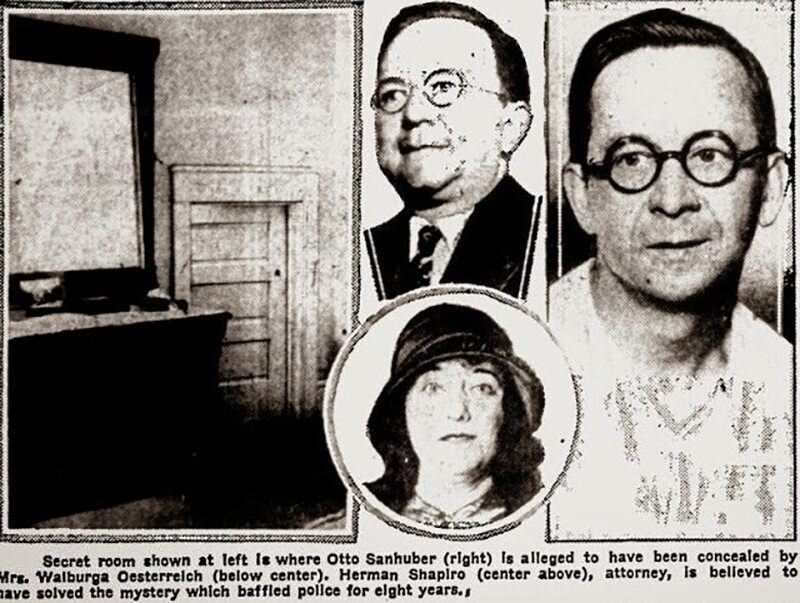
The Married Woman Who Kept Her Lover in the Attic

In April 1930, the Los Angeles Times began publishing what would end up being months’ worth of eye-popping details from an exceedingly strange court case. It involved a “comely” woman named Dolly, her murdered husband, and her lover, a man known as the “garret ghost” who, at Dolly’s behest, lived a “bat-like life in hidden rooms.”
On August 22, 1922 a particularly brutal fight broke out and Sanhuber, fearing for Dolly's life, ran downstairs brandishing Fred's two .25 caliber rifles. He fired three rounds straight into his rival's chest, killing him instantly.
By the time the ex-lovers were arrested the papers had gotten wind of the sordid tale and shutterbugs followed Dolly and Sanhuber everywhere. But the trial outcome was not as eventful as the public would have hoped: though the jury found Sanhuber guilty of manslaughter on July 1, the statute of limitations for such an offense was seven years. Eight years had passed since Frank’s death. Sanhuber’s charges was dropped.

Further Reading: Women Who Kill Men: California Courts, Gender, and the Press by Gordon Morris Bakken & Brenda Farrington

Saturday, June 11, 2016

2,000 year old body of woman found in Isle of Wight bay

The bones of a woman who lived 2,000 years ago, and found in a bay off the Isle of Wight, are to be gifted to Island’s museum. Brothers, Hubert and Graham Smyth discovered the skeletal remains as they set a string of swinging boat moorings at Fishbourne Beach at low tide on 9 March 2015. The bones were in the silt which is under the waterline when the tide is in. Graham Smyth, who is a radiographer, gently lifted out one of the bones and was confident it was a human radius, so he left the rest of the skeleton in situ and called the police.


Tuesday, May 17, 2016

Fu hao - Ancient queen, priestess and leader of warriors

THE story of the woman warrior Hua Mulan has been passed down in history through ballad, film and drama for 1,600 years. Much of the tale’s popularity comes from the rarity of a heroine in a time when women were largely relegated to domesticity.
No artifacts have actually been discovered yet to prove the existence of Mulan, but an exhibition at Capital Museum is capturing attention with revelations of an even earlier female warrior named Fu Hao.
She lived more than 3,000 years ago. Her life is being pieced together through oracle bones, bronze and jade weapons, jewelry and vessels found at an excavation of her tomb in what is now Henan Province in central China.
The museum tribute to her is entitled “Queen, Mother, General — the 40th Anniversary of the Excavation of the Shang Tomb of Fu Hao.” The exhibition at Capital Museum in Beijing runs until June 26.

Astronomers Recreate Ancient Skies to Date a Nearly 2,600-Year-Old Greek Poem


The poet Sappho from the Greek island of Lesbos was revered almost as much as Homer in classical antiquity. Plato called her the Tenth Muse and she appeared on coins and statues for centuries. She reportedly created at least 9 books worth of verse containing 500 poems, but sadly all that remains are about 200 fragments recovered in the late 1800s from a garbage dump in Oxyrynchus, Egypt.

According to Michelle Starr at CNET, the researchers used software called Starry Night (version 7.3) and Digistar 5 from the International Planetarium Society to recreate the night sky as seen from the Greek island of Lesbos. They chose to start with the year 570 B.C., the year Sappho died and the only reliable date associated with her.


Tuesday, May 10, 2016

The Most Successful Literary Hoaxes in History — Barnes & Noble Reads

Whether or not you enjoy a good hoax depends on your perspective; put simply, if you’re the victim, you probably won’t be amused. But, as they say, time heals all wounds, and a truly worthy hoax can be appreciated for its genius once enough time has passed. Here are eight literary hoaxes that were so successful, you simply have to admire them.
Blog post by Jeffrey Somers

Archaeology: "Women in a Temple of Death"


Archaeologists specializing in Peru’s north coast were forced to come up with new answers when they unearthed the unexpected.

Contrary to the long-established tradition of ancient societies in the region to kill male prisoners and drink their blood, researchershave found the remains of the bloody sacrifice of six young women in about A.D. 850, reports Archaeology.

Uncovered beneath the floor of a mudbrick temple in Pucalá, just outside of Chiclayo, the remains of six women perplexed archaeologists.


Egyptian Mummy's Symbolic Tattoos Are 1st of Their Kind


More than 3,000 years ago, an ancient Egyptian woman tattooed her body with dozens of symbols — including lotus blossoms, cows and divine eyes — that may have been linked to her religious status or her ritual practice.

Preserved in amazing detail on her mummified torso, the surviving images represent the only known examples of tattoos found on Egyptian mummies showing recognizable pictures, rather than abstract designs.

The mummy was found at a site on the west bank of the Nile River known as Deir el-Medina, a village dating to between 1550 B.C. and 1080 B.C. that housed artisans and workers who built the royal tombs in the Valley of the Kings. [In Photos: Egypt's Oldest Mummy Wrappings]


Mysterious Braided Hair May Belong to Medieval Saint

A braided head of hair found buried beneath a medieval abbey in England has given up some of its secrets, thanks to a scientist’s curiosity about the relic, which he first saw when he was a schoolboy.
Jamie Cameron, an archaeological research assistant at the University of Oxford in the United Kingdom, first visited Romsey Abbey, near the city of Southampton, on a school field trip when he was 7 years old.
Cameron said he became curious about the abbey’s display of a brightly colored and braided head of hair, which had been found in a lead casket buried beneath the abbey floor. But at the time, nothing was known about the identity of the hair’s owner. [See photos of the mysterious braided hair found at Romsey Abbey]