Showing posts with label roman women. Show all posts

Monday, December 27, 2021

8 powerful female figures of ancient Rome

Women in ancient Rome held very few rights and by law were not considered equal to men, according to a 2018 article on The Great Courses Daily. Roman women rarely held any public office or positions of power, and instead their role was expected to be caring for children and looking after the home.

Most women in Roman society were controlled by either their father or husband. Especially among richer families, women and young girls were married off in order to form political or financial relationships, and rarely could choose their partner.

Despite this lack of rights, there is evidence of a few exceptional women who managed to attain great power and influence in ancient Rome. While some controlled events from the sidelines, others took matters into their own hands, forming conspiracies and even assassination plots to seize control of the Roman empire.


read more here @ Live Science

Sunday, April 30, 2017

How Did Two Faustinas Transform Roman Society?

Ancient Origins has again posted another great article - this time on two Roman women a mother-daughter power-team.  They were Annia Galeria Faustina, known as Faustina the Elder (or Faustina I), wife of Antoninus Pius (d.161AD), and her daughter, Annia Galeria Faustina Minor, known as Faustina the Younger (or Faustina II), wife of Marcus Aurelius (d.180AD)
While their husbands ruled as emperors, the two women were changing the world they knew into a better one. Moreover, the eternal fame they gained placed them in the pantheon of goddesses. Two women who lived during the 2nd century AD proved that being the wife of the most powerful man in the empire is not only a dangerous task, but also a generous gift - which could bring many benefits.
read entire article here @ Ancient Origins

Monday, April 17, 2017

Female Gladiators - Part Of The Lure Of The Roman Arena

Sarah Bond writes in Forbes on the lure of women fighting in the arena:

The use of the word 'gladiatrix' (pl. gladiatrices) is a pseudo-Latin term for these fighters not actually applied in antiquity. In reality, there was a great deal of ambiguity about how one should refer to them. The Roman satirists Martial and Juvenal employ the word 'ludia', which could also be used to refer to an actress or a theatrical dancer, but is most often used to refer to a gladiator's wife.
Relief from Halicarnassus of two female gladiators
The status of these fighters is an oft-discussed point in the literature on these women. Those that were a part of the arena were given a debilitating legal and social stigma called infamia. Yet this did not stop some Roman elites from fighting anyways. The historian Tacitus notes that during the reign of Nero, there were high-ranking women who entered into gladiatorial combat and fought: "
Many ladies of distinction, however, and senators, disgraced themselves by appearing in the amphitheater." Historian Barbara Levick has argued that the ban on elite women participating in the arena likely first came into effect under the emperor Augustus, in 22 BCE. We know that the emperor Septimius Severus re-banned elite women from fighting in the arena in 200 CE. Clearly there was a lure for both men and women. 
Read entire article here @ Forbes


Monday, February 20, 2017

Who was Cornelia Africana?

The life of Cornelia Africana could be the basis for a fascinating Hollywood super-production. Since the beginning, her tale was nothing but an adventurous story about a woman whose extraordinary personality made her reach for the stars. Courageous, intelligent, and powerful, Cornelia could be an inspiration for generations of women.
Can you imagine a lady in ancient times who fought like a man, made negotiations like the best politicians, and reached higher than most men in political matters, but who never lost her feminine charms? Cornelia’s life was a story worthy of many ancient poems, but sadly many details about her story have been lost through time. From the resources that have survived, she appears to have been a powerful woman among the most influential people of antiquity.
Read More Here @ Ancient Origins

Sunday, August 7, 2016

The mystery of the Roman ‘princess’

How we solved the mystery of the Roman ‘princess’ | History Extra

Julian Richards returns to one of the most intriguing cases featured over a decade ago in the BBC’s Meet the Ancestors archaeology series, and discovers that this ancestor has a more remarkable background than he imagined.  
This article was first published in the April 2012 issue of BBC History Magazine. 

One of the most absorbing of those original discoveries was the so-called ‘Roman princess’ who emerged from an excavation at Spitalfields in the east end of London in 1999. The Museum of London archaeology team was digging a huge medieval cemetery that had grown up around the monastic hospital that gave its name to this part of London. But as well as thousands of medieval burials there were also some of Roman date.
Read rest of article here at History Extra

Monday, June 13, 2016

Ancient Greek & Roman Women

Largely excluded from education, the women of Ancient Rome were forever subject to their fathers and husbands, to the point of having no legal rights over their own children. That’s not to say that they couldn’t become successful in business and politics, such as Eumachia of Pompeii, who was an extremely wealthy business magnate.
Aside from the wives and mothers of Roman emperors, who often held a significant amount of political power, the only official high-ranking job open to women was religious. The Vestal Virgins (who kept the sacred fire of Rome burning) were of particularly high status. As priestesses of Vesta – the goddess of the hearth, home and family – the six women would serve for 30 years and held significant power, including independence from their fathers’ rule and they could also manage their own property.

The analysis is based on a scene on a skyphos — a large ceramic cup used for the consumption of large quantities of wine — that represents a parodied depiction of the Judgment of Paris, a well-known incident from Homer’s The Iliad. 
The painted scene on the skyphos could also recall a dramatic presentation of the event, perhaps a short play staged in honor of the local deities. In this case, actors such as those portraying Aphrodite and Hermes on the cup would presumably have appeared as Africans, their affect aided by carved and painted theatrical masks.
The same inclusion of blackness holds true for several other types of scenes found on the Kabeirion skyphoi. One of the most remarkable of these presents a dramatic confrontation taken from Homer’s Odyssey, the epic that follows The Iliad.


Sunday, November 24, 2013

Medieval Discovery of Roman Girl


Some of our greatest archaeological finds have happened by accident, revealing wonders from the past. 
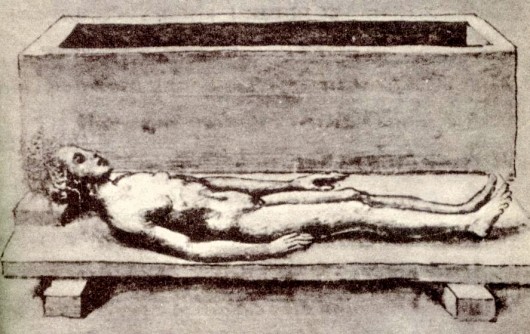
Such a thing could also happen in the Middle Ages, such as when the perfectly preserved body of a girl was discovered along the Via Appia just outside of Rome. The discovery took place in April of 1485.
The name of this girl, however, would continue to remain a mystery, as any inscriptions from this site had long since disappeared. One rumour that was spread around was that this was the body of Cicero’s daughter Tulliola. Another said that had an inscription had been found, saying ’Here lies Julia Prisca Secunda. She lived twenty-six years and one month. She has committed no fault, except to die.’ Everyone did agree that this girl must have been famous and wealthy. In his diary, Antonio di Vaseli, who also saw and marvelled at the body, explained she “must be an illustrious one, because none but a noble and wealthy person could afford to be buried in such a costly sarcophagus thus filled with precious ointments.”


Tuesday, November 8, 2011

Women in Roman Mosaics


From the Science Codex:
Numerous images of women appear in Roman mosaics. The majority are inspired in mythology – goddess, heroines and other protagonists of countless legends – although other flesh and blood women, probably dominae, their daughters, handmaidens and servants, are also documented. "The most significant aspect of these images is the different roles they reflect and their contribution to the construction of certain stereotypes, not just in the Roman world, but also throughout history and up to the present", points out Luz Neira, Associate Professor of Ancient History in the Department of Humanities: History, Geography and Art, and a researcher at UC3M's Institute of Culture and Technology.

Sunday, August 14, 2011

First Ladies of Rome

As Anneliese Freisenbruch admits in this excellent history, most of the Ancient Roman women discussed in her book "would never have come to historical notice if it were not for the men they married or the sons they gave birth to", such was the patriarchal society in which they existed.

There is hardly anything written by women of the era, and too many contrasting versions from male playwrights for Freisenbruch to be definitive. But these more sceptical portraits of women, often either vilified or venerated, are very welcome.

Sunday, June 22, 2008

Galla Placidia, Empress

Daughter of Roman Emperor Theodosius the Great. She was the sister of the eastern Emperor Arcadius and the Roman Emperor Honorius. Aged 7 (395), her mother died in childbirth and this was followed by the death of her 49yo father at Milan. Galla was in Rome under the care of her father's niece Serena when this sad news reached her. She remained in Rome with Serena.

Aged 21, Galla was in Rome when the Visigoths besieged the city (410) and she was taken hostage. When Alaric, the Visigoth King died, the Imperial court at Ravenna demanded the return of the Princess Galla - she was not returned immediately but treated with courtesy by her Christian captors who kept bargainning for her release. Still an honoured captive, the Visigoth King Atahaulf decided he wanted to marry her and make her Queen of the Visigoths (412). Galla herself appeared to be receptive to this but her brother Emperor Honorius was appalled and demanded her return. Defying her brother, Galla married Atahaulf at Narbonne (414) and moved to the Visigoth capital at Barcelona. This marriage barely lasted one year for Atahaulf was murdered (415) - his dying wish was for Galla to be returned to the Imperial court at Ravenna - she was aged 27.

Unfortunately for her, the new King Sigerice mistreated her but he himself was murdered only a week after his accession. Sigerice was succeeded by the Goth Wallia, who agreed to send Galla back to Ravenna. Two years after her return, Galla was married - against her will - to Constantius (417) though she had done her best to fend off his advances. That same year, she gave birth to a daughter Justa Grata Honoria, and a son Flavius Placidus Valentinianus (418).

Galla was made Augusta/Empress by her brother the Roman Emperor Homorius (421) and her husband was made co-Emperor. Shortly after, her husband died of pleurisy and 33yo Galla was ordered to return to Rome by her Emperor brother. Fearing for her own safety and that of her children, Galla fled to Constantinople, where her nephew (the son of her brother Arcadius) ruled as Emperor Theodosius II (421). Life at the eastern court was not all that easy for Galla - she was disliked and distrusted by her nephew. Roman Emperor Honorius died at Ravenna (423) and Eastern Emperor Theodosius II grudgingly granted Galla and her son Valenntinian imperial rank. The following year (424) Theodosius organised the invasion of the Western/Roman Empire - he was accompanied by Galla and her two children. Galla's 6yo son was hailed as Roman Emperor Valentinian III (425) and 36yo Galla effectively controlled the Western Empire for the next ten years, although as a woman she was unable to enforce her will through control of the Roman Legions but instead used her wiles to manipulate rival generals, bu shrewdly playing them off against court officals. Galla acted as effective regent for her son until court intrigue, rebellion and invasion sapped her of her power.

Galla's daughter Honoria, sister of Emperor Valentinian, fled Rome and sought protection fro the Hun leader Attila in order to avoid marriage (449) - though Attila claimed that this act constituted a marriage proposal and so he accepted Honoria as an affianced bride and demanded half the Western Empire as her inheritance. Galla didn't live long enough to see the conclusion of this (the eventual Hun invasion of Rome), dying at Ravenna aged 68 (450) - her nephew, the Eastern Emperor Theodosius II dying the same year.

Tuesday, June 5, 2007

Fabiola

Fabiola (d.399AD)

Fabiola was a women from a Roman patrician family.

She converted to Christianity aged 20yo.

Fabiola divorced her first husband, who was said to have been abusive, remarried and was widowed.

Fabiola turned her immense energy and wealth to founding hospitals and raising the standards of nursing. Hers were by no means the first hospitals; however, they were unique in their time for being both public and giving general treatments. Fabiola's hospitals also practiced surgery as well as nursing.
Fabiola opened a Hospice for pilgrims at Porto with St. Pammachius.

Among Fabiola's associates were at least 15 other well-educated Roman women. Fabiola visited Jerome at Bethlehem (395), and gave her support to him in his controversy with Patriarch John of Jerusalem.

Following her death, Fabiola was canonised.

More on Fabiola.


~~~ Melisende