Showing posts with label medieval italy. Show all posts

Sunday, December 15, 2013

Tale of Trotula

Time has not been kind to the woman known as Trotula Plataerius, Trotula di Ruggiero or Trotula of Salerno. Was she the author of the famous 11th century De passionibus mulierum (On the Diseases of Women) or was she a mythical.

Now the controversy continues with this article from :
These arguments came to a head in the 1500s, when historians and doctors announced that there never was a Trotula in the first place. Since then, she's become a semi-mythical figure. Even those who believe in her existence sometimes doubt her work. The few facts that anyone has pertaining to the woman - that she may have been from a noble family, that she may have had a physician for a husband or a son - have been used to attribute the book to male relatives who used her name as a cover.

See article from
International Journal of Cosmetic Science - Volume 30, Issue 2, pages 79–86, April 2008
Among these women, there was Trotula de Ruggiero (11th century), a teacher whose main interest was to alleviate suffering of women. She was the author of many medical works, the most notable being De Passionibus Mulierum Curandarum (about women’s diseases), also known as Trotula Major. Another important work she wrote was De Ornatu Mulierum (about women’s cosmetics), also known as Trotula Minor, in which she teaches women to conserve and improve their beauty and treat skin diseases through a series of precepts, advices and natural remedies. 


From Google Books:


Sunday, November 24, 2013

Medieval Discovery of Roman Girl


Some of our greatest archaeological finds have happened by accident, revealing wonders from the past. 
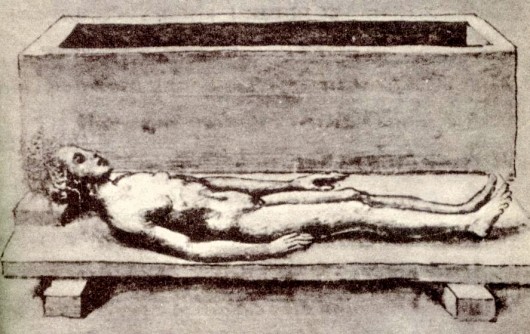
Such a thing could also happen in the Middle Ages, such as when the perfectly preserved body of a girl was discovered along the Via Appia just outside of Rome. The discovery took place in April of 1485.
The name of this girl, however, would continue to remain a mystery, as any inscriptions from this site had long since disappeared. One rumour that was spread around was that this was the body of Cicero’s daughter Tulliola. Another said that had an inscription had been found, saying ’Here lies Julia Prisca Secunda. She lived twenty-six years and one month. She has committed no fault, except to die.’ Everyone did agree that this girl must have been famous and wealthy. In his diary, Antonio di Vaseli, who also saw and marvelled at the body, explained she “must be an illustrious one, because none but a noble and wealthy person could afford to be buried in such a costly sarcophagus thus filled with precious ointments.”


Friday, December 23, 2011

Luca Pacioli - Renaissance Magician

Have you ever wanted to wash your hands in melted lead? Or maybe, you have always wanted to make an egg walk. Meet Luca Pacioli ~~ the Renaissance's own David Copperfield!

Luca Pacioli, a native of Tuscany, was a good friend and sometime artistic collaborator of Leonardo da Vinci.

He is also the author of one of the oldest magic books - De viribus quantitatis (On The Powers Of Numbers). And for the past 500 years, this unpublished book has been hidden away in the archives of the University of Bologna.

"It was written in Italian by Pacioli [a Franciscan monk] between 1496 and 1508 and contains the first ever reference to card tricks as well as guidance on how to juggle, eat fire and make coins dance. It is also the first work to note that Da Vinci was left-handed."

Reporter Lucy McDonald of the Guardian has the full details of this magical story from her 2007 article.

Venetian Lazaretto

A lazaretto or lazaret is a quarantine station for maritime travellers. Lazarets can be ships permanently at anchor, isolated islands, or mainland buildings. Between 1348 and 1359 the Black Death wiped out an estimated 30% of Europe's population, as well as a significant percentage of Asia's population. The original document from 1377, which is kept in the Archives of Dubrovnik, states that before entering the city, newcomers had to spend 30 days (a trentine) in a restricted location (originally nearby islands) waiting to see whether the symptoms of plague would develop. Later on, isolation was prolonged to 40 days and was called quarantine.

Venice took the lead in measures to check the spread of plague, having appointed three guardians of the public health in the first years of the Black Death (1348). The first lazaret was founded by Venice in 1403, on a small island adjoining the city – the island of Santa Maria di Nazareth (also known as Lazaretum or Nazaretum). Today this island is known as the Lazzaretto Vecchio.

Originally, the “Lazzaretto Vecchio” was home to hermits who had erected a church dedicated to St. Mary of Nazareth and a shelter for pilgrims going or returning from the Holy Land (c.1240s). When the monks and novices died out, and on the advice of San Bernardino of Siena, the Senate voted to allocate the island as a shelter for people and goods from infected countries.

The Lazzaretto even then consisted of two islands joined by a bridge to the smallest housed the garrison whilst the larger housed the hospital which incorporated the original monastic buildings. Originally built of timber, these would be later rebuilt in stone. In 1468, the Lazzaretto Nuovo or new settlement was established. The Lazzaretto was enlarged with the adjacent lagoon being reclaimed in 1580s; and a boathouse entrance was built from the canal (1586).

In November, 1631, the plague was definitively eradicated, but at a terrible cost: almost 47,000 died in the city (more than a quarter of the population) and 95,000 in the area comprising Murano, Malamocco and Chioggia.

I was inspired to find out more from this article that appeared in the Independent in 2007:
Archaeologists are now exploring "the graves of Lazzaretto, an island in the Venetian lagoon which became the world's first isolation hospital."

The Independent reports that: "Following an outbreak of the plague in 1348, the Doge and his advisers put their minds to thinking up a way to prevent a recurrence. The upshot, at the beginning of the 15th century, was the world's first isolation hospital occupying the entire small island."

" .. archaeologists have uncovered more than 1,500 skeletons of Lazzaretto patients. Luigi Fozzatti, who is in charge of excavations, said: "It wasn't difficult to imagine that some people would have been buried on the island but we had no idea we would find so many." "

Research is continuing.

Sunday, August 7, 2011

Venetian Lazzaretto

A lazaretto or lazaret is a quarantine station for maritime travellers. Lazarets can be ships permanently at anchor, isolated islands, or mainland buildings. Between 1348 and 1359 the Black Death wiped out an estimated 30% of Europe's population, as well as a significant percentage of Asia's population. The original document from 1377, which is kept in the Archives of Dubrovnik, states that before entering the city, newcomers had to spend 30 days (a trentine) in a restricted location (originally nearby islands) waiting to see whether the symptoms of plague would develop. Later on, isolation was prolonged to 40 days and was called quarantine.

Venice took the lead in measures to check the spread of plague, having appointed three guardians of the public health in the first years of the Black Death (1348). The first lazaret was founded by Venice in 1403, on a small island adjoining the city – the island of Santa Maria di Nazareth (also known as Lazaretum or Nazaretum).  Today this island is known as the Lazzaretto Vecchio.

Originally, the “Lazzaretto Vecchio” was home to hermits who had erected a church dedicated to St. Mary of Nazareth and a shelter for pilgrims going or returning from the Holy Land (c.1240s).  When the monks and novices died out, and on the advice of San Bernardino of Siena, the Senate voted to allocate the island as a shelter for people and goods from infected countries.

The Lazzaretto even then consisted of two islands joined by a bridge to the smallest housed the garrison whilst the larger housed the hospital which incorporated the original monastic buildings.  Originally built of timber, these would be later rebuilt in stone.  In 1468, the Lazzaretto Nuovo or new settlement was established.  The Lazzaretto was enlarged with the adjacent lagoon being reclaimed in 1580s; and a boathouse entrance was built from the canal (1586).

In November, 1631, the plague was definitively eradicated, but at a terrible cost: almost 47,000 died in the city (more than a quarter of the population) and 95,000 in the area comprising Murano, Malamocco and Chioggia.

 
I was inspired to find out more from this article that appeared in the Independent in 2007:
Archaeologists are now exploring "the graves of Lazzaretto, an island in the Venetian lagoon which became the world's first isolation hospital."


The Independent reports that: "Following an outbreak of the plague in 1348, the Doge and his advisers put their minds to thinking up a way to prevent a recurrence. The upshot, at the beginning of the 15th century, was the world's first isolation hospital occupying the entire small island."

" .. archaeologists have uncovered more than 1,500 skeletons of Lazzaretto patients. Luigi Fozzatti, who is in charge of excavations, said: "It wasn't difficult to imagine that some people would have been buried on the island but we had no idea we would find so many." "

Research is continuing.

Sunday, January 23, 2011

Trotula di Ruggiero – The First Beauty Blogger

The first person to write on the science of beauty was an eleventh century Italian woman called Trotula di Ruggiero (often called just Trotula of Salerno – a bit easier to spell and remember). She worked in Salerno in one of the earliest medical schools. She is most famous as the first person to write about women’s medical problems in De Passionibus Mulierum Curandarum. But her De Ornatu Mulierum (about women’s cosmetics) is just as interesting.

Salerno at the time must have been a fascinating place to operate in. The medical school consciously drew on the traditions of the Arabs, the Jews and the Greeks as well as the local knowledge of herbal beauty treatments. It was also a place where women seem to have played a major role in developing knowledge. The local produce and the sophisticated Mediterranean trade routes also provided a rich variety of raw materials.

Monday, November 1, 2010

Review: The Man Who Believed He Was King of France


Interesting - a switched-at-birth story based in France during the reign of King Philip IV and his sons.

The first five chapters of the book deal with the story of Giannino di Guccio who is told that he is the real King of France, though switched at birth, by Colia di Rienzo, Senator (sometime Dictator) of Rome. We follow Giannino as he leaves his home in Siena to set out to prove (by what ever means) that he is indeed Jean I, King of France.

France at this period was locked in a bitter struggle with England over who was entitled to inherit the French throne after the death of Phillip the Fair and his sons. It it the time of the Hundred Years War - and there are many factions eager to see a destablising of political power in France.

The second half of the book deals with the author Tommaso di Carpegna Falconieri's search for the truth behind the story. Was Giannino myth or real? Was his story real or a complete fabrication? Was there any historical "truths" that could support or not such a story.

Falconieri was not the first author to write of Giannino - those who have read Maurice Druon's "Les Rois Maudits" would be familiar with his story.

So fact or fiction - I'll let you decide.

Saturday, October 30, 2010

An Evening With A Medieval Queen

A tale, part fable, part history, of a Sicilian queen in medieval times will be unfolded by composer John Marino at the Temenos Institute on Nov. 5, as he conducts a lecture on the story of "Costanza," the basis of an opera he created the music for.

The story is about Costanza, the heiress of the Norman kings of Sicily. Her father was Roger II who reigned over what is considered the "Golden Age" of Sicily. Palermo was considered the "jewel" of the Mediterranean.

Wednesday, October 13, 2010

The Last Resting Place of Mona Lisa

From the Telegraph:
 
The remains of the Italian woman who was the model for Leonardo da Vinci's Mona Lisa were dug up 30 years ago and now lie in a municipal rubbish tip, an Italian expert has claimed.

Lisa Gherardini died in Florence in 1542 and was buried in the grounds of Sant'Orsola convent.

Over the centuries the Franciscan convent was used as a tobacco factory and a university teaching facility but in the 1980s a redevelopment was launched to convert it into a barracks for Italy's tax police, the Guardia di Finanza.

The developers had no knowledge that it was the final resting place of da Vinci's famous model – that was only discovered in 2007 – and during work to build an underground car park, the convent's foundations were excavated, along with the crumbling remains of graves and tombs.

The rubble was then dumped in a municipal landfill site on the outskirts of Florence.