Monday, June 13, 2016

Ancient mummy unearthed in Mongolia

Ancient mummy unearthed in Mongolia | Daily Mail Online

Archaeologists in Mongolia are slowly unwrapping the mummy of a suspected ancient woman found preserved in the Altai Mountains.  So far only one hand and her feet in modern-looking boots are visible, but experts believe the find dates to around 1,500 years ago. 
It also appears to be the first complete Turkic burial in Central Asia and the remains were found at an altitude of 9,200ft (2,803 metres).
A host of possessions were found in the grave, offering a unique insight into life in Mongolia in around the 6th century AD. These included a saddle, bridle, clay vase, wooden bowl, trough, iron kettle, the remains of an entire horse, and ancient clothing.


The Cunning Female Demons and Ghosts of Ancient Japan

The Cunning Female Demons and Ghosts of Ancient Japan | Broadly


What seems to trap a woman between this life and the beyond is the anguish of being hurt by those closest to her.
Japanese folklore glitters with powerful female spirits and demons who terrorize the living. The common theme of their lives and deaths is transgression: philandering husbands, murdered children, or a family's shame.
These spirits often seek vengeance, typically from anything they encounter. While some have the ability to kill, others will simply watch the objects of their disaffection suffer and die. The curse of the vengeful ghost can become contagious like a disease, and can even infect an area after the ghost has left.
What seems to trap a woman between this life and the beyond is the anguish of being hurt by those closest to her.

Kiya - The Most Mysterious Woman of Amarna

Kiya - The Most Mysterious Woman of Amarna | Ancient Origins

The only thing we really know for certain about Kiya is her name, written in the forms kiya, kiw, kia, kaia, and that she was a wife of Akhenaten titled The Great Beloved Wife .  Much information about Kiya was lost over time and nowadays information about her is mixed with the biographies of Nefertiti and other women of Amarna, leading to an air of mystery about who Kiya really was.
The most fascinating part of the research about Kiya is connected with the mummy of the Younger Lady discovered in tomb KV35. It was the second ''cachette'', after DB320, found with royal mummies inside. The tomb, which was reopened in 1907, was the final resting place for two women known as the Younger Lady and the Elder Lady, who were found lying next to each other.
Dr Joann Fletcher, the famous Egyptologist from York University, announced in 2004 that the Younger Lady was the beautiful Queen Nefertiti. French researcher, Marc Gabolde, in his recently published theory, follows Fletcher's opinion.

Mummy Shows Ancient Egyptians Bleached Their Skin

Mummy Shows Ancient Egyptians Bleached Their Skin


Photo credit: Profesor Reverte Coma
Evidence that the ancient Egyptians plastered on killer cosmetics to whiten their skin has been found in a 3,500-year-old mummy head. Belonging to an anonymous woman age 20-25, the head shows tiny nodules under the cheeks and at the back of the neck that point to a possible skin disorder called exogenous ochronosis. "Such dermatosis is caused by the extensive use of skin bleaching cosmetics," ‎Despina Moissidou, an anthropologist at Nation Kapodistrian University of Athens, Greece, told Discovery News.

2,500-Year-Old Find Gives Rare Insight into Women's Roles in Ancient Israel


Israel Antiquities Authority archaeologists recently discovered two rare ancient seals in the City of David in Jerusalem.  Archaeologists found the seals inside a 2,500-year-old building.
“Inside this building as a result of very gentle work that include also sifting of the finds, sifting of the airs in order to find all the tiny artifacts, we discovered among other stuff two Hebrew seals; one with the name of a man, Sa‘aryahu ben Shabenyahu and another one with the name of a woman, Elihana bat Gaelm,” IAA archaeologist Yana Tchekhanovetes told CBN News.
“It’s very exciting to know that in ancient times were strong woman in Jerusalem living here. Even though we don’t have any idea who was this lady and why she deserved such a special right in this society,” she continued.


Who Was Sattjeni?

Who Was Sattjeni? Tomb Reveals Secrets About Ancient Egyptian Elite


The coffin, discovered this year in the necropolis at Qubbet el-Hawa across the Nile River from Aswan, belonged to an important local woman, Sattjeni, daughter of one governor, wife of another and mother of two more, said excavation leader Alejandro Jiménez-Serrano, an Egyptologist at the University of Jaén in Spain. Sattjeni's mummified body was buried in two cedar coffins made of wood imported from Lebanon. Though the outer coffin had degraded over the nearly 4,000 years since Sattjeni's death, her inner coffin was in excellent condition, according to Egypt's antiquities ministry, which announced the discovery May 24.

The woman behind Egypt's most powerful rulers.
The daughter of a prince and the mother of two of the most powerful governors in the Middle Kingdom of Egypt, a noblewoman known as Lady Sattjeni has been unearthed some 3,800 years after her death, in an ancient tomb in southeastern Egypt. Wrapped in linen and deposited inside a wooden coffin inside another wooden coffin, Sattjeni’s remains are still remarkably preserved, and were found alongside an inscription identifying her as the woman whose family sat directly below pharaoh Amenemhat III, who ruled ancient Egypt from 1800 to 1775 BC.


Tomb of 12th Dynasty Noblewoman Unearthed in Egypt
The tomb of a prominent lady called Sattjeni, who lived during the reign of the 12h Dynasty, was discovered by Spanish Egyptologists in the necropolis of Qubbet el-Hawa (West Aswan), Egypt. The team of researchers from the Jaén University in Spain has been working on West Aswan since 2008 and, since that year, has discovered several intact burials from different time periods. However, the most recent discovery appears as one of the most impressive. The group led by Alejandro Jimémez-Serrano discovered the tomb of Sattjeni, who appears as one of the most important women of her times. According to El Confidencial , inside the tomb the researchers discovered the remains of a woman, who was buried in two wooden coffins. The inscription allowed the identification of her name.


The Four Great Beauties, and the Arts of the Courtesans in Ancient China

The Four Great Beauties, and the Arts of the Courtesans in Ancient China | Ancient Origins

The Four Great Beauties are four ancient Chinese women renowned for their beauty which they skillfully exercised to influence Chinese history. Although each of the Four Great Beauties frequently appear as the subjects or objects of arts, one seldom learns much of them beyond their names, descriptions of their looks and brief mentions of their skills. This is common in ancient Chinese works related to female performers, or courtesans. In their legends, the Four Great Beauties were, in fact, heavily implied as courtesans themselves. Their legends illustrate applications of the early Chinese education utilized and perfected by the ancient courtesans of China, which was then preserved by Confucius as part of his philosophy.

A Brief History Of The Menstrual Period

If stigma around menstruation exists today, you can rest assured it was much worse in earlier times throughout history. Without much knowledge about biology or the human reproductive system, ancient and medieval humans simply saw menstruation as females bleeding without being injured — a phenomenon that appeared to correspond to changes in the moon. For thousands of years, menstruating women were wrapped up in labels and misinformed religious beliefs — at times considered holy and mystical, at other times seen cursed and untouchable. Often, menstruation was completely omitted from man’s documented history, relegated to the “woman’s sphere.” So here’s a brief history of menstruation in both scientific and cultural life, considering the fact that there still remains far more to discover about the subject.
Continue reading article from Medical Daily

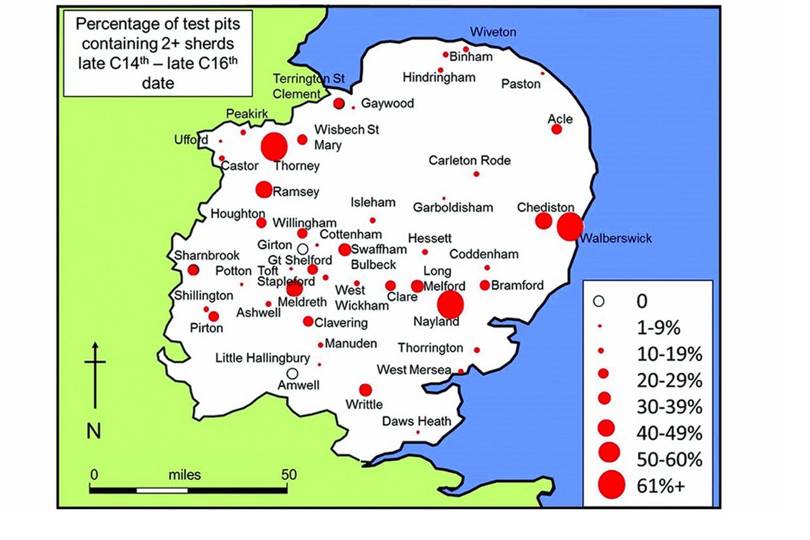
Black Death maps reveal how the plague devastated medieval Britain

An in-depth analysis of pottery shards has revealed the "eye-watering" impact the Black Death had across rural medieval England.
Towns, villages and hamlets were ravaged by the peak of the plague between 1346 and 1351, and between 75 and 200 million people are said to have been killed across Europe and Asia during several centuries of the disease. Now a series of maps has been released which reveal the "devastating" and "eye-watering" effect the disease had across the UK as populations fell. 
The research was led by Professor Carenza Lewis from the University of Lincoln.
"The true scale of devastation wrought by the Black Death during the 'calamitous' fourteenth century has been a topic of much debate among historians and archaeologists," said Lewis. "Recent studies have led to mortality estimates being revised upwards, but the discussion remains hampered by a lack of consistent and scalable population data for the period." "This new research offers a novel solution to that evidential challenge, using finds of pottery - a highly durable indicator of human presence."