Showing posts with label tudor women. Show all posts

Wednesday, April 17, 2013

Anne of Cleves: Henry's Luckiest Wife


I had the pleasure of reading a new (and soon to be published) work by David featuring the fourth wife of Henry VIII of England and entitled "Anne of Cleves: Henry's Luckiest Wife".

Anne has had a bit of a rough time at the hands of chroniclers and writers, being described as being most unpleasant in appearance and personal charm, folksy and uncultured, the Flanders Mare; and yet she also comes across as smart, personable and even pleasant of appearance, and certainly shrewd enough to make a financially beneficial “divorce” from Henry which set her up for the rest of her life in England.  Even today, Anne remains an enigma.

This retelling of Anne’s life is initially told to us in the first person by Anne herself, as she reflects upon her life and the events leading up to her marriage to Henry VIII, King of England.  Anne’s recollections are interspersed with a more standard retelling of events as they occurred before, during and after her marriage.  We find Anne adjusting to court life around her and to her change of status once the divorce was made formal. We are then taken through the events that took place from the death of Henry VIII to Anne’s own demise.

I found this to be a rather enjoyable read, and David presents Anne in a more personable light, attributing to her some measure of intelligence and understanding of the politics of the day, as well as being a typical Tudor-era woman who enjoyed the finer things in life – friends, fashion, gossip, the good life.

Anne certainly was the luckiest of Henry’s wives – she married Henry and managed to keep her head!  And she outlasted both Henry and all his other wives, dying aged 41 in 1557.

For those with a love of all things Tudor, this is a must for your personal library.

David has written a number of  works that readers will enjoy – I certainly found his book on Shakespeare quite intriguing!


You can see a full list of David's books at his website - author website and Goodreads website

Wednesday, October 31, 2012

The Inventive Translations of Mary Sidney Herbert

It's hard to imagine a modern family as prominent in as many ways as Philip Sidney and his sister, Mary Sidney Herbert, Countess of Pembroke were. In addition to the social and political prominence of the Kennedys and the wealth of the Kochs, beyond their personal glamour and estates and Philip Sidney's heroism in war, the brother and sister were at the center of scholarship and art—two realms that were less separated in their time than in the present.

Mary Sidney, proficient in Latin and ancient Greek as well as modern European languages, was a brilliant translator as well as a writer in prose and verse. Active as a patron of the arts and a host to artists, she was the center of a circle that included, in addition to her brother, poets Michael Drayton, Edward Dyer, Fulke Greville, and Edmund Spenser.

Her translations of the Psalms (continuing a project of her brother's, after his death) are said to have influenced, in a following generation, her cousin once removed George Herbert and John Donne.


Friday, December 23, 2011

Elizabeth I & Her Toyboy Essex

In his major new examination of the Elizabethans, historian A.N. Wilson details the passionate love Queen Elizabeth I felt for several men throughout her reign. Here, in the final part of the Mail’s exclusive serialisation, Wilson reflects on the Queen’s later years — and her disastrous infatuation with a courtier young enough to be her grandson . . .

By the time she was in her mid-60s, the Virgin Queen had grown prematurely old, with a ‘goggle throat’ and ‘a great gullet hanging out’.

But if Elizabeth was long past her springtime, so was her once dynamic country. The new French ambassador travelled from Dover to London in 1597 through a landscape he described as ‘wild and untilled’.

In her palace in Whitehall, he was taken to meet her as she sat in a low chair, all by herself and melancholy, almost as if she had been abandoned. Her long, thin face was lined. Her ‘teeth were very yellow and unequal’. On either side of her ears, two great curls hung from beneath a somewhat fantastical red wig.

Saturday, November 19, 2011

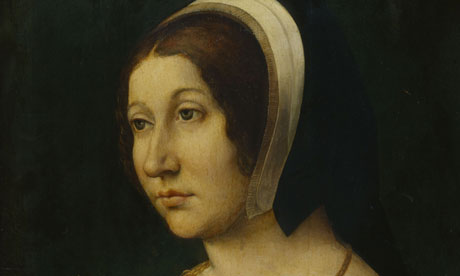
The Woman Formerly Known As Margaret Tudor


Owned by the Revd WH Wayne from at least 1886; sold by Wayne to A Smith of Albert Gate Art Galleries, from whom it was purchased by the National Portrait Gallery. Purchased 1898 (NPG 1173).


The National Portrait Gallery acquired this portrait as Margaret Tudor, sister of Henry VIII and wife of James IV of Scotland. However, both the style and the lack of any securely identified portraits of Margaret Tudor make this identification unlikely. The painterly technique suggests a French or possibly Flemish origin. The woman's costume is also in the style of French court dress of the early 16th century. Her gold jewellery and the stylised pomegranate and leaf pattern, commonly reproduced on expensive silks of the period, hint at her noble status. Recent microscopic examination of her medallion has revealed a horseman hunting with a falcon. Falconry and courtly love were frequently linked in medieval literature, so it is possible that this woman is wearing a love token.


Monday, August 29, 2011

Elizabeth I - Virgin Queen? She was a right royal minx!

The England that the first Queen Elizabeth reigned over so gloriously for 45 years was obsessed with sex and awash with promiscuity. This unrestrained bawdiness was surprising for a nation that worshipped its head of state as an unblemished virgin.

By the standards of later ages — and even today — society then was especially open in its use of sexual language. Shakespeare’s plays are full of nudge-nudge references to rutting, scrambling, sluicing, ravening and lock-picking.

The playwright’s work mirrored and fed the erotic obsessions of the age. This was a land where prostitutes were known as Winchester geese because the Bishop of Winchester owned much of the property that housed London’s dens of vice.

Monogamy, chastity and celibacy must have been practised by some Elizabethans, but they were hardly the norm. And yet, at the helm of this vibrant and exciting nation — growing, getting richer, reaching out to new worlds — was a woman who suppressed her own desires.

She would not marry or have children, and remained for the 45 years of her reign the unassailable Virgin Queen.


Tuesday, November 2, 2010

Courting Diaster: Leanda de Lisle Reviews

From the Literary Review:
Henry VIII boasted to ambassadors of his vivacious eighteen-month-old daughter Mary, 'this child never cries'. The affectionate father was at the same time also a loving husband to Mary's mother, Catherine of Aragon. When that changed so did the child, and there were tears aplenty, as well as a legacy of blood and fire.

Giles Tremlett's book is the first full-length biography of Catherine in forty years. Tremlett lives in Spain, where he works as a journalist for The Guardian, and had immediate access to Spanish sources. He paints an engaging portrait of Catherine's early life in Granada before she was packed off to England to marry Arthur Tudor.


Saturday, August 16, 2008

Review: The Tudor Sisters

Making a trip to the local library today, I came away with a mixed bag of 10 books - a mix of non-fiction and fiction - but all to do with history.

I read this first one over a period of an hour and a half today.

"The Tudor Sisters" by Aileen Armitage is the story of Mary and Anne Boleyn. It begins with the death of their mother and finishes with Henry's impending marriage to Anne. For me, however, it is more the story of Mary. In this book, the author places Mary as the elder of the two sisters who went to France in the entourage of Mary Tudor when she married the King of France.

The book itself is barely 200 pages - and its easy to read, whether the Tudor period of English history takes your fancy or not. Though, not a fan of the abundance of Tudor fiction about, I did enjoy the book.

I think the story of Mary Boleyn is becoming more popular than that of her sister (and rival) Anne. Mary, at least, survived her entanglement with Henry VIII!.

Friday, April 25, 2008

"The King's Whore"

I was reading Robin Maxwell's "The Secret Diary of Anne Boleyn" (it was a very slow week, and as everyone had been raving about this book, I decided to jump on the bandwagon), and was struck by a couple of passages in the book:

Anne: "My father's fortunes risen over Mary's debauchery" ~~~ this was Anne lamenting the fact that her father found favour and fortune when daughter Mary became mistress to King Henry VIII of England.

It was true, the Howards and Boleyns did find favour when Mary became the willing mistress of King Henry - for a young woman at court, to catch the eye of the King, and he was still a handsome and imposing figure at this early stage, was no mean feat. However, to maintain that allure was another thing. But Mary herself was no stranger to "debauchery" - her time at the court of the French King had earned her the nickname of "the hackney". But unlike Anne, Mary enjoyed her time in the spotlight for what it was, knowing that at any moment she would be replaced in the King's favour.

More on Mary Boleyn:
Mary Boleyn
Mary Boleyn


A bit later, Anne again bemoans the fate of women: "A woman is a castle or a piece of land, most valued, oft admired, improved upon. Then she's sold or bought by fortune's sake, for heirs, a bribe, a prize, a debt repaid. Her flesh, her mind, aching heart forgot, nay considered not at all."

Yes, that was the fate of women before her and for some time after her. Women were considered the "property" of the fathers, and then once married, of their husbands. Marriages were arranged - for political considerations, for financial advancement, for social advancement - love and the young woman's own inclination did not enter the equation. Father's sought to ensure that their daughters were seen by those who could enable advancement for the family, and they were married off before they knew what was going on, oft times to a man many many years older.

In the case of royalty, a marriage to a reigning sovereign was considered one of the highest achievements for a young noblewoman. But this also brought with it a new set of constraints. Consider the example of the Tudors - infidelity was treason which result in death; marrying a King did not always entitle one to eternal happiness - this was far from the case more often than not; and of course, though the woman was bound by fidelity, this did not apply to the lusty monarch. Henry VIII is a good example - whilst applauding virtue, obedience and fidelity in his women, he rarely practised it himself.

Yes, catching the eye of a monarch had its rewards. In the case of Mary Boleyn, her family found favour and enrichment (land, money, preferment at court) - Mary herself was rewarded with jewels and money, and a child (though it is speculated that as Henry did not officially acknowledge the child that it may have been fathered by Mary's husband). Yes, even husband's gained advancement and reward for allowing the monarch "use" of a wife.

I again refer to Robin Maxwell's book:
George Boleyn: "I would think him [William Carey, husband of Mary] wise if her were making use of it, seeking favour in return for use of Mary." Yes, much mileage was to be gained from Mary's "use".

But as we know, with hindsight, it was Mary who had the last laugh on them all. She survived her time at the Tudor Court, and more importantly, unlike her sister, Mary kept her head!

The Other Boleyn Girl's Story: the Real One


Monday, June 4, 2007

Katherine Parr

Katherine Parr (c.1512 - 1548)
Sixth Queen of Henry VIII of England.

Katherine was twice widowed - both men elderly and left her considerable fortunes. She was on the verge of contemplating a third marriage to Thomas Seymour (brother of Jane Seymour) when King Henry VIII of England declared himself. Katherine reputedly told Henry she'd rather be his mistress than his wife.

Katherine married (aged 30) Henry (aged 52) in chapel at Hampton Court (1543). There were no children from any of her previous marriages and there would be none with Henry VIII.

Katherine was a devotee of the "new religion" - Protestantism - and her learning and teaching saw her nearly sent to Tower as heretic. She managed to keep her head.

Following the death of King Henry VIII, Katherine finally married Thomas Seymour (1547). There was a scandal involving Thomas Seymour and the Princess Elizabeth, who was residing in Katherine's household at the time, and Elizabeth was removed.

Katherine died in childbirth.

~~~ Melisende