Showing posts with label native americans. Show all posts

Sunday, December 24, 2017

Two Ancient Teenage Girls

For more than 12,000 years, the adolescent girl’s bones lay deep in a Mexican cave. Now analysis of her skeleton is revealing details of her harsh existence in the early Americas — which probably included pregnancy and childbirth before death at a young age.

The bones show that the girl, whom researchers nicknamed Naia, is likely to have travelled long distances on foot, but didn’t carry much on her journeys. The skeleton also reveals that Naia experienced severe and repeated nutritional stress that scarred her bones and teeth, according to results presented on 30 March at a meeting of the Society for American Archaeology in Vancouver, Canada.

For that work, divers examined Naia in the water-filled cavern in the Yucatán Peninsula where she was discovered in 2007. But intruders subsequently tampered with her remains. To prevent further meddling, the bones were gently carried out of the cave in 2014 and 2016 — which also gave scientists easier access to the specimens.


On a ranch near the Santa Maria River in northern Chihuahua, researchers have unearthed more than 18,000 artifacts, including thousands of stone flakes, cores, and hammers, along with 370 projectile points, and a dozen stone ovens.

rancho-santa-maria-skullBut the most surprising find has been the grave of a teenage girl, who was interred among the rocks, alone and unadorned, some 3,200 years ago.

Her remains, researchers say, may help unlock the history of the people who brought agriculture to this arid region, and who were the first known farmers of corn in the Chihuahuan Desert.


Saturday, August 13, 2016

Ancient Cahokia ‘America’s first city’

Almost 50 years ago, archaeologists excavating an ancient city just outside of St. Louis discovered a mass burial site with an unusual central feature – two bodies arranged atop a bed of beads, with several other bodies encircling them.
It was once thought that the elaborate ‘beaded burial’ structure at Cahokia was built as a monument to male power – but now, researchers suggest this is not the case.
A new analysis of the remains reveals that one of these central bodies is actually female, and researchers say the discovery of similar male-female pairs and the remains of a child indicates that women played an important role in society.
In the new study, published to the journal American Antiquity, researchers with the Illinois State Archaeological Survey at the University of Illinois and colleagues found that there are both male and female remains buried at the site of the Native American city, Cahokia. 
Cahokia is said to be North America's first city, and is the largest pre-Columbian settlement north of Mexico. 


Read More: 


Monday, February 18, 2013

Update: Amber Toppah


I would like to add an update to my September blog on Amber Toppah.  The image used was not correct.  As such I have updated the post with the correct image (to the right ->>).  

My humble apologies to Amber who altered me to the error.


Please revisit: First Female Kiowa Leader again.

Monday, October 29, 2012

Kateri Tekakwitha - Native American Saint

Some traditional Mohawks are treating the naming of the nation's first Native American saint with skepticism and fear that the Roman Catholic Church is using it to shore up its image and marginalize traditional spiritual practices.

They see the story of Kateri Tekakwitha as yet another reminder of colonial atrocities and religious oppression.

A Catholic convert at 20, she settled in Kahnawake, a Mohawk settlement south of Montreal where Jesuits had a mission and where she and other women performed mortification rituals such as self-flogging as part of their faith. At her death at the age of 24, Kateri's smallpox scars reportedly vanished and later she was reported to appear before several people. She is buried at a shrine on Kahnawake.

Wednesday, September 5, 2012

First Female Kiowa Leader

While Kiowa women have always been integral to the workings of the tribe in political, cultural, and social spectrums (regardless of their at times absence from some historical and contemporary records), 37 year old Ah-Keen-Geah-Ah-Lay (Charging After the Enemy) was recently sworn in as the tribe’s first female leader.  Her legal name is Amber Toppah and she is the great-great-great granddaughter of Chief Satanta (White Bear).  Ah-Keen-Geah-Ah-Lay is the daughter of Carol Bearbow Toppah (Kiowa/Cheyenne) and the late Byron Toppah (Kiowa). She is one of a growing number of younger Kiowas to be obtaining higher education degrees and choosing to work within the at times difficult field of tribal governance.

Wednesday, August 29, 2012

Interview: Irene Bedard


Since portraying Mary Crow Dog in the Television production of Lakota Woman: Siege at Wounded Knee, depicting the Wounded Knee Standoff, Golden-Globe winning Alaska Native actress has appeared in a vast segment of Hollywood’s finest productions. From her beloved character Suzy Song in Smoke Signals to her voice work in Disney’s Pocahontas, Bedard has proven that a Native actress can make it to the big screen and then some.

In July of 2012, Bedard co-starred in Colonial Williamsburg’s production of “The Beloved Woman,” with actor Wes Studi. During a rehearsal break, she took a few moments to speak with ICTMN about working with Studi, working as a Native actress and what’s to come in the future.

Wednesday, August 8, 2012

La Malinche - Heroine or Temptress

A small army of Spaniards left Cuba in February 1519 on eleven ships headed for the Mainland. The expedition was led by Hernán Cortés who had been Secretary for the Spanish invasion of Cuba led by Diego Velasquez Cuellar. Velazquez had massacred the native warriors, burned their leader, Chief Hatuey, alive, and secured the island and its people as a Spanish colony. 

The point of the expedition led by Cortés, therefore, was to accumulate as much gold as possible, by trade or otherwise, and to capture slaves. After a resounding Spanish victory over the native warriors of Tobasco, the local High Chief told Cortés of the golden city called "Culua." There, he said, a river of gold ran into Montezuma's beautiful City In A Lake Near the Sky. 

To speed Cortés and his soldiers on their way, the huey tlatolani also handed over a number of slave girls to the Spaniards. One of these, baptized as "Marina", had her own reasons for invading the capital of the Aztecs. This woman, now known as "La Malinche", used her great intelligence, her quick mastery of Spanish, and Cortés and his soldiers to conquer Mexico.

Non-Fictional Accounts of La Malinche:
Feminism, Nation & Myth: La Malinche edited by Amanda Nolacea Harris
La Malinche: The Mistress of Hernan Cortes, From Slave to Goddess by Rodrigue Levesque
La Malinche in Mexican Literature: From History to Myth by Sandra Messing Cypress


Fictional Accounts of La Malinche:
The Treasure of La Malinche (Vols 1 & 2) by Jeffry S Hepple
Feathered Serpent: A Novel of the Mexican Conquest by Colin Falconer
Malinche: A Novel by Laura Esquivel


For more on La Malinche see:
La Malinche from Wikipedia

Thursday, March 8, 2012

Apache Chronicle

When documentary filmmaker Nanna Dalunde contacted Douglas Miles (San Carlos Apache/Akimel O’odham) of Apache Skateboards, he was skeptical. Dalunde wanted to make a film about the female skateboarders associated with Miles’s skate crew — to investigate why they skate and why they create. The problem? Dalunde is from Sweden. Like many Natives who’ve seen skewed visions of their people on screen, Miles was wary of yet another non-Native filmmaker (even a well-intentioned one) who might depict American Indians from an outsider’s perspective. He wanted to ensure that the skaters would retain rights to how they were represented, and that they would hold partial rights to the documentary as well.

The solution was both unconventional and simple: Miles stepped up to assist and facilitate the project as a co-director.

The result is Apache Chronicle, a 41-minute look at the lives and artwork of five young Native American female artists and skateboarders. It’s a remarkable perspective that we rarely see in documentary film: the young Native female perspective.

Sunday, September 4, 2011

Book: The Revenant - a story of the Cherokee Female Seminary

Ghostly tales have surrounded Seminary Hall for decades.

The legendary Florence Wilson, longtime principal of the Cherokee Female Seminary, is the emphasis for many of these stories. For several years, Northeastern State University graduate students have led spook-seekers through the lantern-lit halls, telling about sightings of Florence and other spectral spirits.

So the Cherokee Female Seminary was a natural selection for the setting of “The Revenant,” Sonia Gensler’s first novel, published in June.

Gensler didn’t choose to center her story around Wilson, however.

“I wanted a story based on the student population, rather than teachers,” she said Thursday.

Gensler was one of five speakers during the opening session of the annual State of Sequoyah Conference at NSU, hosted by the State of Sequoyah Commission.

Tuesday, June 21, 2011

Female Monacan Chief

From ABC13:
An Amherst County woman has secured her spot in the history of the Monacan Indian tribe. Over the weekend, she was elected the Monacan's first ever female chief.

Sharon Bryant grew up the granddaughter of a Monacan chief, always hoping to follow in his footsteps.

"I dreamed it when I was a child, before there was even an opportunity to be chief," said Sharon 'Bear Woman' Bryant.

It didn't matter that women were not considered for the tribe's top position. Bryant always knew she'd make it happen.

"I grew up in the '70s when women were told that we could be and do anything that we dreamed and I believed that," said Bryant.

Now that her life-long dream has come true, Bryant is ready to unite the tribe, that now has members all over the world.
See also: Monacan Indian Nation

Thursday, February 24, 2011

6 Generations - Story of Chumash Women

From Santa Ynez Valley News:
Audiences at the Santa Barbara International Film Festival applauded “6 Generations,” a movie that brings Chumash history to life.

The film, available on DVD at the Santa Barbara Museum of Natural History, features performances by Ernestine Ygnacio De Soto, a living Barbareno Chumash descendant.

Her mother was the last Chumash native speaker, and her grandmother and great-grandmother helped anthropologists Alfred Kroeber and John P. Harrington understand the Chumash language in the early part of the 20th century. These early recordings can also be heard at the museum.

The film’s producer, museum anthropologist John Johnson, shares screenwriting credits with De Soto.

“History is often told using information from the dominant culture,” Johnson says, but De Soto’s story is told through the voices of generations of Chumash women.

With “6 Generations,” De Soto says she is “honoring her children, her ancestors, and herself,” by keeping the flame of Chumash history alive. She and her family are not members of the Santa Ynez Band of Chumash Indians.

This film enhances her one-woman performance with rare, historic photographs and recordings of the Chumash language and songs, as De Soto becomes each of six women in her family covering 200 years of Chumash life in Santa Barbara.

Sunday, January 23, 2011

US: Bird Woman Remembered

Probably more than any other person in America, Jean Baptiste Charbonneau got to watch history being made firsthand without actually contributing to it. Best of all, he got to do this by the time he was 2 years old. But like most 2-year-olds, his story doesn't end there.

Around 1797, eight years before his son Jean was born, a French-Canadian explorer and trader named Toussaint Charbonneau had purchased two captured Shoshone Indian women and taken them as his wives. One was known as Bird Woman, while the other was known as Otter Woman.

Bird Woman gave birth to Jean Baptiste Charbonneau in 1805 at Fort Mandan, N.D. Fort Mandan was the place where Meriwether Lewis and William Clark stayed in the winter of 1804-05. In fact, Lewis and Clark hired Toussaint Charbonneau to serve as an interpreter to the Hidatsa Indians, and they allowed him to bring along his pregnant wife, Mrs. Charbonneau (aka Bird Woman).

Toussaint Charbonneau spoke no English and did not speak the Hidatsa language very well, but both his wives spoke it well. As a result, one of the wives -- the one known as Bird Woman -- went along on the Lewis and Clark expedition and was of more value to Lewis and Clark than Toussaint was.

Most Americans have never heard the names of Toussaint Charbonneau, Bird Woman or Jean Charbonneau. Bird Woman, though, became so well-known that she didn't even need to use her last name.

The name by which you know her is Sacajawea.

Friday, January 14, 2011

Wiyohpiyata: Lakota Images of the Contested West


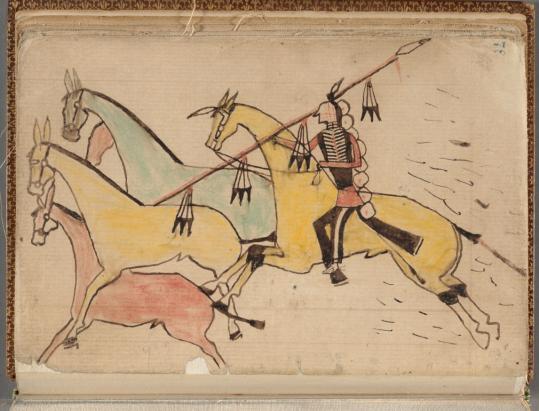
About five years ago, the librarians at Harvard University’s Houghton Library realized they had something special on their hands: a Plains Indian ledger book, filled with drawings made by Lakota Sioux of their battle exploits. Ledger drawings — pictographic art made by Plains Indians in the 19th century, often in accounting books acquired from Euro-Americans — are not uncommon artifacts, but it is unusual to find them bound in their original context.

The book, a goldmine of a historic document, launched research resulting in “Wiyohpiyata: Lakota Images of the Contested West,’’ an exhibit at Harvard’s Peabody Museum of Archaeology and Ethnology co-curated by the museum’s Castle McLaughlin and Butch Thunder Hawk, a Lakota artist who teaches at the United Tribes Technical College in Bismarck, N.D. It’s a riveting dip into Lakota warrior culture, which imbued warfare with spirituality, illustrating how one particular band of Lakota weathered the history of westward expansion sweeping across the Plains, pitting native warriors against US forces.


Tuesday, November 2, 2010

Women in Power in the Navajo Nation

As the USA gears up for the November 2nd elections, there will be history made amongst America’s Natives if Lynda Lovejoy has anything to say about it. While most Americans & the media are focused on the incendiary battles between Democrats, Republicans & the Tea Party; the Navajo nation which is the largest Native American tribe made up of constituents from Arizona, New Mexico and Utah will be reexamining & battling religious & cultural tradition to make history by electing their first ever female president. Many Americans probably know very little about its Natives let alone the fact that they have their own elected government, but hopefully a historical moment will bring America’s much needed focus & attention to its Natives.

Saturday, October 23, 2010

Pocahontas: "I Do"

Her life has been celebrated in song, story and a Disney cartoon, but no one knew where Pocahontas tied the knot with a tobacco farmer—until now.

Archaeologist Bill Kelso and his team were digging this summer in a previously unexplored section of the fort at Jamestown, Va., the country's oldest permanent English colony, when they uncovered a series of deep holes. They believe the holes once anchored heavy, timber columns supporting the fort's first church, known to have been built in 1608 and the place where Pocahontas got married in 1614.


Thursday, September 30, 2010

Warrior Women - Red Power Movement

During the height of political unrest in Indian country during the 1960s and ’70s, men such as Russell Means, Dennis Banks and Clyde and Vernon Bellecourt were the media-recognized leaders of Red Power, the grass roots movement marked by its activism and a resurgence of Indian cultural identity, pride and traditionalism.

But away from much of the media attention stood such women as Madonna Thunder Hawk, Lorelei DeCora, Janet McCloud, Pat Bellanger, Lakota Harden, and LaNada Means War Jack. These were just a few of the Indian women in the trenches of the Red Power movement.

Now, the untold stories of Native women activists will be documented in an upcoming film, “Warrior Women,” a one-hour documentary to be aired on PBS. University of South Dakota Assistant Professor Elizabeth Castle, the film’s writer and producer, eyes a 2012 completion date for the film, which is in pre-production. The project is the recent recipient of a grant from Native American Public Telecommunications.

Friday, April 9, 2010

Wilma Mankiller

From Indian Country Today:
Thousands of newspaper articles, Internet messages, and other tributes and remembrances have already surfaced in honor of the first woman elected to lead the Cherokee Nation, who passed away at age 64 on April 6 after a battle with pancreatic cancer.

The outpouring of adulation, which has included praise-filled statements from President Barack Obama, former President Bill Clinton – who awarded her the Presidential Medal of Freedom in 1998 – and Secretary of State Hillary Clinton, is not surprising to those who knew her best.

From
Worldwide Faith News:
Tributes from Reformed church leaders are pouring in for Wilma Mankiller, an American Indian rights advocate who died Tuesday a 64 after a brief illness. Mankiller, a member of the Cherokee Nation in the United States, was scheduled to be a keynote speaker this June at a global assembly of the World Alliance of Reformed Churches (WARC) and the Reformed Ecumenical Council (REC) in Grand Rapids, United States.

Prior to being diagnosed with pancreatic cancer, Mankiller had agreed to make a keynote presentation at the Uniting General Council (UGC) which will launch the World Communion of Reformed Churches from a merger of WARC and REC.

“Chief Mankiller’s dedication to the rights of Indigenous peoples would have brought an important challenge to all of our churches to act with justice on behalf of the First Peoples of our various countries,” says event organizer, Stephan Kendall, in a statement issued from his office with the Presbyterian Church in Canada.

Biography:
Wilma Mankiller
Wilma Mankiller

Tuesday, October 20, 2009

USA: Violence Against Women Rising

From CNN:
Fifteen years after passage of the Violence Against Women Act to combat physical abuse of women and girls, domestic violence remains especially acute among Native American and Alaska Native women, Justice officials said Monday.

"The levels of violence against American Indian and Alaska Native women are shocking, and cannot be tolerated," said Deputy Attorney General David Ogden. "Indeed, in some tribal land counties, murder rates for American Indian and Alaska Native women are 10 times the national average."

A new report by the Bureau of Justice Statistics released Monday said its victimization survey showed 652,000 incidents of overall violent crime inflicted by intimate partners in 2008.

More than 550,000 violent incidents targeted women; 101,050 targeted men.

Most of the incidents were classified as simple assaults, but there were 111,530 cases of aggravated assault, 44,000 rapes and sexual assaults and 38,820 robberies.

The number of homicides by intimate partners rose slightly in the past two years, while the cases of nonfatal intimate partner violence continued to decline, the Justice Department report said.


Thursday, October 1, 2009

Native Women Targetted by Apathy

From the Canadian Press:
A new report says the federal government's feeble efforts to stop violence against native women should shock Canadians.

Amnesty International says Ottawa must get to the heart of why more than 500 native women have vanished or been murdered in the last 30 years.

The report says federal cash for studies and sensitivity training for police has not stopped the attacks.

Amnesty urged Ottawa to produce a national action plan to co-ordinate standard police investigations and fund victim services.

The human rights watchdog, as well as opposition MPs, are among those urging a national investigation.

The United Nations has also called on Ottawa to look into why the deaths and disappearances of hundreds of native women are unsolved.

Friday, September 25, 2009

Comanche Nation Honours Women

From KAUZ:
It's a long-honored tradition brought to life in Lawton. The Comanche National Museum and Cultural Center paid tribute to the Comanche women who owned, built and moved their homes by building a full-size teepee in front of the museum.

The teepee is one of a kind, painted by a local Comanche artist. Organizers say the raising of the teepee has a great historical importance to the Comanche nation.

Phyllis Wahahrock-Tsi, Museum Director, said "The significance of Comanche women raising the tepee is one role that women played historically among the Comanche women, so this is one way we're able to educate the young children, especially the Comanche children and the Lawton/Fort s=Sill community here."

The teepee will be on display through Sunday (September 26th) in front of the museum located at 701 Northwest Ferris Avenue in Lawton.