Monday, July 9, 2018

How Bad Was Jezebel?

For more than two thousand years, Jezebel has been saddled with a reputation as the bad girl of the Bible, the wickedest of women. This ancient queen has been denounced as a murderer, prostitute and enemy of God, and her name has been adopted for lingerie lines and World War II missiles alike. But just how depraved was Jezebel?

In recent years, scholars have tried to reclaim the shadowy female figures whose tales are often only partially told in the Bible. Rehabilitating Jezebel’s stained reputation is an arduous task, however, for she is a difficult woman to like. She is not a heroic fighter like Deborah, a devoted sister like Miriam or a cherished wife like Ruth. Jezebel cannot even be compared with the Bible’s other bad girls—Potiphar’s wife and Delilah—for no good comes from Jezebel’s deeds. These other women may be bad, but Jezebel is the worst.

Yet there is more to this complex ruler than the standard interpretation would allow. To attain a more positive assessment of Jezebel’s troubled reign and a deeper understanding of her role, we must evaluate the motives of the Biblical authors who condemn the queen. Furthermore, we must reread the narrative from the queen’s vantage point. As we piece together the world in which Jezebel lived, a fuller picture of this fascinating woman begins to emerge. The story is not a pretty one, and some—perhaps most—readers will remain disturbed by Jezebel’s actions. But her character might not be as dark as we are accustomed to thinking. Her evilness is not always as obvious, undisputed and unrivaled as the Biblical writer wants it to appear.

read more here 

Grave of Medieval Bulgarian Princess 'Built Into' Foundations of Stone Church

Article (June 2016) from Archaeology in Bulgaria:
The grave of a female aristocrat from the Shishman Dynasty which ruled the Second Bulgarian Empire (1185-1396) in its last few decades before it was conquered by the Ottoman Turks has been discovered during the excavations of the old church St. George near the town of Trudovets, Botevgrad Municipality, in Northwest Bulgaria.

The now defunct St. George stone church near Trudovets is believed to have been part of a medieval monastery, and still has fragments of medieval frescoes. On the archaeological site of the stone church, locals have found a marble pillar and EarlyByzantine coins from the 5th-6th century, leading scholars to hypothesize that the monastery which existed there may have dated back to Early Christian times.
The St. George Church near Trudovets, Botevgrad Municipality, is in a dire need of restoration. Photo: National Museum of History
The newly discovered grave of a young princess proves that the Botevgrad Valley was also part of their estates because a ring found together with the other female adornments in the funeral inventory features a monogram of the Shishman family.

read more about this amazing discovery here @ Archaeology in Bulgaria

Sunday, July 8, 2018

Dearth of female Nigerian leaders

The only condition necessary for the triumph of evil is for good men to do nothing”, so says the great Irish philosopher, Edmund Burke (1729-1797). Looking at this enduring aphorism in reverse, one might entertain the thought that, perhaps, the only condition necessary for the perpetuation of misrule by men in Nigeria is for good women to do nothing. How did we arrive at a junction where the minority (i.e. male) are perpetuating misrule and violence on the majority (i.e. female) for so long and with such reckless abandon? How come men in this country (as elsewhere) assume that positions of leadership and dominance are their birth-right, while the female folk clasp their palms in resignation? How come our religious leaders in this country continue to preach the virtue of “submissiveness” to the female gender in acquiescence to the perpetrators of violence and oppression against them; the maniac male in their midst?

read more here @ Punch Newspapers

Church reproposes Order of Virgins 50 years after its restoration

In 2020 it will be 50 years since Pope Paul VI revived the ancient Order of Virgins. Consecrated virgins now number approximately 5,000 and live in every part of the world. The Prefect for the Dicastery for Consecrated Life, Cardinal João Braz de Aviz, says that the new Instruction Ecclesiae Sponsae imago is the first Document to address the make-up and discipline of this form of consecration. It is also a response to the interest shown in this revived vocation. It focuses specifically on its place in the Church’s life, and the necessary discernment and formation required, he says.

read more here @ Vatican News

An increasing number Catholic women are taking life-long chastity vows in order to “dedicate themselves” to God, according to the Vatican.

The Holy See has issued new guidance on consecrated virginity in response to growing interest across the world in the little-known spiritual “vocation”.

Consecrated virgins are unmarried women who pledge to remain celibate for their entire lives, eschewing romantic or sexual relationships to devote themselves exclusively to being mystical “brides of Christ”.

Space Coast women aviators honor memory of those who flew before

Women fly.      They pilot large and small, old and new, private and commercial, military and civilian aircraft. The likes of Amelia Earhart, Jackie Cochran, Bessie Coleman, Eileen Collins and Tammie Jo Shults are but a few notables who share this heritage. 
Image result for female wasp pilots
No surprise, then, that a group of women aviators like the Spaceport 99s should have become local custodians of the memory of the Women’s Airforce Service Pilots, the WASP.

The WASP, 1,074 women attached to the United States Army Air Forces as civilians from 1942 to late 1944, flew more than 60 million miles during World War II, transporting every type of military aircraft. They towed targets for anti-aircraft gunnery practice, simulated strafing missions and transported cargo, and before their time in service ended, 38 WASP members lost their lives and one was missing. 

They did it to free male pilots for military combat, but were not themselves formally military pilots; they were granted veteran status 32 years after the war’s end. Fifty-four years after it was over, they finally were formally recognized, when President Obama awarded members the Congressional Gold Medal.

read more 
@ 99s


Women Empowerment in Vedas

From Daily Pioneer:Ancient Indian texts make it quite clear that women were always meant to be respected and valued in our culture, writes Daksh Bharadwaj 

Women empowerment in Vedas
The Vedas say, man himself (aatmanah) is only half or incomplete (ardha), as long as (yaavat) he does not obtain (Vindate) a wife (jaayaa). According to the Vedic teachings and ancient Aryan scriptures, women have been placed at a higher status than man. She has been given preference to man in every field, so much so that when giving a boy a joint name of a god and goddess, the name of the goddess is always placed before the god. We call our country motherland, mother is superior to father. We are taught to be more indebted to mother than father — “Maat devobhava” before “Pita devobhava”.

Woman stands paramount in Vedic culture. We go as far as saying that if one wants to understand culture and civilisation of a nation, one has only to observe how that nation treats its women folk. She is the symbol of culture.

read Vedas online:


read more: 


Sunday, June 24, 2018

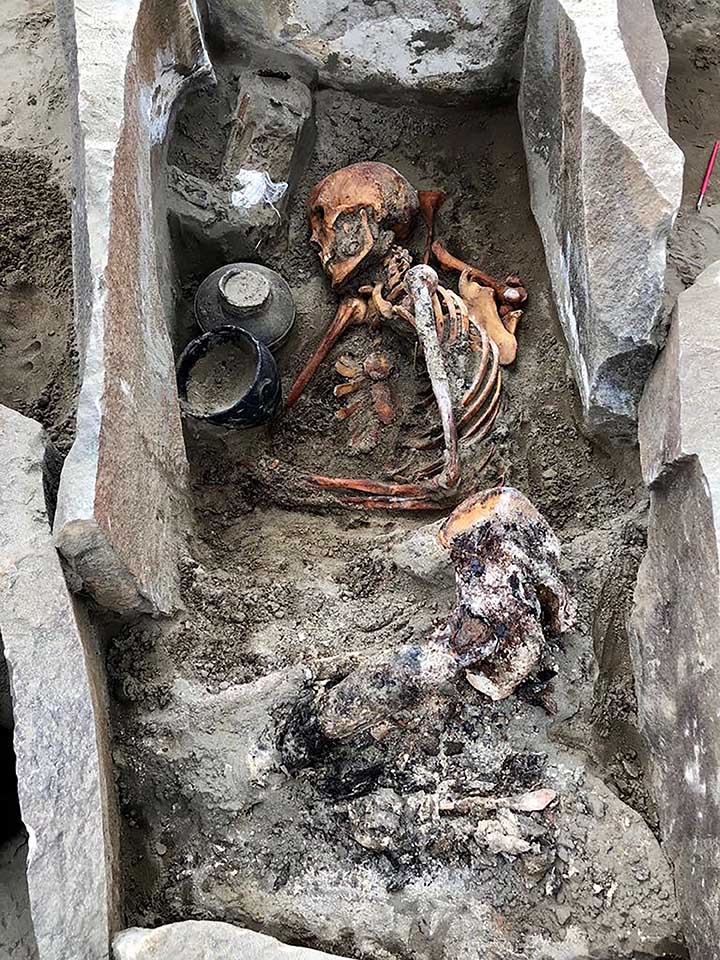
2,000 year old mummified ‘sleeping beauty’ dressed in silk emerges from Siberian reservoir

MummyFrom the Siberian Times:
Archeologists hail extraordinary find of suspected ‘Hun woman’ with a jet gemstone buckle on her beaded belt.

After a fall in the water level, the well-preserved mummy was found this week on the shore of a giant reservoir on the Yenisei River upstream of the vast Sayano-Shushenskaya dam, which powers the largest power plant in Russia and ninth biggest hydroelectric plant in the world.

The ancient woman was buried wearing a silk skirt with a funeral meal - and she took a pouch of pine nuts with her to the afterlife. 

In her birch bark make-up box, she had a Chinese mirror.  Near her remains - accidentally mummified - was a Hun-style vase. 

read more here @ Siberian Times

Sunday, June 10, 2018

The woman who built Jersey's first hospital

Standing in St Brelade’s Church cemetery is an obelisk dedicated to a public-spirited Islander who bequeathed her fortune to the poor and sick at a time when social services were unheard of.

The inscription on the monument is in French. Translated, it reads: ‘To the memory of Miss Marie Mauger – widow of Mr Francis Bartlett – foundress of the General Hospital. Buried in this parish April 26 1741.

Her altruism gave Jersey its first hospital on the site of the present building.  Finally, in 1793, more than 50 years after her death, Mrs Bartlett’s dream finally became reality and the old building of the General Hospital opened its doors.

see also


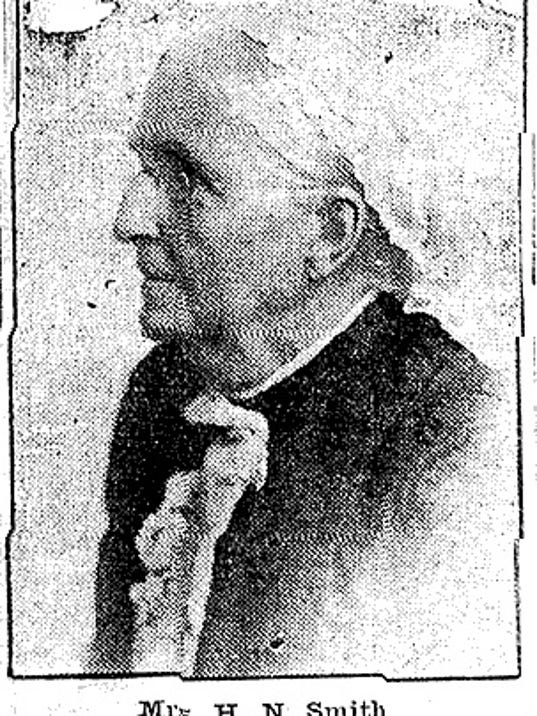
Plymouth's Laura Chase Smith woman ahead of her time

Laura Chase Smith was a woman ahead of her time. A force in her own right, she and her husband, H.N. Smith (Horatio Nelson) were an important part of the growth and development of Plymouth. Laura kept a journal most of her life, and those diary entries would, years later, provide primary source documentation of pioneer Plymouth.

Laura wrote a well-received book, The Life of Philander Chase, First Bishop of Ohio and Illinois, Founder of Kenyon and Jubilee Colleges. But, she also wrote a series of articles for the Plymouth Reporter. Published between December 1872 and June 1873, the series covered the history of the township of Plymouth and the Villages of Plymouth and Quit Qui Oc.

read more here @ Sheboygan Press